






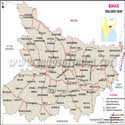
Where Is Bihar Located?
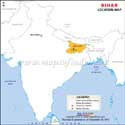
Bihar is located in eastern India, in the fertile plains of the Ganga River. It shares its boundaries with Uttar Pradesh to the west, Jharkhand to the south, West Bengal to the east and Nepal to the north. The Ganga flows from west to east through the state, dividing it into broad northern and southern plains. Its location and river systems have played an important role in shaping Bihar’s geography, agriculture and settlements.
About Bihar
Bihar is one of India’s most historically significant states, with Patna as its capital and a rich legacy linked to ancient Magadha, Nalanda and the Mauryan Empire. Covering 94,163 sq. km (36,357 sq. mi.), it is the 12th largest Indian state by area and the third most populous, with more than 10.4 crore people recorded in the 2011 Census. Bihar currently has 38 districts grouped into 9 administrative divisions. The modern state took its present form after Jharkhand was carved out of southern Bihar on 15 November 2000. Agriculture remains an important part of the state’s economy, supported by its fertile alluvial soils and extensive river network.
The state has 38 districts and shares borders with Uttar Pradesh in the west, Nepal in the north, West Bengal in the east and Jharkhand in the south. Bihar is of great importance when it comes to Indian mapping, linking the northern and eastern parts of the nation. The Bihar location makes it an important region for understanding eastern India’s geography.
As a state in India, Bihar lies on the fertile banks of the river Ganga, has been home to some of the world's earliest civilizations, has some of the most religiously significant sites, and is also a place rich in cultural heritage.
History
Bihar has a rich history that dates back to ancient times. It was once a centre of learning, culture and political influence in India. Bihar was the birthplace of several powerful kingdoms and empires and also had its own share in Indian history.
During the Mahajanapada period in India (6th century BCE – 4th century BCE), the kingdom of Magadha was one of the 16 ancient states of India, located in the current state of Bihar. Subsequently, Magadha grew under strong rulers and was a base for the formation of great empires such as the Mauryan Empire. The empire extended over much of India and beyond under Emperor Ashoka's rule.
Buddhism is also an important aspect of Bihar. The place where Gautama Buddha attained enlightenment under the Bodhi tree is Bodh Gaya, Bihar. The State is home to some of the world's oldest learning centres, where scholars from all over the world used to come to study at Nalanda University and Vikramshila University.
Bihar underwent changes under different rulers during the medieval period. After the Battle of Buxar in 1764, the East India Company strengthened its political control over Bihar, which remained part of the Bengal Presidency under British rule. Bihar and Odisha were separated from the Bengal Presidency in 1912, and in 1936, Bihar and Odisha were made separate provinces. Bihar continued as a province of British India until independence in 1947 and became a state of independent India.
Economy
Bihar is one of the fastest-growing states in India. The farming sector still plays a significant role in the state economy, and the number of people engaged in farming activities is considerable. Bihar is one of the important states of India in producing Vegetables and also in Horticulture and Fruit production.
Because of its fertile land and favourable climate, the state has various crops and fruits. Bihar has also seen progress in the industrial sector, apart from agriculture. Barauni Oil Refinery and power projects in Muzaffarpur help to promote industrial development.
Fatuha is an important industrial area in the Patna region, with manufacturing and other industrial activities. Bharat Petroleum LPG bottling plant is also functional in Fatuha. Bihar is also famous for sugar industries, which make a significant contribution to the economy of the state.
Geography of Bihar
Location and Extent
Bihar is located in eastern India and lies mainly in the fertile Ganga Plain. It shares borders with Nepal to the north and Uttar Pradesh, Jharkhand and West Bengal on its other sides.
Physical Features
The Ganga River divides Bihar into northern and southern plains. The state is predominantly flat, with the Himalayan foothills influencing the geography of northern Bihar and the Jharkhand plateau shaping parts of the south.
Major Rivers
The Ganga is Bihar's principal river. Other major rivers include the Gandak, Kosi, Son, Punpun, Bagmati, Kamla and Mahananda. These rivers support agriculture but also contribute to seasonal flooding in parts of the state.
Climate
Bihar has a humid subtropical climate, with hot summers, a monsoon season from June to September and cool winters. Most of the state's rainfall occurs during the southwest monsoon.
Soil and Agriculture
Bihar has extensive fertile alluvial soils, particularly across the Ganga Plain. Agriculture is an important part of the state's economy, with rice, wheat, maize, pulses, sugarcane, fruits and vegetables among the major crops.
Places of Attraction
Historical, cultural and religious tourism are popular in Bihar. There are several ancient monuments, archaeological sites and religious sites in the State which represent its splendid legacy.
Important tourist places in Bihar are:
- Bodh Gaya and the Mahabodhi Temple: An important Buddhist pilgrimage site.
- Bodhi Tree: Traditionally identified as the place where Gautama Buddha attained enlightenment.
- Nalanda ruins: Ruins of the ancient centre of learning.
- Vikramshila Monastery at Bhagalpur
- Barabar Caves: a historic site and one of the oldest rock-cut caves in India.
- Tomb of Sher Shah Suri.
- The ruins in the ancient city of Vaishali
- Buddha Smriti Park in Patna
- Takht Sri Patna Sahib: a significant religious edifice of the Sikhs, and it is related to Guru Gobind Singh Ji.
Language
Hindi is the official language of Bihar, and Urdu is recognized as the second official language. There are a number of regional languages widely used throughout the state, such as Bhojpuri, Maithili, Magahi, Bajjika and Angika.
Maithili is listed in the Eighth Schedule of the Indian Constitution and is one of the constitutionally recognized languages of India. These languages are a reflection of Bihar's cultural diversity.
Education
Bihar has a rich educational legacy with some of the world's oldest centres of learning. The state now has some significant educational institutions that provide higher education and research.
The major educational institutions in Bihar are:
- Indian Institute of Technology, Patna
- National Institute of Technology, Patna
- All India Institute of Medical Sciences, Patna
- Patna University
- Aryabhatta Knowledge University
- Bihar Agricultural University
- Dr B.R. Ambedkar Bihar University
- Mahatma Gandhi Central University
Bihar Map with Districts
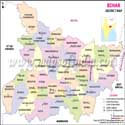
Bihar Map with Districts provides a detailed view of the state’s administrative divisions, showing all 38 districts with their boundaries and locations. Bihar is divided into 9 administrative divisions, with each division comprising multiple districts. The map provides a clear view of the district-wise administrative layout of Bihar and shows the position of individual districts across the northern and southern parts of the state. It is useful for understanding Bihar's administrative geography and the distribution of its districts.
The updated district map of Bihar shows the district boundaries, division-wise district distribution, names of all districts of Bihar, major cities and administrative centres of Bihar.
Bihar is divided into nine administrative divisions:
- Patna Division
- Saran Division
- Tirhut Division
- Darbhanga Division
- Kosi Division
- Purnia Division
- Bhagalpur Division
- Munger Division
- Magadh Division
Bihar Map Showing Major Cities
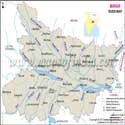
Bihar City Map shows the major cities of Bihar state in the country and their importance in administration, education, trade and tourism. The Bihar cities section helps users identify important urban areas and understand the importance of different cities in Bihar.
Patna
Patna is the capital of Bihar and is one of the oldest cities inhabited continuously in the world. It is the administrative, educational and economic hub of the state.
Gaya
Gaya is a well-known religious city which is famous for Bodh Gaya and the Mahabodhi Temple. It is a Buddhist holy place and a tourist destination for pilgrims and tourists from all over the world.
Muzaffarpur
Muzaffarpur is one of the important trade centres of Bihar and is well known for its production of Shahi Litchi.
Bhagalpur
Bhagalpur is famous for its silk industry and is termed the “Silk City of India”. It is also an important educational and cultural centre.
Darbhanga
Darbhanga is also known for its rich cultural heritage and traditional music, and it is an important historic city in the Mithila region.
Purnia
Purnia is an important city in the north-east of Bihar and is a major trade and agricultural hub.
Bihar District Information
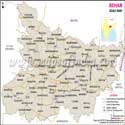
A detailed Bihar district map with information helps users quickly understand the administrative structure, district locations, and important regional divisions of the state.
The table below provides information on selected districts of Bihar, including their headquarters and administrative divisions.
| District | Headquarters | Division |
|---|---|---|
| Patna | Patna | Patna |
| Gaya | Gaya | Magadh |
| Nalanda | Bihar Sharif | Patna |
| Muzaffarpur | Muzaffarpur | Tirhut |
| Bhagalpur | Bhagalpur | Bhagalpur |
| Darbhanga | Darbhanga | Darbhanga |
| Purnia | Purnia | Purnia |
| Saran | Chhapra | Saran |
| Munger | Munger | Munger |
| Vaishali | Hajipur | Tirhut |
A Bihar district map with information helps users quickly understand the administrative structure, district locations, and important regional divisions of the state.
Bihar at a Glance
Bihar State Information | |
|---|---|
| Capital | Patna |
| Date of formation | 22 March 1912 |
| Governor | Lt Gen Syed Ata Hasnain (Retd.) |
| Chief Minister | Samrat Choudhary |
| Tourist attractions | Rajgir, Nalanda, Vaishali, Pawapuri, Bodh Gaya, Vikramshila, Gaya, the ancient city of Patliputra |
| Festivals | Chhatth Puja, Sama-Chakeva, Nag Panchami |
| Major dance and music forms | Jat-Jatin dance of the Mithila region, Bidesia, the songs of Vidyapati, Chau Tribal dances |
| Arts and crafts | Madhubani painting; Sikki grass craft. Grass is used to make baskets, toys, dolls, etc; Sujini kantha embroidery is a specialisation of Bihar. |
| Languages | Hindi, Urdu, Maithili, Bhojpuri, Magahi, Angika, Bajjika and other regional languages |
| Size | 94,163 sq. km |
| Population (Census 2011) | 104099452 |
| Rivers | Kosi, Ganga, Saryu, Gandak, Kamla, Panar, Saura, Pun-pun |
| Forests and wildlife sanctuaries | Valmiki NP, Rajgir WS, Bhimbandh WS, Gautam Buddha WS, Udayapur WS |
| State animal | Gaur (Mithun) |
| State bird | House sparrow |
| State flower | Kachnar (Phanera variegata) |
| State tree | Peepal |
| Major crops | Paddy, wheat, maize |
| Factoids | The Bodhi Tree at Bodh Gaya is traditionally identified with the place where Gautama Buddha attained enlightenment. |
| Nalanda University, a seat of Buddhist learning, was founded around the 5th century AD by King Kumaragupta I | |
| No. of Districts | 38 |
FAQs
Q1: Where is Bihar located in India?
Bihar is located in eastern India. It shares boundaries with Uttar Pradesh to the west, Jharkhand to the south, West Bengal to the east and Nepal to the north.
Q2: How many districts are there in Bihar?
Bihar has 38 districts, which are grouped into 9 administrative divisions. A Bihar district map shows the location and boundaries of these districts.
Q3: Which states and country border Bihar?
Bihar shares its boundaries with Uttar Pradesh, Jharkhand and West Bengal and has an international border with Nepal to the north.
Q4: What are the major rivers shown on the Bihar map?
The major rivers of Bihar include the Ganga, Gandak, Kosi, Son, Punpun, Bagmati, Kamla and Mahananda. These rivers are important features of the state's geography and agriculture.
Q5: What is the area of Bihar?
Bihar covers an area of 94,163 sq. km (36,357 sq. mi.), making it the 12th largest Indian state by area.
Q6: When was Bihar formed as a separate province?
Bihar became a separate province from Bengal on 22 March 1912. Bihar Diwas is observed every year on this date.
Q7: When was Jharkhand separated from Bihar?
Jharkhand was created on 15 November 2000, following the reorganisation of southern Bihar.
Q8: What is the population of Bihar?
Bihar recorded a population of approximately 10.41 crore (104.1 million) in the 2011 Census, making it one of India's most populous states.
Last Updated on: September 15, 2026