|
||||||||||
| ||||||||||
|





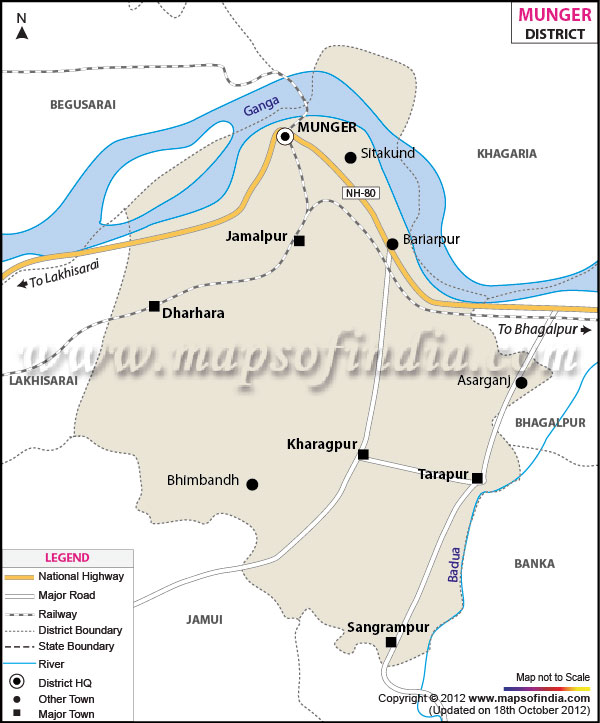
| *Munger District Map highlights the National Highways, Major Roads, District Headquarter, etc. |
About
The district of Munger is one of the oldest and most rich in cultural and historical elements among Bihar state in India. It is in the eastern part of the state, along the southern banks of the river Ganges and is a part of the division of Munger. The district is bounded by Bhagalpur, Lakhisarai, Begusarai and Jamui and is playing a pivotal role both geographically between south and north Bihar. To get a better idea of the arrangement of this part of the state, the Munger district map is frequently used.
The district capital is at Munger town which is a town of historic monuments, religious centres and educational institutions. The town has developed as administrative and cultural center of the region in time. The significance of the Munger district map is apparent through the analysis of the connectivity of the district, particularly the Ganges rail-cum-road bridge with northern Bihar. This connectivity has continuously improved the intra-state trade along with its transportation and integration. Therefore it can be said that combination of ancient heritage and modern development has made Munger a unique district in Bihar.
History and Culture
Use of materials goes back to ancient India at Munger. It was once an element of the strong Magadha empire, that was a predominant factor in developing early Indian civilisation. The region has experienced the rule of the prominent dynasties like the Mauryas and Guptas over centuries, which had played a role in the cultural and political development of the region. The significance of the map of the Munger district is that it shows settlement features and strategic features which were important in the ancient period.
Munger became famous during the Medieval era under Delhi Sultanate and Mughal Empire. It has grown up to become an important administrative and military centre because of its strategic position on the bank of Ganges. Munger's history has been one of the most interesting periods during the 18th century, when it was declared as the capital by Mir Qasim, who was then the Nawab of Bengal. He fortified the area and made it a fortress against the British East India Company. For no other period is the theme of resistance so strongly embodied as for the fort period as shown in the Munger district map (also a symbol of resistance and strength of architecture of this period).
The uniqueness of Munger is that it has numerous cultural diversity related to various traditions, that are the distinguishing features of Bihar. Festivals such as Chhath Puja are of such significance that it is impossible to segregate them from the Ganges as they are celebrated with utmost devotion as well as in grand fashion. Communal harmony and cultural inclusiveness are highlighted in the form of other festivals such as Holi, Diwali, Eid and Muharram. With reference to map of the district of Munger, one can point out the different ghats and religious temples where such celebration is organized as a significant part of the district Munger seems to be located close to the river bed.
Munger has also been linked to yoga and spirituality, another aspect of this culture. The district boasts international Yoga Institutions renowned at an international level, attracting practitioners from all over the globe. It is a spiritual dimension that is added to its historical depth. The distinctive culture is reinforced by the traditional dance forms and music of the local folk culture, as well as by the presence of local music festivals and fairs.
Economy
The district's economy has a diversified structure, where agriculture is its foundation while the industrial and service sectors grow constantly. The Munger district map is an essential piece in the economic activity distribution puzzle of rural/urban areas.
The Government Sector employees the most in administrative offices, Education, Healthcare and Law Enforcement. These mainly cater to towns like Munger and Jamalpur. The very existence of such institutions ensures the implementation of government policy and provision of public services.
There is a strong presence of public sector in the district, notably through the Jamalpur Railway workshop. It was started in the 1800s and is one of the oldest Railway workshops of India and earns a lot of people a livelihood. Jamalpur is in the centre of the Munger district map, which reflects its importance in the district as an industrial centre.
The primary livelihood in the majority of the communities is still agriculture. The crops cultivated on the alluvial fertile land and water supply from Ganges are rice, wheat, maize and pulses. The farming system is mainly traditional but a slow modernisation process is taking place. The Munger district map shows a very extensive agriculture and irrigation system which supports this sector.
The small-scale businesses, small-scale banking, education and health care sectors have each seen growth around Munger, leading the services sector's growth. Retail and service-based businesses have also sprung up in towns, as a result of urbanisation. Tourism is the other way of doing the same to the economy through visitors flow to historical and spiritual places. The Munger district map is helpful in this regard to see these economic zones and their linkages.
Tourism
Along with the many tourist facilities present in the area, these highlight the area's historical, religious and natural worth. This Munger district map is a must have guide for those who are visiting the district, enabling them to navigate through the district's major attractions.
The other very famous visitor's attraction is Bihar School of Yoga that attracts tourists from around the world. It is renowned for its customary yoga exercises, and spiritual education. This centre has taken Munger to a new level as a world belief and wellness centre.
The district is also one of the highly popular tourist destinations for religious places. Visitors come to these sites like Kastaharni Ghat, Chandika Sthan Temple and Sita Kund all through the year. Among them, Kastaharni Ghat is believed to have cleansing powers, and the majority of the population visits the Ghat during the festivals. This is intended to be used in conjunction with the Munger district map to find these sacred places on the river and in the district.
The Bhimbandh Wildlife Sanctuary provides a perfect exploration of forests, hills and diverse wildlife for the nature lovers. It is well known for its hot springs and nature, it is unique place in Bihar. These attractions are all well-summarized in the Munger district map, which allows tourists to organise their trips time and again to make the best of the entire area.
Finally, Munger's tourist attraction is based on the opportunity for historical exploration, spiritual experiences and natural beauty.
Demographics
Munger district's population is culturally and linguistically varied. The total population of the district as per Census (2011) is approximately 1359054. The map of the munger district shown here helps to better understand the numbers of this population in each of the rural villages and urban centres.
This is reasonable education development level of Literacy at district level which is approximately 70.46%. But efforts are underway to make education more widely available in the school and college, particularly in urban areas. While progress is marked over time, listening and literacy targeted development interventions have helped with socio-economic development.
In the district, the language spoken is Hindi, Angika and Urdu. The official language is Hindi and Angika also is widely used in rural areas. Due to cultural diversity, Urdu is also the common language among certain settlements. This is a part of the charm of Munger's social scene.
Most of the people live in rural areas and attract to agriculture and allied activities. But the rate of urbanisation is growing gradually, particularly in the towns such as Jamalpur and Munger. The Munger district map is used to help visualise these demographic patterns and also help to understand the settlement structure of the district.
Administration
Munger district is divided administratively into subdivisions, blocks and panchayat units to ensure proper governance operational. The concept can be easily understood using the concept of Munger district map.
A district is divided into subdivisions like Munger, Jamalpur, Tarapur, Haveli Kharagpur etc. Each subdivision is subdivided again into sub-units called community development blocks which are responsible for managing local governance and development activities. It is these administrative units who are charged with enhancing government programmes and with solving local problems.
The district has several large villages which serve as the main administrative support in the rural areas. The Panchayati Raj institutions also have an important role to play in the management of affairs in the village as far as infrastructure, sanitation or welfare programmes are concerned. These villages may be distinguished with the help of the map of Munger district, which shows the relationship amongst these villages with the urban centre.
The district has police stations and the Administrative offices of the district in charge of the law and order. There is an integrated approach of revenue collection and public service delivery and development programmes through co-ordinated approach with district and state government. The Munger district map helps planners and officials ensure efficient governance and efficient resource allocation.
Along with these structural components, there is the administrative aspects that prioritises decentralisation and participatory governance in the administration of Munger district. Grassroots planning and implementing of development programmes is an important task for local bodies like Gram Panchayat and Zila Parishad. These institutions ensure the effective and efficient delivery of schemes as relate to rural development, education, health care and the infrastructure to intended beneficiaries. The district administration also has strong coordination with different state departments for the implementation of welfare programmes, disaster mitigation programmes and law & order.
FAQs
Q1: What is the total number of villages in Munger district?
Munger district has approximately 1,014 villages, which form the foundation of its rural administrative structure.
Q2: What is the population of Munger district?
As per the 2011 Census, the population of Munger district is around 1,359,054.
Q3: What is Munger district famous for?
Munger district is famous for its historical fort, its association with yoga and spirituality, and its rich cultural and historical heritage.
Last Updated on : June 24, 2026
