






About
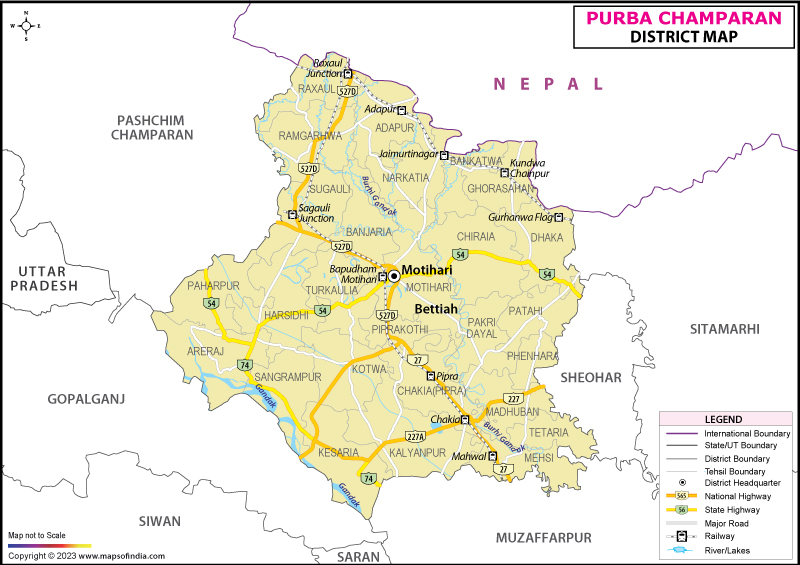
Purbichamparan, popularly called as east Champaran is one of the most important districts in the state of Bihar, famous for its history and achievements. The District is located in the northern region of Bihar state close to Indo Nepal border and is strategically important in the plains of the Gandak basin and is under the jurisdiction of the division of Tirhut. The Purbichamparan district map is often used for geographical and administrative discussion as a large network of towns, agricultural settlements, rivers and border routes is present within the district which is very supportive for economical and governance of northern Bihar.
The total area of the district is about 3968 square kms and provides with fertile alluvial soils, extensive farming and mostly rural population. Purbichamparan is sharing its boundary with west Champaran, Sheohar, Sitamarhi, Muzaffarpur and neighbouring countries Nepal. The district is one of the leading districts of agriculture, in particular, sugarcane cultivation, maize, rice and wheat. The importance of representation of map of Purbichamparan can also be perceived in perspective of transport linkage of Bihar with Nepal, as Raxaul is a significant transport gateway of trade etc.
History and Culture
Purbichamparan is a history with rich associations with ancient Indian civilization and the political events of Mithila and Videha region. Historical traditions indicate that the region earlier was part of the kingdom of the epic Ramayana credits King Janaka. For centuries the region became a part of the influence of various dynasties like Maurya, Gupta, and northern Indian regional states. The nearby ruins prove the oldness of the district, as do the ruins of Buddhist temples and Ashokan pillars. The map of district Purbichamparan is referred to by the historians and researchers to locate the spots of ancient settlements, pilgrimage paths and the sites associated with early Buddhist and Hindu traditions.
The district came to national limelight in Champaran Satyagraha, a landmark movement which began in 1917 when Gandhi launched his first big protest movement against the British rule in India. In indigo-growing areas of Champaran, the farmers were exploited by European planters by imposing them duty to grow indigo instead of food crops. The headquarters at Motihari hence enter into the modern day history of India. The of Purbichamparan district map is often used in educational institutions and research institutes even now to identify some important places which have historical and association with Gandhi's campaign for freedom.
Various festivals like Chhath Puja, Holi, Diwali, Eid and Makar Sankranti are celebrated with great enthusiasm and participation of the community. Individuals from neighbouring districts and Nepal visit rural fairs, which are related to Nepalese temples and traditions. The District map of Purbichamparan is important due to its role in the agricultural calendar, and it also provides information about significant pilgrimage sites, markets and cultural hubs throughout the district.
Some of the local Purbichamparan delights feature delicious Bihari items like, litti chokha, sattu lasshi, khaja and some kinds of rice foods. There is still a connection between rural economy and handicrafts and local trading. Bhojpuri songs and traditional stories are in practice during weddings and festivals in the villages and are an important ceremony. The district also has a history of social and political activism, which dates back to the freedom movement. The Purbichamparan district map of Bihar in contemporary times could even be used as a tool for administrative ease and to understand the diversity in cultures and languages which characterises the Purbichamparan district in Bihar.
Economy
Purbichamparan's economy is mainly agricultural and agriculture is a principle source of employment and earning. On fertile soils and in the riverine plain and favourable climate, rice, wheat, maize, pulses, oilseeds and sugarcane is growing. Farming directly and indirectly is a vital source of livelihood to majority people in the district. Farmers produce their crops with the help of irrigation facilities, mandis and the road system. Economist/Planner study the Purbichamparan district map to enable him/her to understand, analyze the pattern of irrigation, transportation and agricultural areas of the various blocks of a district.
The government has a great impact on the district economy through its various functions such as administrative offices, education institutions, health care services, and extension programmes on rural development. There are job opportunities in the Public Sector like Schools, District Administration, Police Services, Public Works and Welfare Schemes. The various schemes of state and central government have been initiated to improve the rural development of the roads, electrification and sanitization. Farmers, women and economically weaker beneficiary groups also benefit from welfare schemes that fuel local economic development. Authorities rely on the Purbichamparan district map for conducting planning for such initiatives and identifying blocks in need of more infrastructural support and public investment.
Government provides economic support to the districts by providing transport service, banks, agricultural extension programs and cooperative programmes. Historically, many industries were there and sugar mills had been of some importance to the local industrial economy, but they were not without their problems.
Services growth has continued on a steady rise in the past few decades. Thousands of residents work in thousands of education, healthcare, retail trade, transport, telecommunications, and small-scale businesses. Motihari and Raxaul have become prominent commercial centres of the district. Tourism aspects associated to the Gandhi heritage sites and Buddhist sites also adds to the service economy. As urbanisation and infrastructural development progresses, the map of the Purbichamparan district is now being utilized for the purpose of urban development, construction of roads and identification of future industrial/commercial areas.
Tourism
There are a few historically and culturally important tourist attractions of Purbichamparan, which attract tourists from Bihar and from all over India. Motihari is one of the most reputed places for being associated with Mahatma Gandhi and the Champaran Satyagraha. The district headquarters is an important destination where the sites of Gandhi Memorial, historical buildings and institutions linked with freedom movement are also important attractions. The Purbichamparan district map is used by visitors interested in the history of the struggle for independence of India, to find the heritage centres associated with Gandhi's activities in 1917.
Kesaria stupa is one of the most amazing tourist places of the district. It is considered to be one of the world's highest Buddhist Stupas and is thought to have been built back in the day with the same connation of the Buddhist traditions. The building is a favourite among Indians and visitors from around the world interested in history, archaeology and Buddhism. The stupa is a symbol of the district's historic ties with the ancient Buddhist civilisation and regional trade routes. The Purbichamparan district map is thus more attractive and valuable for the conduct of Buddhist tourism, thereby expanding the scope of tourism studies and tourist planning research.
The Areraj area is also a place of great importance, famous for its religious landmarks and traditional festivals. Temples for pilgrims are in great rush during major religious festivals in Hinduism. It also has several water bodies, rural landscapes and agricultural villages, all characterized by a sense of the natural beauty of north Bihar. The border towns like Raxaul are economically important, also a point of interest for the visitor due to their gateway role to Nepal. The Purbichamparan district map has been frequently used by researchers and travellers to gain insight into the strategic positioning of the district in relation to the international border.
Other tourist significance comes from the Motijheel and Gandhi Sangrahalaya and other colonial edifices of Motihari which are located in the district. Cultural tourism that is associated to regional festivals, bhojpuri heritage and rural lifestyle is another growing field of interest. Students and researchers still undertake Educational tours to the places that are related to Champaran movement. Historically and religiously, the Purbichamparan district map is still followed widely in Tourism publications and studies in the region.
Demographics
The population of Purbichamparan district according to Census-2011 was 50,99,371 that is one of the most population density district of Bihar. The land is fertile and has a high rural density, which makes for high population density. Most of the inhabitants stay in villages while towns like, Motihari, Raxaul and Chakia serve as the urban and commercial hub of the area. The demographers tend to analyze the Purbichamparan district map to have an understanding regarding the distribution of settlement, pattern of population concentration and rural development around the district.
Based on the census data the approximate literacy rate of the district is 55.79 per cent. Male literacy rate is substantially higher than the rate for females and over the last few decades although there have been some increases, literacy awareness and knowledge has increased as a result of Government efforts and institutions development. The main regional language spoken is Bhojpuri and the official administrative language is Hindi. Urdu is the second language of a part of the population. The differences reflected in the linguistic influences and social factors of the districts are clearly shown from Purbichamparan map, so that the people can understand the cultural and linguistic diversity.
Administration
Tirhut division is an administrative part of Bihar and Purbichamparan district falls under Tirhut division. The central administration and developmental activities are co-ordinated from the district headquarters, Motihari (Motihari sadar area). The district is divided into blocks and groups of blocks, which are known as “subdivisions” for the purpose of more easily managing the district and improving the delivery of public services to the communities.
It has a total number of 1,344 villages and 27 community development blocks which can be observed in the district. Motihari, Areraj, Raxaul, Sikrahana, Pakridayal and Chakia are some of the really important subdivisions at these areas. Road planning and the implementation of welfare policies, and coordination of development among the various regions of the district is a never-ending process, and references for these tasks are often based through the Purbichamparan district map.
FAQs
Q1: How many villages are there in the district?
Purbichamparan district has a total of 1,344 villages according to official administrative records.
Q2: What is the population of the district?
As per the 2011 Census of India, the population of Purbichamparan district is approximately 5,099,371.
Q3: What is this district famous for?
Purbichamparan district is famous for the historic Champaran Satyagraha led by Mahatma Gandhi in 1917, the ancient Kesaria Stupa and its strong agricultural economy.
Last Updated on : April 17, 2026
