





About
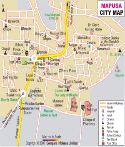
Mapusa (spelled Mah-p-sah or Mopsa in Konkani) is the bright and busy administrative, commercial, and geographical center of the Bardez subdivision in Northern Goa. While the beachfront of Goa is internationally known for its beautiful sunlit beaches, coconut forests and the laid-back coastal nightlife, there is a part of local culture to be rediscovered in Mapusa - the authentic pulse beat of everyday Goan life. It lies a bit away from the popular beach spots, and Because of this serves as an area through which people from different walks of life - mainly farmers, traders, officials, and the public at large - pass by and interact, while doing their everyday work. As centuries rolled by, that place of measurement quietly evolved and eventually, Mapusa emerged as the main town and market for Northern Goa. The area is not only geographically significant as a point of transition from coastal belts to agrarian regions of Bardez but also a crucial point of interconnection of these regions.
History & Culture
Mapusa's deep-rooted traditions in agrarian life have remained undiminished throughout colonial rule and have, in the process, adopted the distinctive Indo-Portuguese cultural elements. The town of Mapusa belonged, before the arrival of the Portuguese in 1543, to the old Gaunkari system, a traditional village structure, where agricultural lands were collectively owned and managed by elders of the village. When the Portuguese took over, Mapusa become an administrative headquarters and one of the first places to be served by Christian missionaries and a parish town. It is the Portuguese who recognized the strategic importance of the location as an intermediary between interior farming villages and coastal shipping lanes. After the long history of Portuguese colonial government, Mapusa besides acquiring European architectural style, governmental model, and religious practices, was also fortunate to preserve Goan traditions down to the last drop of community-based lifestyle which is yet the core of Goans.
Multiculturalism and religious tolerance are among the main features of the cultural identity of Mapusa plus ancient and deeply seated traditions and lively community gatherings. Feast of Our Lady of Miracles (Milagres Saibinn): This festival which takes place on the sixteenth day after Easter at the St. Jerome Church is probably the most dazzling example of the interfaith history of the Goan people.
It goes across religions, bringing large numbers of Hindu and Christian devotees together. Locals say that Hindus worship Milagres Saibinn as one of seven sisters, connected with Goddess Lairai of Shirgao. At the feast, worshippers of both religions stand by each other while saying prayers and sprinkling coconut oil over the statue ofVirgin Mary, showing their respect and thankfulness. Mapusa's Living Culture: One of the hallmarks of the life and culture of Mapusa is its weekly Friday Market that has continuously operated for centuries.
Economy
Economically, Mapusa acts as the main market for North Goa. Contrary to many coastal towns whose business revenue greatly changes with the peak of the tourism season, Mapusa always has a constant economy, mainly because the town gets its living by wholesale, public administration, logistic services and retail activities.
Government Sector
The local administration is a big proportion of the daily running of the town as Mapusa is where the offices of the Bardez sub-division's main civil administration, including civil courts, police headquarters, city municipal plan, district utility centers, and other public service facilities are located. This government establishment not only gives job opportunities continuously under the government sector but also encourages thousands of people of Goa to come to Mapusa daily for various legal, administrative, and citizenship-related purposes.
Public Sector
Public Sector: Fundamental to the public sector are vital public service operations as well as major urban and rural infrastructure development, and regional transportation. The town of Mapusa in northern Goa acts as not only the hub but also a vital junction in the transportation network of the north. The transport hub includes a large government-contracted bus terminal managed by Kadamba Transport Corporation next to privately run bus routes. The availability of such infrastructure enables the small and remote villages nearby to access bigger cities like Panaji, Margao, and also travel down to the neighboring states of Maharashtra and Karnataka. It is also worth noting that the availability of public health amenities like the North Goa District Hospital makes it one of the most important medical facilities of the entire northern part of the state.
Services Sector
The service industry is the main reason behind the economy of Mapusa town. The town hub is filled with wholesale and retail shops of family-run businesses catering to the needs of textile shops, hardware stores, suppliers of building materials, electronics, and food items that are distributed by restaurants, resorts, and residential areas of Bardez. Outside the commerce sector, close-by areas such as Thivim Industrial Area and the Industrial belt adjacent to the Thivim Railway Station contain many small and medium-sized manufacturing units producing pharmaceuticals/engineering goods/plastic processing and packaged foods. Healthcare services, bank services, and universities complement a strong economic environment that ensures stable employment even during the off-season.
Tourism
Mapusa gives an interesting insight into traditional urban life, regional architecture, and daily local activities if you are a traveler seeking more than Goa's beach-side sights.
Major Tourist Attractions
Mapusa Municipal Market: This is essentially the town's hub. Getting in there on a Friday enables you to have a first-hand look at the bustling local market and vibrant social scene, with a taste of different regional culinary traditions. Church of St. Jerome (Milagres Church): Started at 1594 and rebuilt in 1838 after a fire, this ancient Church showcases colonial-style clean, and attractive architecture and continues to be an active church, spiritual center and a historical monument of the town. Maruti Temple: Right in the city center is this lovely Lord Hanuman temple which has become a main landmark after the mid-20th century renaissance of the Hindu temple art. Housing areas of Heritage type: As you wander through old residential parts of Altinho, you come upon the silence of streets bordered by the traditional Goa Portuguese-style houses, with colorful red-tiled roofs, lofty ceilings, huge verandas (balces), and unique oyster-shell windows.
Demographics
Mapusa gives an interesting insight into traditional urban life, regional architecture, and daily local life. Mapusa town belongs to one of the urban municipal areas in Northern Goa that have characteristics of being multilingual, having a high literacy level among the population and being densely populated with different people. Population: The total official municipal census of residents living in Mapusa are 39,989. Literacy Rate: A literacy rate of above 91% is a mark of Mapusa's achievement, surpassing a great part of the country; this is a direct outcome of Goa's public educational system's efficiency. Konkani: A language that is native to Goa, is also the official language of the state, and besides that, people mostly communicate in it at home and use it when engaging in daily activities that they do in the market. Marathi: This language is mainly used in the literary, religious, and formal worlds. English: This language becomes the means of communication at a higher level of education, government agencies, courts that deal with legal affairs, commercial trading and hospitality business. Hindi: A language that is understood and spoken by a large spectrum of people in industries and also by migrant workers.
Administration
Mapusa is the sub-divisional headquarters of Bardez Taluka under North Goa District. Municipal Administration: A municipality in the traditional sense is the city area, and that is what theMapusa Municipal Council (MMC) regulates: the public amenities and sanitation. Beyond municipal properties, the local infrastructure as well as market management in the different municipal wards they operate. Tehsils and Village Panchayats Holding the status of the Tehsil headquarters, Mapusa brings the administrative, civil, and revenue services to 39 neighboring villages within Bardez Taluka. Agricultural and Urban fringe villages: Bastora. Historic and Residential Villages: Moira, Aldona.
| Official Name | Mapusa |
| Location | Goa |
| Area | 11.32 sq. km |
| Population | 39,989 (2011) |
| Language | Konkani,Marathi,English |
FAQs
Q1: How many villages are in the district/sub-division administered through Mapusa?
Mapusa consists of 39 village revenue and several urban municipal wards.
Q2: What is the population of Mapusa?
As per 2011, 39,989 people live in Mapusa.
Q3: What is Mapusa famous for?
Every time you visit here, Mapusa is the Friday marketplace where all the different Goan spices, local produce, handicraft items, and delicacies gather in one spot for trading and selling. The place is further made special by the Milagres Church dedicated to St. Jerome which also witnesses the unique interfaith celebrations here.
Q4: What is the nearest airport and railway station to Mapusa?
The nearest railway station for Mapusa is Thivim Railway Station (Tivim), located 12 km away. A railway line runs through the N. Goa area and is connected to major Indian cities via the Konkan Railway. Thivim is the main station providing the connection to the Mapusa region.
Q5: When would be the best time to go to Mapusa?
The perfect period to visit the coastal city Mapusa would be the winter or cooler season which is between November and March. It's a period with temperatures ranging from about 20C (68F) to 32C (90F) which is quite ideal when strolling along the stalls of an open market as well as exploring its narrow lanes.
Q6: How far is MapUSA from the major beaches of North Goa?
The Mapusa location offers you with a comfortable inland access to the beaches of North Goa as the most famous ones have been spread around within the 10 to 15km distance circle from it.
Q7: What are the operating days and hours for the Friday Market MapUSA?
The major public marketplace of Mapusa is open on all days from 8:00 AM to 8:00 PM. On this Friday Yet the very special, world-famous Friday Market comes alive as early as 7:30 AM each Friday and is in full swing until late midday.
Q8: What are the transport facilities to get Mapusa connected with other cities of Goa?
One of the largest bus stations in northern Goa has a presence in Mapusa with several buses, both government-owned and privately-owned, operated by the KTC - Kadamba Transport Corporation and other companies as well through regular as well as private sector buses.
Last Updated on : August 03, 2026
