





About
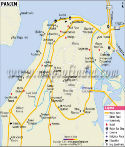
The administrative headquarters of North Goa district and the capital of the state of Goa is the city of Panaji or Panjim which is not a district, but a taluka in Tiswadi. The city got the name ‘city of the mouth of the Mandovi' from the old Konkani word ‘land that does not flood', which is a suitable description of the city's location on a slightly elevated plain on the south bank of the Mandovi at its mouth in the Arabian Sea. With a royal Portuguese decree it became a city in 1843 and was renamed Nova Goa; it became capital of Portuguese India and retained the status even after Goa's liberation and incorporation into the Indian Union in 1961. Colonial style houses with pastel colored walls, red tiled roofs, promenade along the river side and the hillside providing terraced landscape and the Church of Our Lady of the Immaculate Conception add a distinct Indo-Portuguese charm and a distinct Goan Konkani culture to Panaji. Be it exploring hidden art galleries or simply watching goats glide down the river, Panaji city captures the timeless spirit of Goa and continues to occupy an important palace in the tourist scene of Panaji.
History & Culture
Panaji existed as a small riverside hamlet under the control of the Adil Shahi rulers of Bijapur, before it became prominent and was conquered by the Portuguese, who took over the entire Goa area in 1510 when major changes were taking place in this region. Occasionally eclipsed by Old Goa the Portuguese capital and one of the most significant cities in Asia, Panaji started to become important administratively from the 18th century onwards when repeated epidemics and the silting up of the Mandovi river made Old Goa increasingly unattainable as a capital.
The Idalcao Palace which is now the Secretariat was the first of the Portuguese structures to be built in Panaji and the fortunes of the town continued to grow until 22 March 1843 when Panaji was elevated to city status named Nova Goa and made the capital of Portuguese India until the Portuguese left it in 1961. This is best preserved in the Fontainhas quarter that is famous by the name Goa's Latin quarter where the narrow lanes are lined by brightly painted Portuguese-style houses, wrought-iron balconies and some small chapels that have been acknowledged as heritage sites.
The Church of Our Lady of the Immaculate Conception was originally constructed as a small chapel in 1541 and then rebuilt in a grand style in the 17th century and since then it has continued to amaze people with its grandeur. It is the city's most famous landmark with a whitewashed Baroque façade and a distinctive zig zag staircase leading from the streets up to the main square. On the cultural front the city reflects Goa's unique blend of Catholic and Hindu traditions featuring such temples as Mahalaxmi Temple and the Shanta Durga Temple as well as numerous churches and mosques including the Goa State Museum and Sunaparanta Goa Centre for the Arts, which nurtures Goa's contemporary art scene, and the Goa Classical and Folk Music Academy, a hub for the arts. Goa's famous pre-Lenten Carnival, Goa State Museum, and Sunaparanta Goa Centre for the Arts bring a lively flavor to its cultural calendar, showcasing Goa's classical and folk music traditions and the state's contemporary art scene.
Economy
Panaji, the capital of Goa, has a strong role in the administrative sector and tourism and trade, and also has a relatively small services sector, which is significant for the small geographical size. In the Government Sector, Panaji has the Goa Legislative Assembly, the state Secretariat, and offices of many state government departments and directorates, and Public Administration is one of the biggest employment generators in the city; The presence of the Raj Bhavan, the official residence of the Governor at Cabo, and several other state-level institutions further emphasizes this role. The Public Sector footprint consists of the Corporation of the City of Panaji, responsible for civic services like water supply, sewerage, waste management services, and property taxes, and the public sector banks, insurance offices, and utilities which have their offices in the capital because of its administrative significance.
Historically, port and river transport services have supported allied public infrastructure and the city is also an educational centre with the administrative offices of Goa Medical College and several government-aided schools and colleges that provide formal jobs. Hospitality, river cruise tourism and retail trade are major components of the Services Sector, which is the most visibly present economic activity sector, with floating casinos moored along the Mandovi River, restaurants on the river and the heritage guest houses in Fontainhas catering to domestic and international tourists, and the markets like the Panjim Market and 18th June Road, being economic hubs for clothing, spices and everyday needs. The close distance of Panaji from Goa's international airport and vital highways has also boosted business tourism, events and MICE (meetings, incentives, conferences and exhibitions) tourism, providing an additional impetus to its service-driven economy.
Tourism
Panaji is a tourist hotspot due to its unique blend of colonial architecture, being right on the river, and the convenience of access to the rest of Goa's coastline. The Latin Quarter of the old Portuguese Goa is the well-preserved Fontainhas quarter and is an attractive place to visit for its narrow cobbled lanes, pastel coloured Portuguese houses, art galleries and boutique cafes.
The Goa State Museum is located near the Secretariat and the Adil Shah Palace offers a glimpse into the state's rich history, which spans three cultures—Hindu, Islamic and Portuguese—and has scenic views of Fontainhas and the Mandovi river.
Altinho Hill is another short walk away, with stunning views of Fontainhas and the Mandovi River. The riverfront itself is a highlight, with evening cruises, float casinos, and live music providing a contrast to the more sedate daytime scene, whilst outside the city centre, Miramar Beach has a lovely beach where the Mandovi meets the Arabian Sea; it's great for an evening stroll and sunset viewing. History buffs and nature lovers can also make visits to the nearby Old Goa, where the Basilica of Bom Jesus and the Se Cathedral are UNESCO World Heritage Sites; in the Dr. Salim Ali Bird Sanctuary, on Chorao Island, a sanctuary for bird lovers amidst the mangrove forests of Mandovi.
A circuit of tourism that catches the spirit of heritage, nature and leisure in a limited radius from the capital, is completed by the restored fort of Reis Magos, built by the Portuguese in the 16th century and which overlooks the river at Verem, as well as by the romantic promontory of Dona Paula, linked to a local well-known legend.
Demographics
According to the 2011 population census the population is 40,017 persons in 10,613 households, whereas the area under the jurisdiction of the Corporation of the City of Panaji (including adjoining outgrowths) has a population of 70,991 persons in 17,807 households.
The Panaji Urban Agglomeration has a population of 114,759 which was way more that the next two big urban centres in the state, Margão and Mormugão and the number of females (973) per 1,000 males was fairly equal for the municipal corporation area when compared to many cities in India. The city of Panaji has a higher literacy rate of 92.7% according to the available data from the municipality with male literacy at 94.71% and female literacy at 90.61%, indicating that the city has a robust educational infrastructure. Around 1701 people belong to the Scheduled Caste, 4586 people belong to the Scheduled Tribe and given this high share in the population the government ensures that welfare policies for this segment is implemented in the best possible ways and accountability is maintained via democratic means.
Goa's unique linguistic legacy is reflected in the fact that Konkani is the mother tongue of all the people of Goa, while also being the official language and widely used in administration, education and commerce, and English is also being used as an official language of the state and is being widely used in administration, education and commerce, and Portuguese is still being used in administration, education and amongst the old generation as the language of culture and heritage but is dying as the language of commerce and business, along with Marathi and Hindi being spoken by migrants.
Administration
Panaji is not a revenue district but the capital city of Goa and is a part of the administrative district of North Goa, with its administrative headquarters being in Panaji and more specifically Tiswadi taluka of North Goa taluka. It is governed by the Corporation of the City of Panaji, which is a formal municipal corporation since 2002, but had its roots in an older civic body, and is the oldest civic body in Asia, with 30 elected seats on a first-past-the-post basis, every five years elected by the local electorate to a term of four years and a term limit of two. Panaji city is divided into 37 wards, each having one corporator elected for electoral and administrative functions, for which he/she is responsible for the civic issues in the ward.
Politically, Panaji is its own panchayat, and Member of the Legislative Assembly of the city constitutes the city and represents it in the Goa Legislative Assembly, which is also located within the city. Apart from land revenue administration, law and order, and district-level planning, which are handled in the North Goa district office and Tiswadi taluka office respectively, Panaji lacks any component villages or sub-taluka revenue units of its own as a small urban municipal unit does not have such components.
| Official Name | Panaji |
| Location | Goa |
| Area | 8.27 sq. km |
| Population | 40,017 |
| Language | Konkani |
FAQs
Q1: How many villages are there in Panaji?
There are no villages here since Panaji is not a district city, but an urban area with 37 civic administrative municipal wards.
Q2: What is the population of the city?
The population of the city is 40,017.
Q3: What is Panaji famous for?
Panaji is known for its Indo-Portuguese heritage, colorful Latin Quarter of Fontainhas, the Church of Our Lady of Immaculate Conception and its picturesque banks of the Mandovi River.
Q4: In which district and taluka is Panaji located?
Panaji is the district headquarters of the district of North Goa, which is part of the taluka of Tiswadi.
Q5: What is the literacy rate of the city?
The literacy rate of the city of Panaji is 92.7%.
Q6: The administration of Panaji is vested in whom?
The Corporation of the City of Panaji is the administrative body of Panaji.
Q7: In which year was Goa made a Union Territory?
In 1843, it was raised to city status by the Portuguese royal decree and was the seat of Portuguese India until liberation in 1961.
Last Updated on: August 03, 2026
| Find Distance from Panajicity to other Indian Cities | |||
