|
||||||||||
 | ||||||||||
|





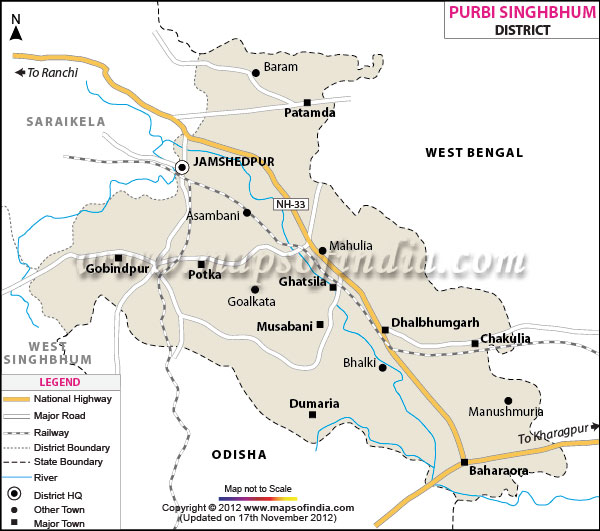
| *East Singhbhum District Map highlights the National Highways, Major Roads, District Headquarter, etc. |
About
East Singhbhum is one of the important districts of Jharkhand where it is referred as the industrial nerve centre of the state. The district is responsible for the administrative interest of its headquarter city which is the industrially, economically and planned city of the Indian country, Jamshedpur. The East Singhbhum was carved from Singhbhum district on 16th January 1990 and is now an important industry, commerce and cultural centre to the district.
While searching for Administration wards of Jharkhand and Bihar, East Singhbhum district map is also searched online from time to time. In studying the districts of the East Indian administration, researchers will sometime find themselves using the term East Singhbhum district map. Geography discussion sites likewise utilize the East Singhbhum district map in geography level arrangements studies.
History and Culture
District has tribal history; the area has been inhabited by tribal people even before the introduction of modern industries. The influence of tribal customs, folk traditions and community based social systems is still found in many rural areas of the district in their daily life. The Santhal, Ho, Munda and Bhumij tribes have maintained the differences among their cultures with the help of festivals, dances and music and each tribe had its own cultural ritual.
The colonial people, British saw the value of the minerals in this area and started to gradually introduce mining and industrial activities. But the most revolutionary change was effected by the founding of Tata Steel in Jamshedpur by Jamset Ji Tata and later the subsequent generation. Jamshedpur emerged as one of the first planned industrial cities of India, and is historically significant in the industrialisation of the country.
East Singhbhum's cultural life is a blend of tribal customs and the contemporary urban atmosphere. The Chhau and santhali dance forms are played in social gatherings and festive occasions among the tribes. The tradition of playing the folk drum and traditional instruments continues in the celebration of the community. Handicrafts, bamboo products and tribal art are also an important aspect of the district culture.
There are major festivals such as sarhul, sohrai,mage parab, karmab and Tusu parab which are celebrated here. Festivals celebrated by the Hindus like Durga puja, Diwali and Holi are also celebrated with great enthusiasm, particularly in urban areas like Jamshedpur. Reflecting the tribal, Bengali, Bihari, Odia and industrial urban cultures, the district is seen as a harmonious combination due to its varied population.
Jamshedpur is well known for its festivity association, cultural programmes and community activities of Durga Puja. The cosmopolitan nature of the population has also led to recovery after the district has become popular for literary activities, theatrical activities, as well as modern art. Educational Institutions and the cultural organizations of the district hold exhibitions, seminars and performances of the traditions and customs of the area from time to time, which also take into account the modern influence.
The phrase East Singhbhum district map is sometimes used in historical and educational contexts to draw comparisons about administrative systems in the eastern Indian state of Bihar. East Singhbhum district map is seen in some regional geography teaching resources in conjunction with teaching analysis for districts. In general the word East Singhbhum district map may be encountered as part of general studies on the districts of India as part of preparation for competitive examinations.
Economy
The talk is one on about the economy of East Singhbhum, which is one of the strongest in Jharkhand, driven by industry, mining, manufacturing and services. The district has itself become an important economic centre not only of Jharkhand but also of eastern India. Presence of big industries, mines and commercial establishments has created jobs, urbanisation in all over the district.
The government sector has a bigger role in administration and development of the district. There are many employed residents that are affiliated with the mining, forestry, education, healthcare and public works/rural development sectors. There is substantial public administration and civic management taking place in administrative offices at Jamshedpur and Ghatshila.
Industrial facilities and mineral resources make the public sector a significant contributor in East Singhbhum. Tata Steel has remained the largest industrial concern of the district and has played an important role in the economy of the area for over a century. The steel industry has a large variety of ancillary industries, engineering units and transport service companies. Copper mining and processing also help to contribute to the district economy apart from the production of steel.
Overall, the services sector has grown at an accelerated pace in the past few decades. The importance of banking, education, healthcare, hospitality and information technology services has kept increasing. Jamshedpur can be regarded as a commercial hub since shopping markets offer a lot of economic activity, educational institutions operate there, and medicines are manufactured at hospitals and there are service industries.
There is also some contribution by small-scale industries and informal industries to the district economy. Local livelihoods are enabled through manufacturing of metal products, machinery and parts, handicrafts and household goods. The agricultural importance in rural development is still apparent as the common tasks there are paddy cultivation, farming of vegetables and rearing of animals.
In some publications of economic research a reference is made to East Singhbhum district map when pointing out to district planning models. The district under study can be compared with other districts with the help of reference like East Singhbhum district map for developmental study by East Singhbhum in administrative training institute. East Singhbhum district map is also found in regional economic documents related to socio-economic analysis and comparison.
Tourism
East Singhbhum has abundant as many tourist attractions consisting of both natural and wildlife, industrial and religious elements. The district is a popular tourist destination of Jharkhand, West Bengal, Odisha and other parts of India.
The District has been found to have clean roads, clean parks & planned urban environment, with Jamshedpur as it's main tourist centre of the District. The park is said to be one of the most visited park in the city, the park is called Jubilee park. There are many landscaped gardens, fountains and recreational facilities located within the park, as it is setup over a large area. During a lighting festival thousands of visitors visit the park on an annual basis.
Ghatshila is a most scenic place in East Singhbhum. It is a town which is surrounded by hills and forests, situating on the banks of 'Subarnarekha' river. Place gained popularity because of the writings of Bengali author Bibhutibhushan Bandyopadhyay, who spent a lot of time there. The peaceful ambiance of Ghatshila, the riverview,the culture and tradition of the place makes it tourist friendly.
The other tourist sites of importance are the Burudih lake, Dharagiri falls, Phuldungri hills and Rankini temple. Baharagora and Chakulia are also among the popular tourist destinations which provide natural charm for visitors and being among the wooded areas, they are near to the woods. The district is also a place where religious tourism is noted and can be located with the East Singhbhum district map. Every day Hindu deities are worshipped in temples and in the indigenous belief system the supernatural forests (sacred groves) retain spiritual value to them.
Demographics
East Singhbhum is one of the most densely populated district in Jharkhand. The population of the district as per Census of India 2011 was around 22.9 Lakhs. Demographic increase has occurred with the industrialization, urbanization and population movements. A significant population part of the urban population in the State is from Jamshedpur. The literacy rate of district is approximately 75.5 per cent, which is one of the more literate districts in Jharkhand.
The district's language and culture are diverse. Bengali is widely used in urban and semi urban areas and Hindi is widely used for communication. Other languages spoken in the district are important are Santali, Urdu, Bhojpuri, Odia, Ho and Mundari languages. The multilingual environment reflects the District's tribal diversity and the migration of people for jobs.
District has a population which consists of a significant population of STs. The tribal communities are also sustaining their traditions, language, customs and practices in the times of fast growing urbanisation. A demographical profile where the coexistence of tribal settlements with industrial centres in urban areas exists.
Administration
East Singhbhum district is one of the important districts in Jharkhand, which is administered by the subdivisions, blocks, Panchayats and municipal bodies. Jamshedpur is the economic and administrative centre of the district.
The district is essentially divided into two subdivisions Dhalbhum and Ghatshila. These subdivisions are then further broken down into Administrative blocks which are well structured for good administration and development in the rural areas. Golmuri-cum-Jugsalai, Potka, Patamda, Boram, Ghatshila, Musabani, Dumaria, Baharagora, Dhalbhumgarh, Chakulia and Gurabandha are the important blocks in the district.
The district of East Singhbhum has 1809 revenue villages, some of them being inhabited as well as uninhabited. The panchayati raj bodies are very important in village administration, rural governance as well as functioning in general. Jamshedpur has multiple civic bodies, comprising municipal and industrial, who work in tandem with the urban administration body to work on the infrastructure and sanitation, amongst other public services.
Agriculture, rural welfare and industrial regulation developments; healthcare, education and general developments managed by the district administration. District police administration and local police stations scattered throughout urban & rural areas maintain law and order.
| PURBI SINGHBHUM DISTRICT PROFILE | |
|---|---|
| COUNTRY | INDIA |
| STATE | JHARKHAND |
| AREA | 3,533 sq km |
| DISTRICT HEADQUARTERS | Jamshedpur |
| ASSEMBLY SEATS | 6 |
| POPULATION | |
| Total | 2291032 |
| Male | 1175696 |
| Females | 1115336 |
| Density/km2 | 949 |
| Sex Ratio | 930 |
| LITERACY RATE (% age) | |
| Male | 84.51 |
| Females | 67.33 |
FAQs
Q1: How many villages are there in the district?
East Singhbhum district has around 1,810 villages.
Q2: What is the population of the district?
The population of East Singhbhum district is 22,93,919 according to the 2011 Census.
Q3: What is this district famous for?
East Singhbhum district is famous for Jamshedpur, steel industries, mining, and the Dalma Wildlife Sanctuary.
Last Updated on : May 11, 2026
