|
||||||||||
 | ||||||||||
|





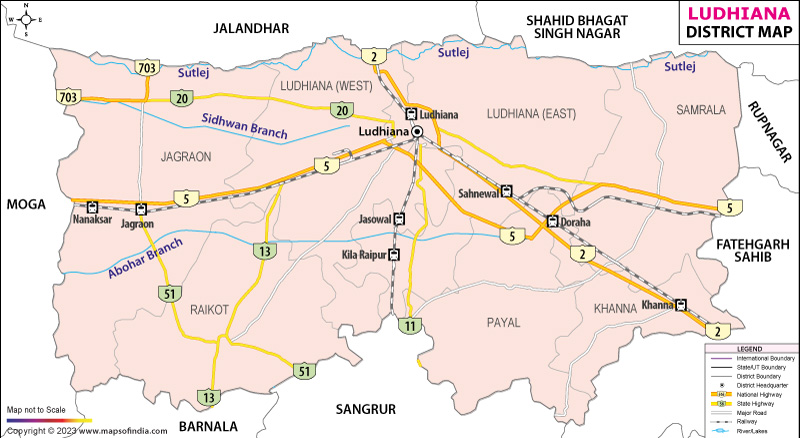
| *Ludhiana District Map highlights the National Highways, Major Roads, District Headquarter, etc in Ludhiana . |
Ludhiana keeps moving, always. Called the Manchester of India by some, here you hear weaving shuttles clicking alongside the steady spin of cycle works, forming a sound all its own. Yet past the mills and machines, devotion runs strong, warmth comes naturally, stories stretch back through time - each thread tied to how northern India became what it is.
About
Ludhiana stands as Punjab’s biggest city, driving trade, factories, and schools. On the former edge of the Sutlej River, it rests along the ancient Grand Trunk route. Named by honoring those who began it, the word Ludhiana twists from Lodhi-ana - calling it the “Settlement of the Lodhis.” Born in 1481, this place began as a tiny fortress town before swelling into a sprawling urban core. Not long after, it became the engine behind Punjab’s economy - factories rising where soldiers once stood. Chances are, your warm wool jacket or that bike leaning nearby traces back here somehow. Because what matters most isn’t just money made - it's how the fields of old meet machines of now right within these streets.
History & Culture
Ludhiana's past tells of endurance through hardship. Under Sikandar Lodhi’s rule, the place first came into being. Lawless times gripped the region until help arrived from above. Yusaf Khan, alongside Nihand Khan, stepped forward to bring calm. In time, Nihand made his home in Mir Hota - a name soon swapped for one that echoes still.
For hundreds of years, those in power wanted Ludhiana because it sat close to the Sutlej River. From there, troops under Mughal command passed through on their way to Kabul. Though Afghans later held sway, the town kept its role as a key crossing spot. Its location made movement easier, no matter who ruled. Ludhiana shifted into sharp focus during the 1800s. After the deal at Amritsar in 1809 - signed by the British and Maharaja Ranjit Singh - the place took on new weight. Across the river loomed the Sikh Empire, close enough to feel. Because of that presence, soldiers poured in. A large base went up, built not in haste but with purpose.
The Cultural Tapestry -
Bursting with warmth, Ludhiana lives by its "Vadda Dil" - big heart, bigger spirit. Joy spills into the streets during lively celebrations that never hold back. Rooted customs shape daily life, passed down without pause. Energy pulses through every gathering, each moment loud with pride. Tradition stands strong here, not spoken but felt in motion. Out near Kila Raipur, winter gives way to something wild each year. Old men hop on bikes like they’ve got springs in their legs. Carts pulled by oxen kick up dust as
crowds roar from the edges. Strength here isn’t measured in medals but in grit passed down through generations. This place breathes tradition without asking for attention.
Out here, creativity breathes through every alley. Legends rose from these streets - Sahir Ludhianvi being one whose words refuse to fade. Even now, his verses hum quietly among book lovers and late-night readers. Time moves fast, yet his voice lingers, tying factory smoke to old-world dreams.
Economy
Ludhiana runs on grit, not giants. While elsewhere big names dominate, here it’s the countless smaller shops and factories stitching things together.
Government and Public Sector -
Though run mainly by businesses, the city relies on public efforts for key studies and behind-the-scenes operations. Punjab Agricultural University sits at the heart of Ludhiana, standing tall since its early days. From that shift grew an export wave farmers still ride today. Research pulses through its labs even now, shaping farming far beyond local fields.
Running through the heart of transport networks, rail lines tie into federal communication systems. Office operations spread wide where tracks converge under regional oversight.
Services Sector -
The services sector has seen exponential growth: Ludhiana stands out when it comes to healthcare. CMC opened its doors as Asia's first medical school just for women. People travel far because of places such as DMC. Treatment here pulls in visitors from every corner of India. Out on Ferozepur Road, global labels pop up between sleek shopping centres. Ownership of cars per person runs deep here, higher than in most places across the country. That habit pulls in big spending on premium goods. Stores thrive because drivers keep arriving, drawn by shiny storefronts and imported names.
Private Sector -
Out on the streets where bikes rule, Ludhiana churns out close to 15 million every year. Though small in size, its impact rolls far beyond city limits. Homegrown names such as Hero, Avon, and Neelam started right within these lanes. Each frame built here carries a legacy shaped by decades of steady pedalling. Most Indian woollen socks and fabrics come from this region. A knitwear piece bought in Delhi might have started life in a Ludhiana workshop instead. Out here, making things just right is second nature. Sewing machines roll out under names like Rita and Usha - steady hands at work. Not far off, pieces meant for German cars take shape, quietly finding their way into models from Mercedes and BMW. Precision runs deep in the craft of local tinkerers.
Tourism
Old stones stand beside fresh green spaces where people wander in Ludhiana. What once crumbled now shares ground with places built for play and rest.
Historical and Religious Landmarks -
Lodhi Fort stands close to the Old City, once home to rulers of a five-century-old lineage. Though time has worn down most structures, thick brick ramparts remain standing. Echoes of long-ago wars linger where halls used to echo with voices. Ruins speak without words, shaped by conflict and centuries passing.
Gurudwara Manji Sahib rests quietly in Alamgir, held deep in reverence by many. After fighting at Chamkaur, it's believed Guru Gobind Singh Ji spent time right here. Water still pools in the calm sarovar, a quiet contrast to the noise beyond its walls. Meals are shared without pause inside the langar hall, feeding one person after another.
Nature and Leisure -
Among the biggest rose gardens across Asia, covering thirty acres, Nehru Rose Garden breathes life into the urban space. Thousands arrive each year when the Rose Festival blooms there, turning quiet pathways into busy promenades. City air shifts here, softened by petals and slow strolls under open sky. Just past Amaltas along the GT Road sits a place where tigers move freely through wide, guarded spaces. Instead of factories and smoke, here there’s space for wild things to breathe. While steel mills hum nearby, this patch stays quiet, watchful. Where metal rises on one side, trees stretch tall on another. Time passes, yet the chug-chug sound stays familiar. What began long ago still rolls today.
Demographics
Ludhiana breathes diversity. Workers arrive from across India, drawn by factories humming day and night - this mix shapes daily life here. As per the 2011 census, Ludhiana had a population of 1,618,879. The literacy rate was 86.50 per cent, and the population consisted of 950,123 males and 743,530 females. Main Languages: Punjabi, Hindi and English. Folks here pack into tight spaces, almost six out of ten squeezed inside the official city lines. Life moves quickly because of it - Ludhiana hums at its own sharp rhythm.
Administration
Ludhiana runs the district's affairs, tucked inside the Patiala Division. With industries humming and farms stretching wide, managing things moves fast here. The district is organized into 7 Tehsils:
Ludhiana East: The older, traditional trade heart.
Ludhiana West: sleek homes sit beside busy offices here. Upscale shops rise near quiet neighborhoods. This part breathes city life with a polished edge. Living feels steady, work hums close by.
Khanna: Famous for having the largest grain market in Asia.
Jagraon: A major religious and historical hub.
Fertile ground defines Samrala, a farming hub where crops thrive. Fields stretch wide here, fed by rich earth that supports steady harvests year after year.
Buried in time, Raikot holds quiet links to the old teachings. Stories linger here, passed through generations near sacred footsteps. Not far from forgotten paths, echoes of guidance remain in plain view. Among fields and low hills, remembrance takes root without announcement. Forts rise among fields where old ways still hold ground. Life here moves to rhythms shaped by seasons long remembered.
Villages
Ludhiana draws strength from 916 surrounding settlements. Not merely fields and farms, many now boast sharp reading skills and up-to-date services. Where rural life meets city production lines, steady growth takes root. Stability rises where village energy feeds the factory rhythm.
| Facts of Ludhiana District | |
|---|---|
| State | Punjab |
| District | Ludhiana |
| District HQ | Ludhiana |
| Population (2011) | 3498739 |
| Growth | 0.00% |
| Sex Ratio | 873 |
| Literacy | 82.2 |
| Area (km2) | 3967 |
| Density (/km2) | 975 |
| Tehsils | Jagraon, Khanna, Ludhiana, Payal, Raikot, Samrala |
| Lok Sabha Constituencies | Ludhiana, Fatehgarh Sahib |
| Assembly Constituencies | Khanna, Samrala, Sahnewal, Ludhiana East, Ludhiana South, Atam Nagar, Ludhiana Central, Ludhiana West, Ludhiana North, Gill (SC), Payal (SC), Dakha, Raikot (SC), Jagraon (SC) |
| Languages | Punjabi including Malwai, Hindi, English |
| Rivers | Sutlej |
| Lat-Long | 30.774879,76.002617 |
| Travel Destinations | Nehru Rose Garden, Hardy's World, Guru Nanak Bhawan, Rural Museum, Tiger Safari, Maharaja Ranjit Singh War Museum, Gurudwara Charankanwal Sahib Deer Park, Water Resource Museum, Gurdwara Manji Sahib, Gurdwara Alamgir Sahib etc. |
| Government Colleges/Universities | Govt. Science and Research College, Govt. College (Karmsar), Govt. College (Ludhiana), Govt. College (Ludhiana), Govt. College (Sidhsar) etc. |
FAQs
Q1: What number of villages exist within the Ludhiana district?
Ludhiana holds 916 villages within it. From these places comes much of what feeds the local economy - crops rise from their fields while workers move toward factories after dawn. Because farming stays strong here, food flows steadily into markets across the region. Workers from rural spots also fill roles where machines still need hands. When harvest ends, some shift to industrial work nearby. Life moves between soil and workshop often without pause. These communities stand quietly but carry weight in how the district functions every day.
Q2: How many people live in the Ludhiana district altogether?
Right now, about 3.5 million people live here, based on 2026 figures. Still holding the title, it's Punjab’s busiest patch - more folks packed into one area than anywhere else.
Q3: What is the Ludhiana district famous for?
Ludhiana earns the nickname "Manchester of India" because of its massive textile industry. Beyond cloth, bikes define much of its identity - it’s known worldwide as a hub for bicycle manufacturing. The city carries weight in farming circles, too, housing the Punjab Agricultural University. Another claim to fame? Every year, Kila Raipur lights up with sports unlike any other during the Rural Olympics.
Last Updated on : May 08, 2026
