






About
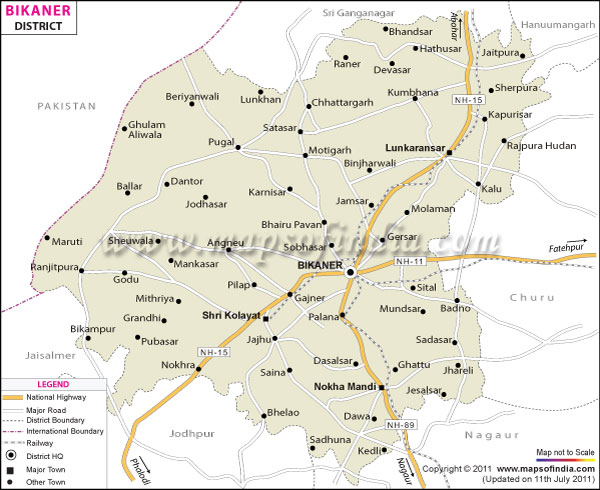
Bikaner lies within the arid terrain of Rajasthan’s northwest, cradled by shifting dunes of the Thar Desert. Bordering Pakistan on one flank, it meets Ganganagar in the north, while touching Hanumangarh toward the upper right edge. To the far side stretches Churu, with Nagaur appearing beyond the southeastern curve and Jaisalmer lying low to the southwest.
Established in 1488 by Rao Bika - a resolute Rathore ruler - its origins trace back through lineage to Rao Jodha, who shaped Jodhpur long before. From silence rose a decision: he picked Jangladesh, an empty stretch of wild terrain. There, a settlement emerged - Bikaner, named not only for him but also for Nehra, a guide through tangled claims on earth and power. Covering roughly thirty thousand two hundred forty-seven square kilometers, the region unfolds in waves of shifting sands, sparse bushes bending under wind, skies meeting land in blurred lines redrawn by daylight.
Heat scours the ground each summer; water flows nowhere permanently. Yet life took root anyway. The town became a command center, marketplace, and nerve point across the arid west. Stone carved from rust-colored rock shapes its skyline. Flavors unique to this place travel far beyond borders. Soldiers pass through. Factories hum near ancient walls. This is how survival reshaped itself into permanence.
History and Culture
Independence marks one early chapter in Bikaner’s past, followed by long stretches of careful negotiation. Though founded by Rao Bika, it was later leaders who shaped its borders through steady effort. While others resisted imperial forces, Rai Singh I chose to cooperate with Akbar. Because of such choices, prosperity flowed into the land over time. Peace allowed stone palaces to rise where sand once shifted without pause. Junagarh Fort emerged not just as a shelter but as a statement. Art flourished when patronage replaced conflict as policy. Under British influence, continuity mattered more than change. Ganga Singh ruled with attention to water, among other things. His canal cut across barren ground, altering harvests for decades after.
Instead of standard Hindi, voices carry Marwari, shaped by soft rhythms felt more than heard. From this place emerged a rare form of visual expression - the Bikaner Style - where bold Rajput themes meet subtle Mughal grace within tiny painted scenes. Crafted first here, Usta art transforms surfaces: camel leather, wall panels, brought alive with fine gold patterns pressed into skin and plaster alike.
Energy rises during festivals across Bikaner, shifting the quiet desert into motion. Held each January by officials overseeing travel interests, the global Camel Gathering highlights regional traditions through animal parades, footwork displays, and painted dromedaries. Further reverence appears at Deshnoke, where crowds gather toward a sanctuary known not for idols but for rodents considered divine. Color spreads wide when Holi arrives - stages host traditional storytelling acts while streets echo with laughter and soaked garments under bright powder clouds.
Economy
Among India's arid zones, Bikaner thrives through time-tested crafts alongside industrial activity and growing service networks. Though once shaped by desert routes and wandering merchants, today it draws strength from local assets to stand prominent within western Rajasthan’s economy.
Government Sector
Stability within Bikaner’s economic framework emerges largely through public-sector engagement, supplying consistent jobs to many residents. Located near national boundaries, the region supports extensive military operations - specifically an expansive army training ground and a pivotal air force installation - prompting ongoing needs in construction, transport networks, and material supply chains.
Public Sector
It is within the framework of governance that oversight of resources and foundational systems persists across the region. Operating behind large-scale energy distribution, state institutions such as the Rajasthan Rajya Vidyut Prasaran Nigam sustain electricity flow toward intensive water extraction and manufacturing operations. Among them stands the Indira Gandhi Canal Project unit - its work centered on preserving irrigation arteries vital to farming zones. Movement throughout the area gains structure via institutional transit arrangements: RSRTC routes complement Bikaner’s railway node managed under Indian Railways. Financial access and logistical support emerge quietly yet steadily through publicly held banking mechanisms, along with centralized storage agencies serving entrepreneurial activity in gradual motion.
Services Sector
Despite modest beginnings, growth in services emerged mainly through education hubs and finance channels expanding across urban centers. A complex web of banking operations now serves those involved in commerce, property ventures, and vehicle logistics. With steady visitor numbers, heritage stays benefit alongside independent drivers offering excursions. Sweets from Bikaner reach international shelves, fueling employment within packaging units and grocery distribution lines.
Tourism
Among India's historic towns, Bikaner stands apart through its collection of intricately carved sandstone palaces. Though often overlooked, it holds temples and shrines shaped by centuries of spiritual practice. A quiet atmosphere replaces the constant foot traffic seen elsewhere. Instead of modern distractions, remnants of royal desert life remain visible in narrow lanes and weathered walls. History here unfolds gradually, not performed for cameras.
Junagarh Fort
Unlike others across Rajasthan that rise atop steep elevations, Junagarh Fort rests firmly within open arid land. Built under Raja Rai Singh’s direction in 1589, it sits enclosed by a wide trench filled with water. Design details reveal strong influences from both Rajput and Mughal traditions, seen clearly in its structure. Inside, spaces such as Anup Mahal, Karan Mahal, and Badal Mahal unfold slowly - each layered with fine gold patterns. Floors bear imported tiles from Italy, while above, ceilings glow with countless mirrored surfaces. Among stored items lies an old aircraft from the First World War, kept within palace grounds.
Karni Mata Temple Deshnoke
Thirty kilometers out from Bikenar lies the Karni Mata Temple, a site unlike any other dedicated to worship. Referred to by many as the "Rat Temple," it shelters more than twenty-five thousand black rodents held sacred, called kabas in local speech. These creatures are thought to carry souls of kin from a holy woman born centuries ago. Among the masses of dark-furred ones, seeing an uncommon white kaba brings strong belief in fortune ahead. Found only once in great numbers, that pale animal hints at favor beyond ordinary reach.
National Research Centre on Camel
On the edge of Bikenar lies a distinct facility focused solely on camels - the leading one across Asia for both research and reproduction. Different types of these animals live here, viewable up close by guests who come to watch how they move, rest, or interact. Movement through the grounds may include time atop a seated ride offered under clear skies or shaded paths. Among quiet structures sits a small shop where drinks and chilled items are prepared - camel milk shaped into desserts or poured into warm cups rests at the core of what is served.
Rampuria Haveli
Among the tight pathways of the ancient fortified town rests the cluster of Rampuria residences. Constructed during the twentieth century by affluent traders following the Jain faith, these large homes rise in reddish stone. Ornate sculpting covers their surfaces, while arched glass panes suggest distant architectural influences. Balconies stretch outward with quiet prominence. One glimpses, through them, a time when commerce shaped Bikaner’s height.
Demography
Bikaner district holds a shifting mix of people, where age-old desert traditions meet newer city patterns. Official figures from the 2011 Census record 2,363,937 individuals living in the area. Among them, men make up 1,240,401, whereas women number 1,123,536. For every thousand males, there are 906 females - a balance seen across western Rajasthan. Though most inhabitants remain in countryside settlements, roughly one-third live differently: within towns and cities governed by municipalities. Despite its arid setting, urban presence here exceeds what is typical in similar desert regions. The contrast between village routines and town growth shapes daily existence throughout the region.
Among districts, Bikaner shows a literacy level of 65.13%. Notably, men reach 75.90% literacy - higher than women, whose rate stands at 53.23%. Despite this divide, progress has emerged slowly since more colleges opened regionally. Because education campaigns focused on girls began nearly ten years ago, improvement has followed steadily.
In terms of language, Rajasthani forms the core expression here; its Marwari variant is heard everywhere - from households to street vendors. Official work uses Hindi, a tongue nearly every resident grasps fully. Corporate zones, schools, and areas catering to travelers favor English instead. When it comes to belief systems, Hindu traditions shape life for most - around 84.70% follow them closely. A significant portion, roughly 11.20%, belongs to Islam, a presence rooted deep in regional history. Jains, though fewer at about 2.70%, hold notable influence; their mark appears clearly in buildings, trade networks, and public welfare efforts throughout Bikaner.
Administration
Spread across a vast region, the Bikaner district splits into nine tehsils for smoother administration. Under each lies a Tehsildar handling civil matters along with land documentation. Oversight at the local level ensures structured recordkeeping. The system functions through designated officers assigned per zone. Division helps maintain order within large territorial spans. Nine units form the backbone of daily governance tasks. Authority flows through appointed officials managing specific areas. Local control supports consistent management practices. Administrative clarity comes from this segmented layout.
Besides containing the principal urban center, Bikaner Tehsil hosts key government offices along with courts essential to regional governance. While public services concentrate here, so does decision-making authority tied to local administration. Where population density peaks, institutional presence grows strongest across departments. Although smaller divisions exist nearby, functional importance centers on this zone. With civic life anchored firmly within its boundaries, legal and bureaucratic systems operate primarily from this node.
Lunkaransar Tehsil sits in the northern stretch, overseeing expanses where salt lakes appear alongside wide tracts of oilseed cultivation. Its terrain links arid flats with agricultural zones shaped by seasonal rhythms. From above, patterns emerge - geometric fields meet natural depressions holding saline waters. Farming activity here adapts to sparse rainfall through methods passed across generations. Remote yet connected, the area sustains routines aligned with climate and soil limits.
Deep within the border zones, Kolayat forms part of the administrative structure. Development extends further through Chattargarh, woven into regional planning. Public services take shape in Pugal, supported by local frameworks. Bajju appears among these divisions, contributing to balanced outreach.
| Facts of Bikaner District | |
|---|---|
| State | Rajasthan |
| District | Bikaner |
| District HQ | Bikaner |
| Population (2011) | 2,363,937 |
| Growth | 41.19% |
| Sex Ratio | 905 |
| Literacy | 65.13 |
| Area (km2) | 30247.90 |
| Density (/km2) | 78 |
| Tehsils | Bikaner, Chhatargarh, Khajuwala, Kolayat, Lunkaransar, Nokha, Poogal, Sridungargarh |
| Lok Sabha Constituencies | Bikaner |
| Assembly Constituencies | Bikaner East, Bikaner West, Dungargarh, Khajuwala, Kolayat, Lunkaransar, Nokha |
| Languages | Hindi, Rajasthani including Marwari |
| Rivers | ----- |
| Lat-Long | 28.149503,72.892685 |
| Travel Destinations | Junagarh, Ganga Museum, Bhandasar Jain Temple, Laxmi Nath Temple, Shiv bari Temple, Ratan Behari Temple, Kolayat, Karni Mata Temple, Gajner Wild Life Sanctuary, Kalibangan, Devi Kund Sagar etc. |
| Government Colleges/Universities | Maharaja Ganga Singh University, Government Dungar College, Government Law College, Govt. College, M.L.B. Government College, M.S. Government Girls College etc. |
FAQs
Q1: How many villages are in the Bikaner district?
923 revenue villages appear on official records within the Bikaner district.
Q2: What is the population of the district?
As per official Census records, Bikaner district is home to 2,363,937 people.
Q3: What is the district of Bikaner most famous for?
Bikaner district is famous for the crisp Bikaner Bhujia that is eaten all over India. The Junagarh Fort and Karni Mata Temple in Deshnoke are the two most celebrated sites in the district. The Usta craftsmanship, passed down through generations, is another artistic marvel of the district.
Last Updated on : June 22, 2026
