






Introduction
Firozabad lies close to Agra, tucked inside Uttar Pradesh, where skill, endurance, and deep-rooted culture shape daily life. Famous now as the hub of glass or called home to bangles, its true tale runs deeper than labels suggest. Once named Chandrawarnagar, it carried echoes of old worlds before emperors stepped in, then colonizers arrived, later emerging into today’s mix of factory hardships and quiet victories.
History
Firozabad earns its nickname - City of Glass Bangles - from roots buried deep in northern India's shifting history. Long ago, people knew this land as Chandrawarnagar, some say under King Chandrasen’s hold. Nestled close to Agra, it sat where traders passed, bringing new ways through constant movement. Slowly, hands learned skills carried on winds from distant markets. Time piled up changes until shaping glass became its mark. What began quietly turned steady into what stands today.
It changed course when the Mughals took hold. Named later for Firoz Shah, one of Akbar's trusted men, it slipped neatly into imperial systems. Craft found favor with these rulers, so local makers dug deeper into glass. Bangles began appearing then, along with ornamental pieces - tiny sparks of what would define the place. Structures rose, styles shifted, echoes of that time still hum through the streets today.
Glass work in Firozabad grew more during colonial times. Back then, the British saw value in making it a center for small industries, linking local makers to broader trading routes. Into the 1800s and past 1900, glass bangles from here stood out - sold across India and shipped overseas too. Many skilled workers earned their living through this trade; life in the town began revolving around molten glass and furnaces. Still, under colonial rule, things weren’t easy - workers often faced unfair treatment while machines stayed scarce, leaving production rooted in old methods instead of modern tools.
Once free from colonial rule, it kept growing its glassmaking craft. In the years following 1947, tiny factories sprang up, often run by families working together under one roof. Worn on wrists everywhere in India, these bangles stood for heritage, grace, and who people were. Not just jewelry - glass cups, ornamental pieces, even parts for machines began coming out of local furnaces too. Even with new tools arriving, old ways stayed strong, hands teaching hands how to shape molten sand like their ancestors did.
Worldwide attention found the glass craft in the city by the 1900s, with pieces appearing at global shows. Yet behind that shine, smoke from coal ovens stained the air, harming health and land. Workers bent over hot flames for hours, their safety mostly ignored. Instead of progress, old methods held back growth, trapping many in tough routines. Clean energy trials began slowly, pushed by aid groups and officials watching closely.
Starting with quiet roots, Firozabad grew under emperors, then shifted during foreign rule, later shaping a new face among today's towns. Known widely for bangles made of glass, that name sticks not just by chance - it shows how skill passed down lives on, bending with time yet holding form. Century after century, its path traces something larger - the way old ways sit beside new ones across India, places where small workshops echo bigger stories about who we are.
Culture
Glass bangles define Firozabad, not just as trade but as lifeblood. From dawn on, workshops hum with molten colors shaping fragile circles. These sounds - light taps, soft chimes - are part of daily rhythm here. Faiths coexist quietly, voices rising at different hours from temples, mosques, homes. Language shifts subtly between lanes - Hindi shaded with Braj Bhasha tones. Hands learn early how to twist heat into beauty without words being spoken. Skills travel not through schools but across dinner tables and courtyard talks. What others see as trinkets carry stories older than most records show. Each bracelet holds labor that stretches back decades, maybe centuries. Tradition sticks because it fits like skin, worn without thinking.
Words shape how people live together in the city. Though Hindi and Urdu carry most daily talk, echoes of both Hindu and Muslim lives hum beneath them. Dialects like Braj or Awadhi slip into conversations, coloring words with local shade. Folk tunes pass down tales that bind generations. Expression flows through voice here - poems grow from streets, stories breathe in courtyards, meaning stirs beyond mere speaking.
Festivals breathe life into Firozabad’s everyday scenes. Beside quiet lanes, the Mahavir Digambar Jain Temple rises near mosque domes, proof of steady coexistence. During Diwali, streets glow just as brightly as they do at Eid. Holi throws color; Muharram holds silence - both draw neighbors close. Raksha Bandhan ties wrists while stitching wider circles of care. Devotion shows in prayer, yes - but also in who shares food after sunset. Moments meant for gods become times for laughter between homes. Unity grows not through speeches, but through steps taken toward one another.
Glass makers in the city shape more than just bangles - chandeliers, trinkets, and bright decorations flow from their hands, each piece shaped by instinct rather than rules. Families here usually stick to one trade, passing it down through many years. Though young people now listen to different music and dream of other lives, old ways still shape daily routines. Weddings follow familiar patterns, filled with local tunes that echo across neighborhoods. Life moves faster these days, thanks to phones and cities pulling attention outward. Still, the clink of bangles marks time like a quiet heartbeat. Glass work pays bills, yes - but also tells who people are.
Language
Firozabad's way with words carries echoes of centuries, shaped by time and movement through the streets. Though part of western Uttar Pradesh, it doesn’t just mirror the area - it adds a twist of its own. Most people speak Hindi, the common thread tying neighbors together when talking or doing business. From classrooms to markets, official offices to doorsteps, this language holds things steady. Day after day, it quietly keeps life moving. What stands out, besides Hindi, is Urdu’s deep presence - felt most clearly within Muslim communities, coloring both storytelling and daily life. Not merely used in conversation, their shared space in the city mirrors older blended ways of living built slowly over generations.
Out here, local ways of speaking shape who people feel they are. Not far from town, you might hear Braj Bhasha or Awadhi shared between neighbors, passed down through years. Older folks keep these forms alive, especially when telling stories after sunset. Folk tunes float through fields, carried by voices using words that textbooks rarely catch. Braj ties back to tales of Krishna - its rhythm soft, almost like prayer woven into talk. Awadhi feels closer to soil and sweat, matching the pace of daily work and quiet humor. Side by side, they form something unspoken but clear: many ways of saying things can belong in one small space.
Poetry written in Urdu shapes much of what people do each day here. Long-standing traditions bring crowds together for mushairas where verses echo through open spaces instead of fading quietly indoors. These days, English matters more, especially for young people aiming at study or jobs beyond their town. Though it does not fill streets or homes like before, you will spot it growing in classrooms, universities, even meetings between workers. Still, beneath that shift, Firozabad holds tight to its own voice - a mix of Hindi and Urdu shaping how people speak, think, live.
Geography
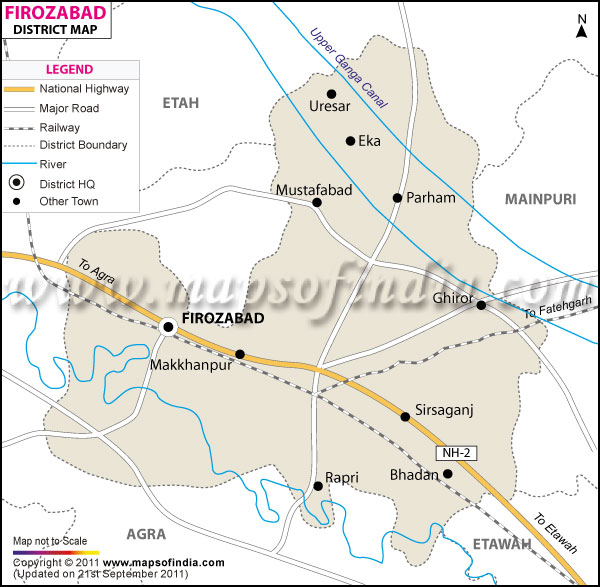
Firozabad is located in western Uttar Pradesh, just near Agra, where the land meets the southward flow of the Yamuna River. Flat, rich soil has drawn people here for ages - not only to live but also to exchange goods and craft items by hand. The city meets Etah to its north, while Mainpuri and Etawah lie beyond its eastern edge. Southward, the stretch ends at the Yamuna River - this waterway shapes more than just borders. Instead, it quietly guides farming patterns and supports local ecosystems across the area. Most soil here comes from river deposits, rich and fine, making it good ground for growing wheat, rice, or lentils. Yet factories have slowly taken up space once used by fields over time. Sitting 540 feet (164 meters) high, the land stays nearly level, much like other parts of the great northern plain. Because of this gentle lay of earth, movement and living spaces developed easily through history.
Firozabad faces scorching, arid summers, frequently seeing mercury climb past 40°C. Afterward, moisture-laden winds arrive, ushering in a rainy season of mild downpours. Cool breezes define the winter months, sometimes dipping close to 5°C at night. Shifts between these conditions influence how farming unfolds across the area. Daily routines adapt steadily to such weather swings throughout the year.
| Facts of Firozabad District | |
|---|---|
| State | Uttar Pradesh |
| District | Firozabad |
| Location | Western Uttar Pradesh |
| District HQ | Firozabad |
| Population (2011) | 2498156 |
| Growth | 21.69% |
| Sex Ratio | 875 |
| Literacy | 71.92 |
| Area (km2) | 2361 |
| Density (/km2) | 1044 |
| Tehsils | Firozabad, Jasrana, Shikohabad, Tundla |
| Lok Sabha Constituencies | Firozabad |
| Assembly Constituencies | Firozabad, Jasrana, Shikohabad, Sirsaganj, Tundla |
| Languages | Hindi, Urdu |
| Rivers | Yamuna |
| Lat-Long | 27.186242,78.562431 |
| Travel Destinations | Chadamilal Jain Temple, Shri Shuparshnath Jain Mandir, Gher Khokal, Chandprabhu Jain Mandir, The Jama Masjid, Marsalganj Jain Temple, The Kalan Mosque etc. |
| Government Colleges/Universities | Shri P.D. Jain Inter College, S.R.K. College Of Computer Science & Education etc. |
FAQs
Q1: Why is Firozabad Known For Glass Bangles?
Firozabad holds that name thanks to its unmatched output of glass bangles across India. For hundreds of years, families have shaped molten glass, teaching each new wave of makers by hand. Life here breathes through the rhythm of furnace flames and clinking stacks of bracelets. Tradition pulses strongest where workshops glow red at dusk.
Q2: What is the historical origin of Firozabad?
Far back in time, this land carried the name Chandrawarnagar, home to King Chandrasen's rule. Under the vast reach of the Mughals, a shift came - Firoz Shah, one of Akbar’s trusted nobles, gave his mark, renaming it Firozabad. Craftsmanship took root here, slowly building markets where goods moved steadily through hands.
Q3: Which languages are commonly spoken in Firozabad?
Out here, Hindi runs things - shows up everywhere from offices to street talk. Meanwhile, Urdu carves its own space, deeply tied to poems and old writings. Then there are languages like Braj and Awadhi, spoken through villages, each adding color to how people speak. These voices together carry stories older than most records.
Last Updated on : May 08, 2026
