




Introduction
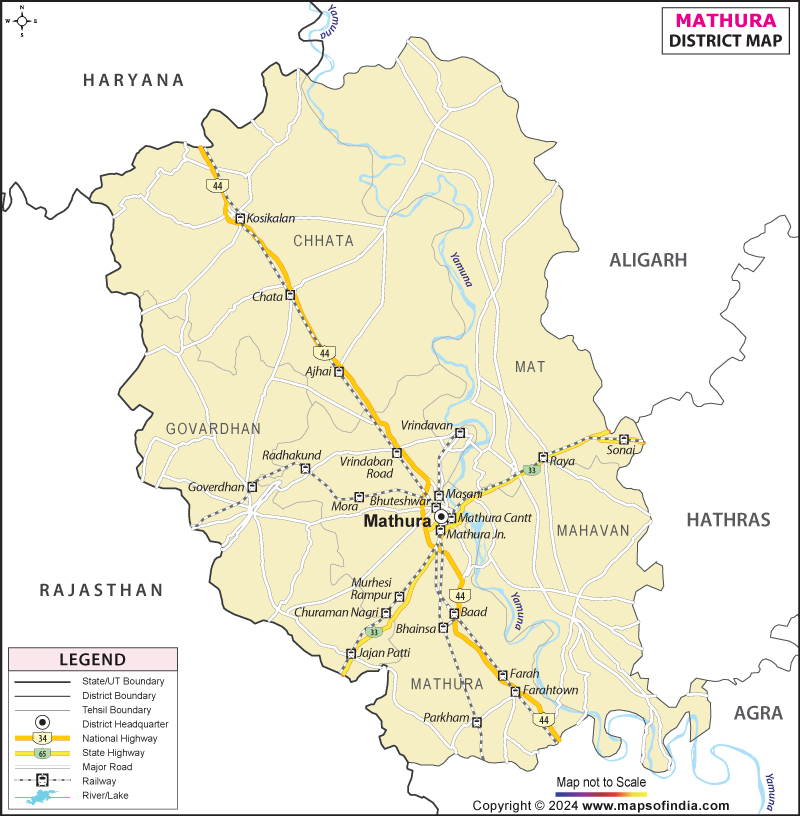
Mathura is one of the oldest and most sacred cities in Uttar Pradesh located along Yamuna River, clearly visible on the mathura district map. It is the birthplace of Krishna, a religious hub of great significance in the Hindu religion. The city is a part of the culturally enriched Braj along with millions of believers who visit the place especially during the Janmashtami and Holi celebrations. Mathura which has a history dating back to ancient times is also defined in terms of temples, ghats, sculptures and colourful traditions and as such is a very important centre for spirituality, art and heritage in northern India.
History
Mathura is one of the oldest Indian cities with its history being over three millennia old. It is situated on Yamuna River in Uttar Pradesh, clearly visible on the mathura district map and it has been an important political, religious and cultural centre since ancient times. Mathura is deemed to be the birth place of Krishna and one of the seven holy cities of the Hindu religion (Saptapuri).
It is archeologically evidenced that Mathura has been inhabited as early as the 8th century BCE. It was the capital of the Surasena kingdom in the days of Mahajanapadas. The Mauryan Empire also ruled the city in the 4th -3rd century BCE. Buddhism thrived in the area under the Mauryas in the reign of one of their emperors, Ashoka. Many stupas, monasteries and sculptures have been constructed making Mathura a great hub of learning and art of the Buddhist faith.
Mathura became a key political and artistic capital between the 2nd and 3rd century CE under the Shungas, Kushans, and other local dynasties. Kanishka was a Kushan ruler who was a great patron of art and religion and under his reign the Mathura School of Art used to flourish. The school is recognized by red sandstone sculpture with iconography of Buddhism, Jain and Hinduism. Mathura was one of the earliest places where the anthropomorphic image of the Buddha was developed.
Mathura remained an important religious and artistic centre during the Gupta period (4th-6th century CE), which is sometimes known as the Golden Age of Indian culture. Temples of Hindu gods were built and the city continued being a major pilgrimage. However, since the beginning of the medieval period, Mathura has experienced a number of invasions because of its affluence and religious importance.
In the 11th century, Mahmud Ghazni invaded and looted the city, destroying a large number of temples. Thereafter, Mathura had periods of decline and flourishing during the Sultanate of Delhi and the Mughal Empire. The Mughal ruler, Akbar adopted a relative tolerance policy and as such the religious practices of the Hindu faith thrived. However, some temples were destroyed during the reign of the king Aurangzeb with mosques built in their sites.
Mathura was taken over by the Marathas and then the British East India Company in the 18th century. The city was incorporated into the North-Western Provinces during British rule. Even after losing its political value, it still had its religious significance and was still visited by the pilgrims of India.
Mathura underwent significant revitalization and infrastructure development after independence in 1947.
Culture
The city Mathura, clearly visible on the mathura district map is characterized by a strong interest in religion, tradition, art, and everyday life. It is situated in the culturally diverse Braj region of Uttar Pradesh and its identity is highly influenced by its connection with Krishna. The cultural life in the city is based on the devotion (bhakti), temple worship, festivals, music, dancing, and sacred geography connected with the life of Krishna.
Mathura has festivals in the core of the cultural expression. The most significant of the festivals is the Janmashtami which is the birthday celebration of Krishna and is celebrated most grandly in the Krishna Janmabhoomi Temple. There are lights and flowers around the temples, devotional songs are sung at night and dramatic performances referred to as Raslila as such are movements imbued with scenes in the life of Krishna. Another great festival is Holi, celebrated with great enthusiasm. Every year thousands of visitors come to observe these celebrations, which are both spiritually oriented and full of fun with the community.
Ethnography of the Temple is the most prominent culture in Mathura. Many temples, ghats and holy places are unanimously visited all year round. Dwarkadhish Temple is reputed to be of a complex structure and with numerous rituals. Everyday worship, exhortations, and bhajans and kirtans bring an ambience of spirituality throughout the city.
Mathura is also famous because of its art background. The city became a great sculpture centre during the Kushan and Gupta times by virtue of the ancient Mathura School of Art. This art of craftsmanship still persists in one way or another such as idol-making, and temple art. The traditions of classical music and devotional dancing, especially the dancing related to Krishna devotions, still play a significant role in local culture.
Food is one of the major aspects of Mathura culture. The city is also a hub of the traditional sweets and mostly the peda which is commonly served as prasad (sacred offering) in temples. The use of vegetarian food prevails as a result of religious activities and feasts are made on special occasions.
Another aspect that pilgrimage tourism has influenced is the social and economic life of the city. There are also markets in the temples where religious objects, handicrafts, and traditional clothing are sold. Rhythm of everyday life is strongly linked to the time of temples, the schedule of the festivals, and pilgrims activities.
Language
The language culture of Mathura is evidence of its great historical background and religious value to the Braj region of Uttar Pradesh. The common language used in Mathura is Hindi and this is the common language used in administration, education and also in everyday communication. Nevertheless, the native and culturally unique language of the land is Braj Bhasha which is a western dialect of Hindi and therefore, has got immense literary value and devotional value.
The bhakti of Krishna and the Krishna bhakti school in general are intertwined with Braj Bhasah. A variety of devotional songs (bhajans), poems and Raslila songs are being composed and sung in Braj Bhasa. It was the language that thrived during the medieval times particularly in the writings of poet-saints like Surdas whose poems glorifying Krishna helped in bringing enrichment to North Indian devotional literature. In Mathura and its environs, particularly in rural village life and on the occasion of the religious festival, Braj Bhasa is still a sense of emotion and cultural identification even up to today.
Written in a Devanagari script, Standard Hindi is popular as a medium in schools, government offices, press and in business. It is a point of communication link with the visitors and pilgrims who represent various regions of India. Hindi is also spoken in temples and markets, and this aspect largely helps Mathura to communicate with visitors as a large pilgrimage center.
There is also an Urdu speaking population in Mathura it can be said that due to the past Mughal era and similarity in cultural values of the northern region of India. It is applied in some religious, literary and social applications. Also Sanskrit is still ceremonial in the holy rituals of temples and religious discourses where most of the prayers and scriptures are recited using the Sanskrit language.
The English language has become prominent in the recent decades especially in areas of education, tourism and hospitality. English is a commonly spoken language in schools and colleges and is generally known in cities. Tourism development and enhanced connectivity have also contributed to the higher practical application of English in hotels, travel facilities and business establishments.
Geography
Mathura is found in the west of Uttar Pradesh, clearly visible on the mathura district map and represents a significant portion of the culturally notable Braj region. The city is situated on the western bank of Yamuna River, clearly visible on the mathura district map which is the main source of the physical landscape, agricultural life and religious life. It is geographically positioned to be some 150 kilometers south of Delhi, and some 50 kilometers north of Agra thus it is accessible because of strong road and rail transport networks.
One has to consider that Mathura is physiographically located in the rich Indo-Gangetic Plain. Mostly the land is flat and slightly undulating as seen in alluvial plains that are composed of river deposits over a period of centuries. The soil is mostly alluvial and rich in nutrients and is very fertile. Also grown in the rural properties, are crops like wheat, mustard, sugarcane, and vegetables. The dairy farming is also popular indicating the traditional connection of the area with rearing cattle which is strictly connected with Krishna lore.
The Yamuna River, clearly visible on the mathura district map is the greatest geographical characteristic of Mathura. It is not only supporting irrigation and agriculture, but also of immeasurable religious significance. The banks of the river have a number of ghats where ritual bathing and religious ceremonies were conducted. The Yamuna, however, is also affected by environmental issues like pollution and decreased water flow like most of the other rivers within northern India and this has both ecological and cultural consequences upon the city.
Mathura has a humid subtropical climate. Summers lasting between April and June are so hot with temperatures often reaching 40°C. The rainy period comes during the month of July and extends to the month of September and features moderate rainfall similar to the rest of the Indo-Gangetic plain but has the effect of flooding the areas locally. Winters are cool and pleasant (November to February) and the temperature occasionally goes down to below 10°C. The winter season is regarded as the best season to have tourism and pilgrimage.
The vegetation of the area is characterized by mostly cultivated crops, indigenous trees and shrubs of the northern plains. The increase in population in the city has slowly turned some areas of the natural landscape into housing settlements, highways, and business hubs. Some green spaces and rural pockets continue to retain some traces of the traditional landscape in spite of the modernization.
| Facts of Mathura District | |
|---|---|
| State | Uttar Pradesh |
| District | Mathura |
| District HQ | Mathura |
| Population | 441894 |
| Growth | 22.78% |
| Sex Ratio | 863 |
| Literacy | 70.36 |
| Area (km2) | 39 |
| Density (/km2) | 761 |
| Tehsils | Chhata, Mahavan, Mat, Mathura |
| Lok Sabha Constituencies | Mathura |
| Assembly Constituencies | Baldev, Chhata, Goverdhan, Mant, Mathura |
| Languages | Hindi including Braj |
| Rivers | Yamuna |
| Lat-Long | 27.492131,77.67432 |
| Travel Destinations | Shri Krishna Janmbhoomi, Dwarkadish Temple, Gita Mandir, Rangaji Temple, Jugal Kishor Temple, Radharaman Temple, Jaipur Temple, Shahji Temple, Vrindavan Chandrodaya Mandir, Prem Mandir, Sri Vrindavan-Chandra Mandir, Shree Radha Ras Bihari Ashta Sakhi Temple, Vishram Ghat etc. |
| Government Colleges/Universities | B.S.A. Degree College, K.R. Degree College, Brij Bihari Degree College, K.R Girls Degree College, R.C.A Girls Degree College, I.O.P. Degree College etc. |
FAQs
Q1: What is the most appropriate time to visit Mathura?
Its good visiting time is during the autumn season between October and March when there is pleasant weather. The Janmashtami and Holi are also particularly colorful occasions to celebrate the culture of the city.
Q2: Is Mathura ideal for family holidays?
Yes, Mathura is the place that is perfect to visit with the family and make spiritual journeys. The temples, ghats and the pilgrimage towns around such as Vrindavan, clearly visible on the mathura district map provide worthwhile experience to both young and old.
Last Updated on : May 08, 2026
