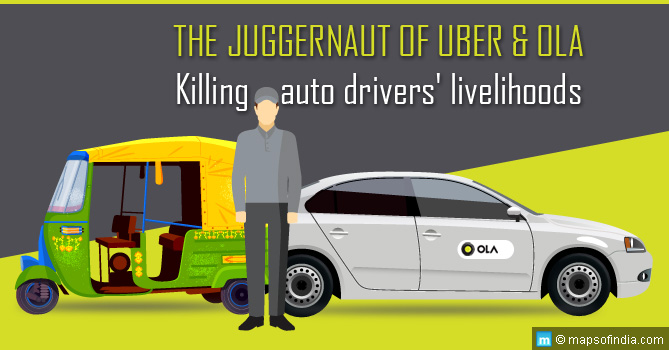
 This is a fight that has been going on ever since Industrial Revolution, when machines began to replace humans in performing functions that were faster, more efficient and cheaper. The principle argument then, as now, remains loss of livelihood.
But that didn’t stop man from experimenting, innovating and creating better, faster, cheaper and more efficient alternatives to what was prevalent at the time. That is how humans have evolved and improved quality of life over time.
Change is constant and while disruptive change causes pain in the short term to a select few, in the long term, people at large benefit. Otherwise, the disruptive technology would have been abandoned, and many have.
In more recent times, we have witnessed the telecommunications industry change completely over a short period of time with pagers initially, followed by mobile phones and subsequently smartphones, which in turn has put several industries out of business, as Information and Communications Technology (ICT) converged to make our lives better. True, jobs were lost as traditional industries made way for new ones, but newer jobs got created too.
The banking industry is another example where disruptive technology is forcing change as the economy transitions from a cash-based to a cashless one, with smartphones facilitating instant verification and fund transfers. Here too, jobs will be lost, but newer ones are coming up too.
The same applies to the current fight between traditional cab drivers and App-based cab drivers from companies like Ola and Uber. It is interesting to note that just a few years ago, Radio taxi companies like Easycabs and Meru were viewed as ‘disruptive’ by traditional cab drivers. The similar protests about losing livelihood took place then as well. But today, both Easycabs and Meru remain on the fringes of extinction, as companies like Uber and Ola surge ahead to replace them and capture market share.
So, are the vociferous protests from traditional cab and auto drivers really valid or is it another case of old resisting the new? The answer to that must be viewed keeping in mind the most important stakeholder in this, the Commuter.
The Commuter comes first
Remember, taxis and autos are not operated by the government but is left to the individual driver to decide whether to enter into a service-driven opportunity to earn a living or not. The driver enters the line fully understanding the upsides and downsides of cab driving and takes the business risk on his own volition.
Taxis exist for the commuter and any policy or decision by the government must first consider the benefits to the commuter. The interests of taxi/auto drivers come later but must never come at the cost of commuter interest.
What does a commuter expect?
Any commuter would like to avail a taxi or auto at the instant he or she requires the services. The vehicle must be clean, the fare transparent, consistent and valid, driver courteous and the journey safe and without incident. Increasingly, commuter preference is for air-conditioned cabs and going forward, this will become the norm.
In case of any inappropriate driver behaviour, the commuter would like to report the matter and will prefer a quick redressal to his or her complaint. The advantage with Uber and Ola is that they have control over the driver in real time and are in a position to take immediate action against an erring driver.
That’s not the case with traditional taxis and autos, who continue to indulge in rude behaviour, taxi/auto refusal, demand additional fare and indulge in meter tampering. Since they are protected by politically strong unions, the hapless commuter gets almost no redressal, neither from Police nor from the transport department, which is supposed to monitor and regulate them. This is one of the prime reason that commuters prefer app-based cabs. The respective companies respond immediately to any misbehaviour.
On its part, the government must understand and accept that any technology, scheme or transportation option must fulfil these expectations. Same applies to taxi/auto drivers. Any option that narrows the gap between commuter expectation and service delivery, will survive while others will be forced into extinction. That’s the way it has been and will continue to remains so. As of now, App-based cabs seem to fulfil most of the expectations other than surge pricing. More on that later.
Traditional versus App-cabs
The biggest complaint that the traditional taxis and auto drivers have against Uber and Ola is that they don’t have a level playing field. The list of complaints include:
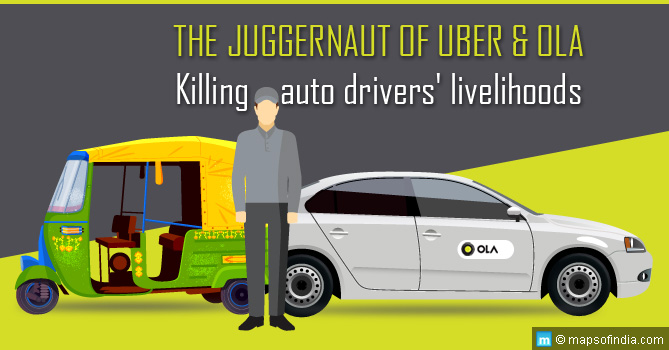
This is a fight that has been going on ever since Industrial Revolution, when machines began to replace humans in performing functions that were faster, more efficient and cheaper. The principle argument then, as now, remains loss of livelihood.
But that didn’t stop man from experimenting, innovating and creating better, faster, cheaper and more efficient alternatives to what was prevalent at the time. That is how humans have evolved and improved quality of life over time.
Change is constant and while disruptive change causes pain in the short term to a select few, in the long term, people at large benefit. Otherwise, the disruptive technology would have been abandoned, and many have.
In more recent times, we have witnessed the telecommunications industry change completely over a short period of time with pagers initially, followed by mobile phones and subsequently smartphones, which in turn has put several industries out of business, as Information and Communications Technology (ICT) converged to make our lives better. True, jobs were lost as traditional industries made way for new ones, but newer jobs got created too.
The banking industry is another example where disruptive technology is forcing change as the economy transitions from a cash-based to a cashless one, with smartphones facilitating instant verification and fund transfers. Here too, jobs will be lost, but newer ones are coming up too.
The same applies to the current fight between traditional cab drivers and App-based cab drivers from companies like Ola and Uber. It is interesting to note that just a few years ago, Radio taxi companies like Easycabs and Meru were viewed as ‘disruptive’ by traditional cab drivers. The similar protests about losing livelihood took place then as well. But today, both Easycabs and Meru remain on the fringes of extinction, as companies like Uber and Ola surge ahead to replace them and capture market share.
So, are the vociferous protests from traditional cab and auto drivers really valid or is it another case of old resisting the new? The answer to that must be viewed keeping in mind the most important stakeholder in this, the Commuter.
The Commuter comes first
Remember, taxis and autos are not operated by the government but is left to the individual driver to decide whether to enter into a service-driven opportunity to earn a living or not. The driver enters the line fully understanding the upsides and downsides of cab driving and takes the business risk on his own volition.
Taxis exist for the commuter and any policy or decision by the government must first consider the benefits to the commuter. The interests of taxi/auto drivers come later but must never come at the cost of commuter interest.
What does a commuter expect?
Any commuter would like to avail a taxi or auto at the instant he or she requires the services. The vehicle must be clean, the fare transparent, consistent and valid, driver courteous and the journey safe and without incident. Increasingly, commuter preference is for air-conditioned cabs and going forward, this will become the norm.
In case of any inappropriate driver behaviour, the commuter would like to report the matter and will prefer a quick redressal to his or her complaint. The advantage with Uber and Ola is that they have control over the driver in real time and are in a position to take immediate action against an erring driver.
That’s not the case with traditional taxis and autos, who continue to indulge in rude behaviour, taxi/auto refusal, demand additional fare and indulge in meter tampering. Since they are protected by politically strong unions, the hapless commuter gets almost no redressal, neither from Police nor from the transport department, which is supposed to monitor and regulate them. This is one of the prime reason that commuters prefer app-based cabs. The respective companies respond immediately to any misbehaviour.
On its part, the government must understand and accept that any technology, scheme or transportation option must fulfil these expectations. Same applies to taxi/auto drivers. Any option that narrows the gap between commuter expectation and service delivery, will survive while others will be forced into extinction. That’s the way it has been and will continue to remains so. As of now, App-based cabs seem to fulfil most of the expectations other than surge pricing. More on that later.
Traditional versus App-cabs
The biggest complaint that the traditional taxis and auto drivers have against Uber and Ola is that they don’t have a level playing field. The list of complaints include:
- Being forced to follow government defined pricing
- Not being allowed to introduce surge pricing
- Have to register with unions and wear uniforms
- Have to pay substantial insurance
- Have to pay for additional taxi-permits for interstate travel, where applicable
- Forced to operate CNG-based vehicles
- Significant loss of monthly income
- Consumer preference for app-based cabs for longer distances within city limits due to lower fares.