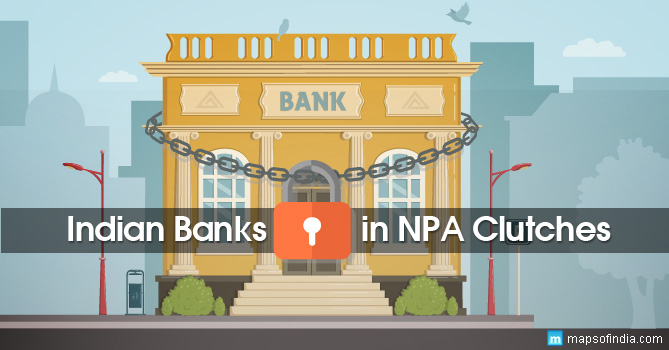
 NPA - Non-performing asset.
Till about 4 or 5 years ago, not many outside the banking and finance industry had a clear understanding of the meaning of NPA. At the very least, it did not feature in the lexicon of the ordinary man. Thanks to Vijay Mallya and the Kingfisher default fiasco, this changed rather quickly. A NPA, in simple terms is a loan that is under jeopardy of default; that is, the borrower has failed to make any payment - repayment of principal and interest payment - for a period of 90 days or more.
Mallya owed his lenders a sum of about INR 7,000 crore, but the total reserve price of his pledged assets (at an auction) did not seem to exceed INR 65 lakhs. By the time the State Bank of India finally decided to declare Mallya and his two companies "wilful defaulters", the NPA nightmare had been already going on for some 4-5 years.
After this incident (or string of incidents) every Indian is now asking the question: “What is my bank’s NPA?” And these are mere depositors. Shareholders have started to sit up and take notice.
Bad Debt Booms
Earlier this year, in February 2016, The Indian Express had filed an RTI query and the revelation that the response by the Reserve Bank of India threw up was a shocking and unnerving one. According to India's central bank, between the years 2013 and 2015, a total amount of INR 1.14 lakh crore had been written off as bad debt or debt that cannot be recovered. This figure comes from 29 state-owned banks and does not include the NPAs of banks that are privately owned.
The RBI's response to the RTI query also revealed that bad debts for Indian banks rose from INR 15,551 crore (as of 31 March, 2012) to INR 52,542 crore (as on 31 March, 2015). This is more than a threefold rise. The top banks that have written off bad debts in 2015 were -
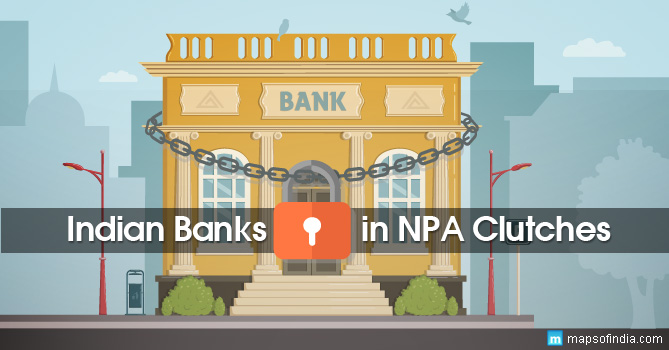
NPA - Non-performing asset.
Till about 4 or 5 years ago, not many outside the banking and finance industry had a clear understanding of the meaning of NPA. At the very least, it did not feature in the lexicon of the ordinary man. Thanks to Vijay Mallya and the Kingfisher default fiasco, this changed rather quickly. A NPA, in simple terms is a loan that is under jeopardy of default; that is, the borrower has failed to make any payment - repayment of principal and interest payment - for a period of 90 days or more.
Mallya owed his lenders a sum of about INR 7,000 crore, but the total reserve price of his pledged assets (at an auction) did not seem to exceed INR 65 lakhs. By the time the State Bank of India finally decided to declare Mallya and his two companies "wilful defaulters", the NPA nightmare had been already going on for some 4-5 years.
After this incident (or string of incidents) every Indian is now asking the question: “What is my bank’s NPA?” And these are mere depositors. Shareholders have started to sit up and take notice.
Bad Debt Booms
Earlier this year, in February 2016, The Indian Express had filed an RTI query and the revelation that the response by the Reserve Bank of India threw up was a shocking and unnerving one. According to India's central bank, between the years 2013 and 2015, a total amount of INR 1.14 lakh crore had been written off as bad debt or debt that cannot be recovered. This figure comes from 29 state-owned banks and does not include the NPAs of banks that are privately owned.
The RBI's response to the RTI query also revealed that bad debts for Indian banks rose from INR 15,551 crore (as of 31 March, 2012) to INR 52,542 crore (as on 31 March, 2015). This is more than a threefold rise. The top banks that have written off bad debts in 2015 were -
- State Bank of India - INR 21,313 crore
- Punjab National Bank - INR 6,587 crore
- Indian Overseas Bank - INR 3,131 crore