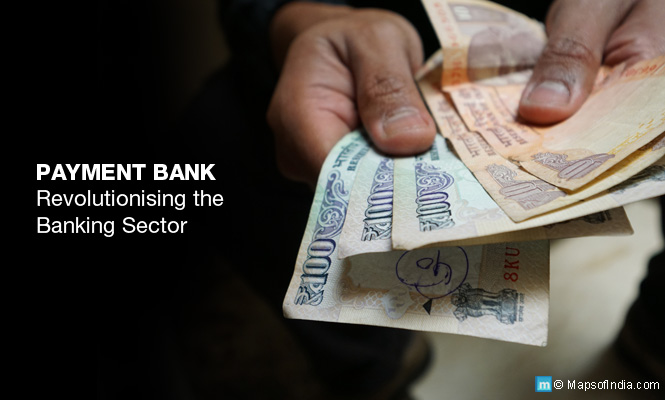
 To widen the reach of the banking services in India and in order to achieve central government’s goal of financial inclusion, the Reserve Bank of India (RBI) has taken a strategic move. The RBI has given an in-principle approval to 11 entities to be set-up as payment banks. These payment banks are aiming to provide basic banking facilities, especially to low-income groups and small businesses. Let us see what this evolution stands for and how will it work for the Indian population and the financial markets.
What are payment banks?
In simple terms, a payment bank is generally a non-full service niche bank in India. It is a distinguished bank that will undertake only limited banking functions which are allowed as per the Banking Regulation Act of 1949. The licenced entities as payment banks could only receive deposits and offer remittances. They cannot undertake lending activities. These banks can offer banking functions such as payments, deposits, remittances, internet banking, and would initially be allowed to take cash deposit of maximum Rs. 1 lakh per individual.
What are the objectives of payment banks?
The main objective of the payment banks is to increase financial inclusion by offering small saving accounts and payment remittance services to low-income households, migrant labour workforce, small businesses and other unorganised sector entities and other similar users. It will also enable high volume-low value transactions in deposit and payment/remittance services in a technology-driven environment.
What they can do and what not?
The payment banks are accessible to certain dos and don’ts. They are:
To widen the reach of the banking services in India and in order to achieve central government’s goal of financial inclusion, the Reserve Bank of India (RBI) has taken a strategic move. The RBI has given an in-principle approval to 11 entities to be set-up as payment banks. These payment banks are aiming to provide basic banking facilities, especially to low-income groups and small businesses. Let us see what this evolution stands for and how will it work for the Indian population and the financial markets.
What are payment banks?
In simple terms, a payment bank is generally a non-full service niche bank in India. It is a distinguished bank that will undertake only limited banking functions which are allowed as per the Banking Regulation Act of 1949. The licenced entities as payment banks could only receive deposits and offer remittances. They cannot undertake lending activities. These banks can offer banking functions such as payments, deposits, remittances, internet banking, and would initially be allowed to take cash deposit of maximum Rs. 1 lakh per individual.
What are the objectives of payment banks?
The main objective of the payment banks is to increase financial inclusion by offering small saving accounts and payment remittance services to low-income households, migrant labour workforce, small businesses and other unorganised sector entities and other similar users. It will also enable high volume-low value transactions in deposit and payment/remittance services in a technology-driven environment.
What they can do and what not?
The payment banks are accessible to certain dos and don’ts. They are:
| Do’s | Don’ts |
|
|
- On 23 September 2013, the RBI formed a Committee on Comprehensive Financial Services for Small Businesses and Low Income Households headed by Nacghiket Mor.
- On 17 July 2014, the RBI issued the draft guidelines for payment banks, inviting suggestions and comments from interested entities and general public.
- On 27 November 2014, final guidelines for payments banks were released by the RBI.
- On 4 February 2015, the RBI released the list of the entities which have applied for the payment banks.
- On 28 February 2015, during the announcement of the Annual Budget, it was declared that India post will run a payment bank through its large network in the country.
- On 19 August 2015, the RBI gave an in-principle approval to 11 entities to set up payment banks.
- Aditya Birla Nuvo Limited
- Airtel M Commerce Services Limited
- Cholamandalam Distribution Services Limited
- Department of Posts
- Fino PayTech Limited
- National Securities Depository Limited
- Reliance Industries limited
- Shri Dilip Shantilal Shanghvi (Sun Pharma promoter)
- Shri Vijay Shekhar Sharma (CEO of One Communications, which runs PayTM)
- Tech Mahindra Limited
- Vodafone m-pesa Limited
- Minimum capital required should be Rs. 100 crore.
- For the first five years, the promoter contribution should be at least 40%.
- Excess shareholding could be brought down to 40% by the end of fifth year, to 30% by the end of tenth year, and to 26% in 12 years since the date of commencement of business.
- Foreign shareholding would be on similar rules for FDI set up for the private banks in India.
- The Banking Regulation, 1949 to regulate the voting rights.
- Other entities except for promoters will not be allowed to have shareholding of more than 10%.
- Any acquisition of more than 5% will need approval from the RBI.
- The majority of bank’s board of directors should include independent directors who will be appointed as per the guidelines of the RBI. It should also have to comply with the ‘fit and proper’ criteria meant for Directors as issued by the RBI.
- The payment bank has to be fully networked and technology driven from the time of its commencement.
- 25% of its branches have to be in the unbanked rural areas.
- They must use the term “payment bank” so as to differentiate it from other type of banks.
- They will be registered as public limited company under the Companies Act, 2013.
- The RBI has strictly said that the banks need to have a high powered ‘Customer Grievance Cell’ to handle customer complaints and concerns.