- Expanding population and concomitant development initiatives at the expense of environmental degradation
- The region's development has been primarily unplanned, and industrial plants that emit dangerous chemicals into the environment are frequently positioned near housing and commercial areas rather than designated regions.
- Increased car traffic (despite the Delhi metro has not decreased) and the resulting increase in noise and air pollution.
- Every day, approximately 8,000 m tonnes of solid garbage are created in Delhi (National Environmental Engineering Research Institute), yet the authorities only manage to collect roughly 5000 - 5500 m tonnes of trash. This contributes to the accumulation of waste.
- There is a firm reliance on fossil fuels, the combustion of which emits many hazardous pollutants into the air.
- Large-scale building operations produce dust pollution, which accounts for approximately 56% of the PM10 and PM2.5 load.
- Delhi's landlocked location also contributes to higher levels of air pollution when compared to other metropolitan areas. North-westerly winds blowing from Pakistan, Afghanistan, and Rajasthan bring dust to the region. The Himalayas restrict the air's escape path. As a result, dust and pollutants collect in the area. Because of low-level inversion, this is particularly noticeable in the winter.
- Stubble combustion also contributed to the region's air pollution. During the winter, large-scale crop burning in Haryana, Rajasthan, Uttar Pradesh, and Punjab creates a heavy fog over the Delhi-NCR region. According to one research, agricultural residue burning produced around 149 million tonnes of CO2, more than 9 million tonnes of CO2, 0.25 million tonnes of SOX, 1.28 million tonnes of particle matter (PM), and 0.07 million metric tonnes of black carbon. As is evident, it contributes significantly to greenhouse gas emissions.
- While not the primary cause of air pollution, fireworks contribute to the problem.
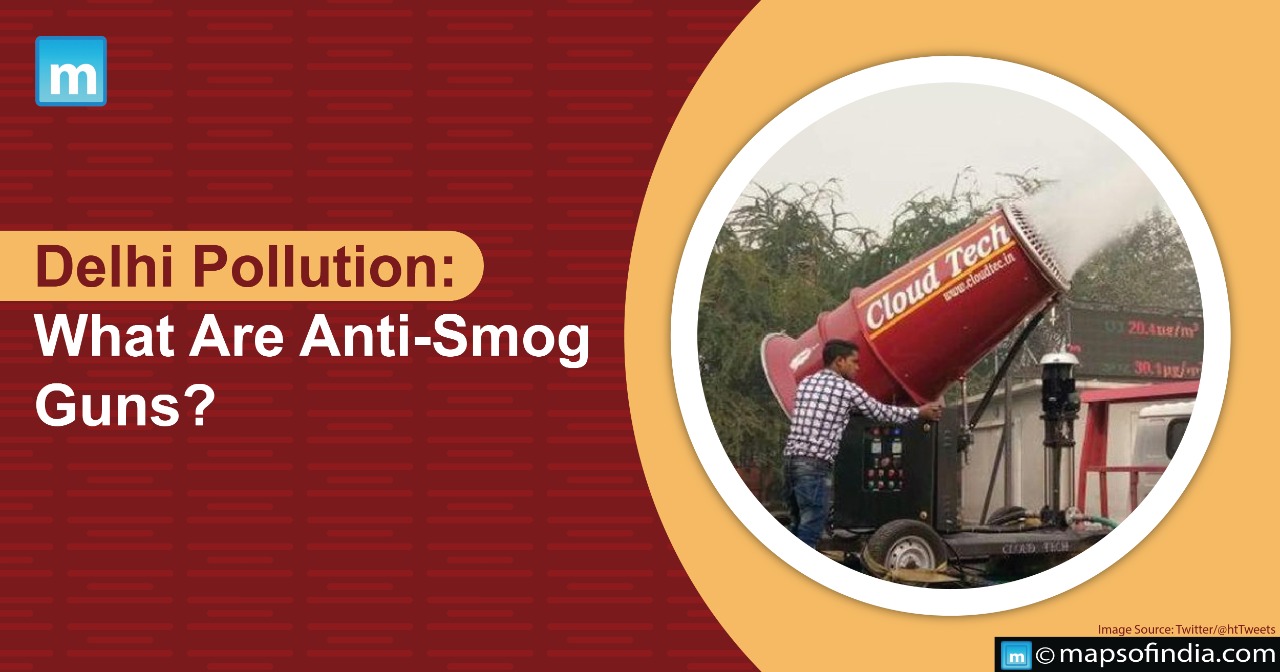
- An anti-smog cannon sprays nebulised water particles into the environment to combat environmental pollution.
- When attached to a water tank and placed on a truck, the gadget may be used to spray water throughout the city to settle dirt and other dissolved materials.
- It can spray water from a height of 50 meters, and the results have been favourable since the spray behaves like rain, settling dust particles and PM 2.5.
- Local pollution emissions
- Pollution transportation from neighbouring states and areas
- Meteorological conditions such as wind velocity and temperature