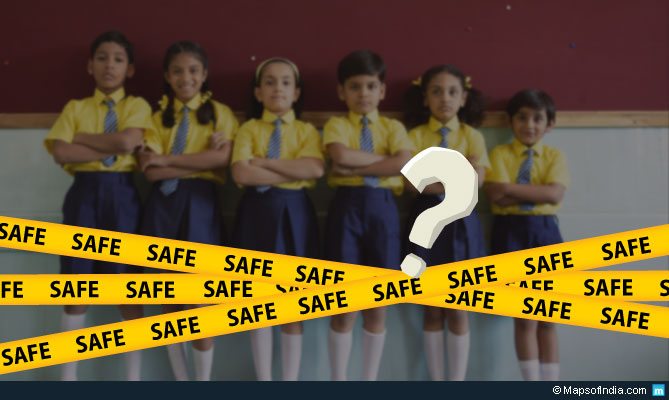
 We send our children to the school to get educated, and till a few decades ago, we did not have to dwell too much on the safety of our children in the schools; we took it for granted, for the school was always synonymous with the word 'safe'. Unfortunately, it is no longer the case.
In 1995, in Mandi Dabwali, many school children perished in a fire at a prize distribution ceremony
In 2001, 971 school children died in the Bhuj earthquake
In 2004, 94 children burned to death in a school in Kumbakonam
In 2013, 24 children died of food poisoning after the mid-day meal in a Bihar school
In 2014, a 6-year old child was raped by two gym instructors.
The list seems to be endless; from natural calamities to the man-made ones, from the negligence of man to the beast like action of man, our children are no longer safe in school. Some of these disasters could have been averted by simple prevention and preparedness. We, as parents, must make certain that we are aware of the norms and regulations that a school must follow, and keep a vigil on their compliance.
The recent terror attack on a school in Pakistan should jolt the parents of school going children in India out of their complacency, and they should become more aware.
Disaster management in schools
Creating a safe environment for the children in school is the most important task, as in the case of any emergency they are the most vulnerable. National Disaster Management Authority, of the Ministry of Home Affairs, strongly feels that there has to be a structural, as well as non-structural intervention, to ensure the safety of the children. Structural intervention would include strict check on the guidelines set up for school buildings, while non-structural would mean educating the staff, teachers, and students about disaster management. The Ministry insists that every school adopt a school safety programme targeting the educational institutions, emergency officials, teachers, students and even the community at large. Under this programme, the students learn about safety measures, thus becoming future disaster managers, while a disaster resilient society is built by way of educating the community. Some of the ways and means of educating the child are:
We send our children to the school to get educated, and till a few decades ago, we did not have to dwell too much on the safety of our children in the schools; we took it for granted, for the school was always synonymous with the word 'safe'. Unfortunately, it is no longer the case.
In 1995, in Mandi Dabwali, many school children perished in a fire at a prize distribution ceremony
In 2001, 971 school children died in the Bhuj earthquake
In 2004, 94 children burned to death in a school in Kumbakonam
In 2013, 24 children died of food poisoning after the mid-day meal in a Bihar school
In 2014, a 6-year old child was raped by two gym instructors.
The list seems to be endless; from natural calamities to the man-made ones, from the negligence of man to the beast like action of man, our children are no longer safe in school. Some of these disasters could have been averted by simple prevention and preparedness. We, as parents, must make certain that we are aware of the norms and regulations that a school must follow, and keep a vigil on their compliance.
The recent terror attack on a school in Pakistan should jolt the parents of school going children in India out of their complacency, and they should become more aware.
Disaster management in schools
Creating a safe environment for the children in school is the most important task, as in the case of any emergency they are the most vulnerable. National Disaster Management Authority, of the Ministry of Home Affairs, strongly feels that there has to be a structural, as well as non-structural intervention, to ensure the safety of the children. Structural intervention would include strict check on the guidelines set up for school buildings, while non-structural would mean educating the staff, teachers, and students about disaster management. The Ministry insists that every school adopt a school safety programme targeting the educational institutions, emergency officials, teachers, students and even the community at large. Under this programme, the students learn about safety measures, thus becoming future disaster managers, while a disaster resilient society is built by way of educating the community. Some of the ways and means of educating the child are:
- Building awareness by way of campaigns, rallies etc
- Conducting mock drills for fire disasters and earthquakes
- First aid training
- A clear picture of command and control, so that in case of an emergency there is no chaos
- Use of the fire extinguisher
- Educate the child; as per the age, teach the child the difference between good touch and bad touch.
- Convince the child, no matter what, our love for them is unconditional
- Open all channels of communication with the child
- Create a buddy system in school, so that the child is always in the company of a friend. Each should know the whereabouts of the other at all times
- Regularly interact with teachers, including physical education and art teacher; make it a point to immediately meet any newly appointed teacher.