Class 12th CBSE Term 1, English Core Board Exam Question Paper and Answers Key 2021-22 Table
- SUBJECT- English Core
- Term- I
- Time allowed- 90 minutes
- Maximum Marks- 40
SECTION -A (Reading)
I. Read the passage given below:
1. What's the one thing that you associate with your college days ? For me, it was consuming copious amounts of chai. A cup of tea was a panacea to all troubles and the companion to all joys. In this exclusive interview, we caught up with 65-year-old Deepak Garg owner of Ganga Dhaba, a spot that every officer from National Academy of Administration has visited multiple times. 2. Deepak begins, "My family has been here for almost 90 years. It was my grandfather who first started working here as the supplier to the hotel that existed then. "In 1964, when Deepak was all of eight, he lost his father and the responsibility of raising four children fell on his mother. 3. "Our growing up years were a huge struggle. My mother used to teach home science at a local Balwadi school, and which was also where my siblings and I studied," he says. In 1978, Deepak says that he started food joint that he named Om Chinese restaurant. "In those days, there was a huge liking for Chinese food and hence the name and the choice of cuisine," he says. 4. For almost 17 years, things continued and then Deepak got a Public Call Office (PCO) installed for the Officer Trainees. The business did so well that soon he had installed more than ten telephones, with separate cabins, to allow them some privacy while they made and received their calls. 5. "The OTs who would talk on the PCO from here would always refer to the place as "Ganga Dhaba'. It was because this place is so close to the Ganga hostel inside the academy, that slowly the name changed and it became Ganga Dhaba. Since it was the OTs that gave us our identity, we decided to change the name and call it Ganga Dhaba," he says. 6. There have been instances when Deepak and his family members have learnt dishes from the OTs. He says, "So many dishes on our menu today are because some officer came in and decided to teach us how to make them." 7. We have seen two generations of officers, served the parents, who now as the parents come back to drop their children at the academy and tell us to take care of them. What more can we ask for? While the money we make is not great, the respect and the love we have accumulated over the years is what keeps us going." says Deepak, proudly, (400 words) Based on your understanding of the passage, answer any eight out of the ten questions by choosing the correct options :1. What, according to the author, gave him solace during his bad times in his college days?
(a) Friends (b) Family (c) Tea (d) TelephoneThe correct answer is: Tea
2. Read the following statements :
(i) Mr. Deepak named his food joint Om Chinese.
(ii) Chinese food was then popular among people.
(a) (ii) is the cause for (i), (b) (i) is the cause for (ii). (c) (i) is true and (ii) is false. (d) (i) is false and (ii) is true.The correct answer is: (ii) is the cause for (i)
3. 'Soon he had installed ten telephones.' In the light of the above statement select the option that lists the right inference.
(a) He was kind enough to do social service for the OTV (b) He was successful and flourishing in his business. (c) He expanded his canteen to accommodate more people. (d) He switched his business from canteen to telephone booths.The correct answer is: He was successful and flourishing in his business.
4. The gesture of changing the name of the food joint to 'Ganga Dhaba' speaks of Deepak's
(a) wavering mind (b) tendency to change with times (c) respect and tribute to OTS (d) dogmatic approachThe correct answer is: respect and tribute to OTS
5. ...... his family members learnt dishes from OTs." Choose the option that lists the inference with reference to the above statement
(a) OTs were equally good connoisseurs of food. (b) his family was mediocre in cooking, (c) his family had close association and good rapport with OTs. (d) his family wanted to learn more recipes to expand their business.The correct answer is: OTs were equally good connoisseurs of food.
6. As per paragraph 7, select the option that sums up the personality of Deepak Garg
(a) He is a struggler, lacks business acumen to make his business profitable. (b) He is a very social and friendly person and enjoys a good relationship with OTs. (c) A responsible son who shared the burden of his family (d) A person who upholds dignity and esteem in life, not materialisticThe correct answer is: He is a very social and friendly person and enjoys a good relationship with OTs.
7. ....OT's that gave us our identity." He means to say
(a) His canteen was in the vicinity of OT's hostel. (b) The canteen was named after the OTs hostel (c) It was Ots who helped his family to learn new recipes. (d) It was OTs who patronized his canteen business.The correct answer is: It was OTs who patronized his canteen business.
8. Choose the option that aptly defines Deepak Garg's life story "from struggling childhood days to becoming a successful businessman",
(a) Where there is a will, there is a way. (b) Make Ray while the Sun shines (c) A good fire make a good cook. (d) Despair gives courage to a coward.The correct answer is: Where there is a will, there is a way.
9. ...... many dishes on our menu today are because some officer came in and decided to teach us." Choose the option that rightly reflects the tone of the speaker.
(a) Ignorance (b) Humility (c) Pride (d) RegretThe correct answer is: Humility
10. ...... tell us to take care of them." Choose the option that lists the appropriate reason behind the statement.
(a) Parents make a request as they stay away from their children. (b) Deepak Garg can take care as he stays close to the hostel (c) Parents trust and respect Deepak Garg's hospitality (d) Parents pay Deepak Garg for the facilities he offers.The correct answer is: Deepak Garg can take care as he stays close to the hostel.
II. Read the passage given below: 1. Air pollution is a major threat to human health. The United Nations Environment Programme has estimated that, globally, 1.1 billion people breathe in unhealthy air. The World Health Organization (WHO) has estimated that urban air pollution is responsible for approximately 800,000 deaths and 4.6 million people lose their lives every year around the globe. 2. Traffic and transportation problems, inadequate drainage facilities, lack of open spaces, carbon emission, and the accumulation of waste aggravate the problem. Air pollution is associated with increased risk of Acute respiratory infections (ARI), the principal cause of infant and child mortality in developing countries. 3. Urban air quality in most mega cities has been found to be critical and Kolkata is no exception to this. An analysis of ambient air quality in Kolkata was done by applying the Exceedance Factor (EF) method, where the presence of listed pollutants' (RPM, SPM, NO, and SO2) annual average concentration are classified into four different categories; namely critical, high, moderate, and low pollution. Out of a total of 17 ambient air quality monitoring stations operating in Kolkata, five fall under the critical category, and the remaining 12 locations fall under the high category of NO2 concentration, while for RPM, four record critical, and 13 come under the high pollution category. The causes of high concentration of pollutants in the form of NO, and RPM have been identified in earlier studies as vehicular emission (51.4%), followed by industrial sources (24.5%) and dust particles (21.1%). 4. Later, a health assessment was undertaken with a structured questionnaire at some nearby dispensaries which fall under areas with different ambient air pollution levels. Three dispensaries have been surveyed with 100 participants. It shows that respondents with respiratory diseases (85.1%) have outnumbered waterborne diseases (14.9%) and include acute respiratory infections. (ARI) (60%), chronic obstructive pulmonary diseases (COPD) (7.8%), upper tract respiratory infection (UTRD) (1.2%), Influenza (12.7%), and acid-fast bacillus (AFB) (3.4%). 5. To live a healthy life and have better well-being, practising pollution averting activities in one's day-to-day activities is needed. These pollution averting practices can only be possible when awareness among the masses is generated that the air they breathe outdoors is not found to be safe. Pollution in India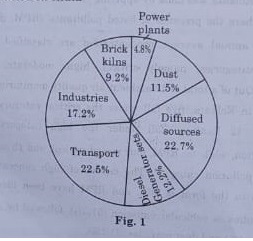 Based on your understanding of the passage, answer any six out of the eight questions by choosing the correct options :