
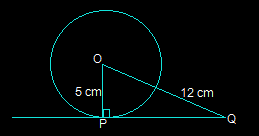
 In the above figure, the line that is drawn from the centre of the given circle to the tangent PQ is perpendicular to PQ.
And so, OP ⊥ PQ
Using Pythagoras theorem in triangle ΔOPQ we get,
OQ2 = OP2+PQ2
(12)2 = 52+PQ2
PQ2 = 144-25
PQ2 = 119
PQ = √119 cm
So, option D i.e. √119 cm is the length of PQ.
In the above figure, the line that is drawn from the centre of the given circle to the tangent PQ is perpendicular to PQ.
And so, OP ⊥ PQ
Using Pythagoras theorem in triangle ΔOPQ we get,
OQ2 = OP2+PQ2
(12)2 = 52+PQ2
PQ2 = 144-25
PQ2 = 119
PQ = √119 cm
So, option D i.e. √119 cm is the length of PQ.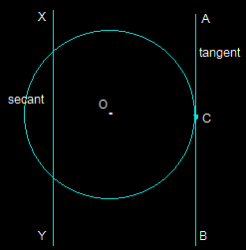 In the above figure, XY and AB are two the parallel lines. The line segment AB is the tangent at point C while the line segment XY is the secant.
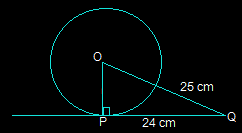 So, OP is perpendicular to PQ i.e. OP ⊥ PQ
From the above figure, it is also seen that △OPQ is a right angled triangle.
It is given that
OQ = 25 cm and PQ = 24 cm
By using Pythagoras theorem in △OPQ,
OQ2 = OP2 +PQ2
(25)2 = OP2+(24)2
OP2 = 625-576
OP2 = 49
OP = 7 cm
So, option A i.e. 7 cm is the radius of the given circle.
So, OP is perpendicular to PQ i.e. OP ⊥ PQ
From the above figure, it is also seen that △OPQ is a right angled triangle.
It is given that
OQ = 25 cm and PQ = 24 cm
By using Pythagoras theorem in △OPQ,
OQ2 = OP2 +PQ2
(25)2 = OP2+(24)2
OP2 = 625-576
OP2 = 49
OP = 7 cm
So, option A i.e. 7 cm is the radius of the given circle.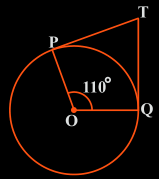 So, OP ⊥ PT and TQ ⊥ OQ
∴∠OPT = ∠OQT = 90°
Now, in the quadrilateral POQT, we know that the sum of the interior angles is 360°
So, ∠PTQ+∠POQ+∠OPT+∠OQT = 360°
Now, by putting the respective values we get,
∠PTQ +90°+110°+90° = 360°
∠PTQ = 70°
So, ∠PTQ is 70° which is option B.
So, OP ⊥ PT and TQ ⊥ OQ
∴∠OPT = ∠OQT = 90°
Now, in the quadrilateral POQT, we know that the sum of the interior angles is 360°
So, ∠PTQ+∠POQ+∠OPT+∠OQT = 360°
Now, by putting the respective values we get,
∠PTQ +90°+110°+90° = 360°
∠PTQ = 70°
So, ∠PTQ is 70° which is option B.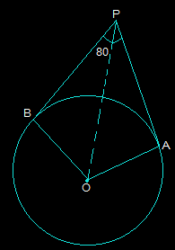 Now, in the above diagram, OA is the radius to tangent PA and OB is the radius to tangent PB.
So, OA is perpendicular to PA and OB is perpendicular to PB i.e. OA ⊥ PA and OB ⊥ PB
So, ∠OBP = ∠OAP = 90°
Now, in the quadrilateral AOBP,
The sum of all the interior angles will be 360°
So, ∠AOB+∠OAP+∠OBP+∠APB = 360°
Putting their values, we get,
∠AOB + 260° = 360°
∠AOB = 100°
Now, consider the triangles △OPB and △OPA. Here,
AP = BP (Since the tangents from a point are always equal)
OA = OB (Which are the radii of the circle)
OP = OP (It is the common side)
Now, we can say that triangles OPB and OPA are similar using SSS congruency.
∴△OPB ≅ △OPA
So, ∠POB = ∠POA
∠AOB = ∠POA+∠POB
2 (∠POA) = ∠AOB
By putting the respective values, we get,
=>∠POA = 100°/2 = 50°
As angle ∠POA is 50° option A is the correct option.
Now, in the above diagram, OA is the radius to tangent PA and OB is the radius to tangent PB.
So, OA is perpendicular to PA and OB is perpendicular to PB i.e. OA ⊥ PA and OB ⊥ PB
So, ∠OBP = ∠OAP = 90°
Now, in the quadrilateral AOBP,
The sum of all the interior angles will be 360°
So, ∠AOB+∠OAP+∠OBP+∠APB = 360°
Putting their values, we get,
∠AOB + 260° = 360°
∠AOB = 100°
Now, consider the triangles △OPB and △OPA. Here,
AP = BP (Since the tangents from a point are always equal)
OA = OB (Which are the radii of the circle)
OP = OP (It is the common side)
Now, we can say that triangles OPB and OPA are similar using SSS congruency.
∴△OPB ≅ △OPA
So, ∠POB = ∠POA
∠AOB = ∠POA+∠POB
2 (∠POA) = ∠AOB
By putting the respective values, we get,
=>∠POA = 100°/2 = 50°
As angle ∠POA is 50° option A is the correct option.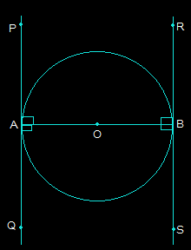 Now, both radii i.e. AO and OB are perpendicular to the tangents.
So, OB is perpendicular to RS and OA perpendicular to PQ
So, ∠OAP = ∠OAQ = ∠OBR = ∠OBS = 90°
From the above figure, angles OBR and OAQ are alternate interior angles.
Also, ∠OBR = ∠OAQ and ∠OBS = ∠OAP (Since they are also alternate interior angles)
So, it can be said that line PQ and the line RS will be parallel to each other. (Hence Proved).
Now, both radii i.e. AO and OB are perpendicular to the tangents.
So, OB is perpendicular to RS and OA perpendicular to PQ
So, ∠OAP = ∠OAQ = ∠OBR = ∠OBS = 90°
From the above figure, angles OBR and OAQ are alternate interior angles.
Also, ∠OBR = ∠OAQ and ∠OBS = ∠OAP (Since they are also alternate interior angles)
So, it can be said that line PQ and the line RS will be parallel to each other. (Hence Proved).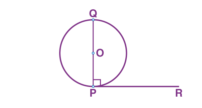 ∠OPR = 90° (radius ⊥ tangent)
Also, ∠QPR = 90° (Given)
∴ ∠OPR = ∠QPR
Now, the above case is possible only when centre O lies on the line QP.
Hence, perpendicular at the point of contact to the tangent to a circle passes through the centre of the circle.
∠OPR = 90° (radius ⊥ tangent)
Also, ∠QPR = 90° (Given)
∴ ∠OPR = ∠QPR
Now, the above case is possible only when centre O lies on the line QP.
Hence, perpendicular at the point of contact to the tangent to a circle passes through the centre of the circle.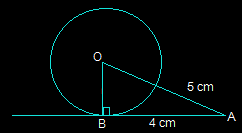 Here, AB is the tangent that is drawn on the circle from a point A.
So, the radius OB will be perpendicular to AB i.e. OB ⊥ AB
We know, OA = 5cm and AB = 4 cm
Now, In △ABO,
OA2 =AB2+BO2 (Using Pythagoras theorem)
52 = 42+BO2
BO2 = 25-16
BO2 = 9
BO = 3
So, the radius of the given circle i.e. BO is 3 cm.
Here, AB is the tangent that is drawn on the circle from a point A.
So, the radius OB will be perpendicular to AB i.e. OB ⊥ AB
We know, OA = 5cm and AB = 4 cm
Now, In △ABO,
OA2 =AB2+BO2 (Using Pythagoras theorem)
52 = 42+BO2
BO2 = 25-16
BO2 = 9
BO = 3
So, the radius of the given circle i.e. BO is 3 cm.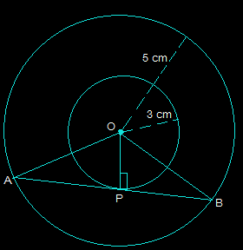 From the above diagram, AB is tangent to the smaller circle to point P.
∴ OP ⊥ AB
Using Pythagoras theorem in triangle OPA,
OA2= AP2+OP2
52 = AP2+32
AP2 = 25-9
AP = 4
Now, as OP ⊥ AB,
Since the perpendicular from the center of the circle bisects the chord, AP will be equal to PB
So, AB = 2AP = 2×4 = 8 cm
So, the length of the chord of the larger circle is 8 cm.
From the above diagram, AB is tangent to the smaller circle to point P.
∴ OP ⊥ AB
Using Pythagoras theorem in triangle OPA,
OA2= AP2+OP2
52 = AP2+32
AP2 = 25-9
AP = 4
Now, as OP ⊥ AB,
Since the perpendicular from the center of the circle bisects the chord, AP will be equal to PB
So, AB = 2AP = 2×4 = 8 cm
So, the length of the chord of the larger circle is 8 cm.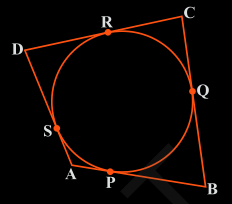 From this figure we can conclude a few points which are:
(i) DR = DS
(ii) BP = BQ
(iii) AP = AS
(iv) CR = CQ
Since they are tangents on the circle from points D, B, A, and C respectively.
Now, adding the LHS and RHS of the above equations we get,
DR+BP+AP+CR = DS+BQ+AS+CQ
By rearranging them we get,
(DR+CR) + (BP+AP) = (CQ+BQ) + (DS+AS)
By simplifying,
AD+BC= CD+AB
From this figure we can conclude a few points which are:
(i) DR = DS
(ii) BP = BQ
(iii) AP = AS
(iv) CR = CQ
Since they are tangents on the circle from points D, B, A, and C respectively.
Now, adding the LHS and RHS of the above equations we get,
DR+BP+AP+CR = DS+BQ+AS+CQ
By rearranging them we get,
(DR+CR) + (BP+AP) = (CQ+BQ) + (DS+AS)
By simplifying,
AD+BC= CD+AB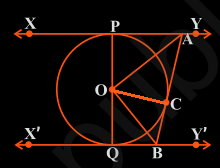 Now the triangles △OPA and △OCA are similar using SSS congruency as:
(i) OP = OC They are the radii of the same circle
(ii) AO = AO It is the common side
(iii) AP = AC These are the tangents from point A
So, △OPA ≅ △OCA
Similarly,
△OQB ≅ △OCB
So,
∠POA = ∠COA … (Equation i)
And, ∠QOB = ∠COB … (Equation ii)
Since the line POQ is a straight line, it can be considered as a diameter of the circle.
So, ∠POA +∠COA +∠COB +∠QOB = 180°
Now, from equations (i) and equation (ii) we get,
2∠COA+2∠COB = 180°
∠COA+∠COB = 90°
∴∠AOB = 90°
Now the triangles △OPA and △OCA are similar using SSS congruency as:
(i) OP = OC They are the radii of the same circle
(ii) AO = AO It is the common side
(iii) AP = AC These are the tangents from point A
So, △OPA ≅ △OCA
Similarly,
△OQB ≅ △OCB
So,
∠POA = ∠COA … (Equation i)
And, ∠QOB = ∠COB … (Equation ii)
Since the line POQ is a straight line, it can be considered as a diameter of the circle.
So, ∠POA +∠COA +∠COB +∠QOB = 180°
Now, from equations (i) and equation (ii) we get,
2∠COA+2∠COB = 180°
∠COA+∠COB = 90°
∴∠AOB = 90°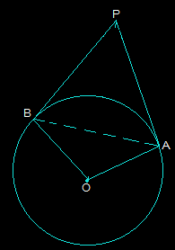 From the above diagram, it is seen that the line segments OA and PA are perpendicular.
So, ∠OAP = 90°
In a similar way, the line segments OB ⊥ PB and so, ∠OBP = 90°
Now, in the quadrilateral OAPB,
∴∠APB+∠OAP +∠PBO +∠BOA = 360° (since the sum of all interior angles will be 360°)
By putting the values we get,
∠APB + 180° + ∠BOA = 360°
So, ∠APB + ∠BOA = 180° (Hence proved).
From the above diagram, it is seen that the line segments OA and PA are perpendicular.
So, ∠OAP = 90°
In a similar way, the line segments OB ⊥ PB and so, ∠OBP = 90°
Now, in the quadrilateral OAPB,
∴∠APB+∠OAP +∠PBO +∠BOA = 360° (since the sum of all interior angles will be 360°)
By putting the values we get,
∠APB + 180° + ∠BOA = 360°
So, ∠APB + ∠BOA = 180° (Hence proved).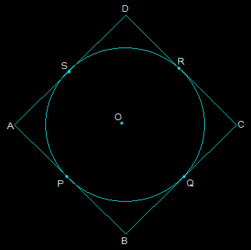 From the above figure, it is seen that,
(i) DR = DS
(ii) BP = BQ
(iii) CR = CQ
(iv) AP = AS
These are the tangents to the circle at D, B, C, and A respectively.
Adding all these we get,
DR+BP+CR+AP = DS+BQ+CQ+AS
By rearranging them we get,
(BP+AP)+(DR+CR) = (CQ+BQ)+(DS+AS)
Again by rearranging them we get,
AB+CD = BC+AD
Now, since AB = CD and BC = AD, the above equation becomes
2AB = 2BC
∴ AB = BC
Since AB = BC = CD = DA, it can be said that ABCD is a rhombus.
From the above figure, it is seen that,
(i) DR = DS
(ii) BP = BQ
(iii) CR = CQ
(iv) AP = AS
These are the tangents to the circle at D, B, C, and A respectively.
Adding all these we get,
DR+BP+CR+AP = DS+BQ+CQ+AS
By rearranging them we get,
(BP+AP)+(DR+CR) = (CQ+BQ)+(DS+AS)
Again by rearranging them we get,
AB+CD = BC+AD
Now, since AB = CD and BC = AD, the above equation becomes
2AB = 2BC
∴ AB = BC
Since AB = BC = CD = DA, it can be said that ABCD is a rhombus.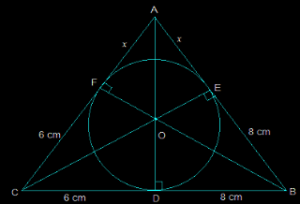 Consider the triangle ABC,
We know that the length of any two tangents which are drawn from the same point to the circle is equal.
So,
(i) CF = CD = 6 cm
(ii) BE = BD = 8 cm
(iii) AE = AF = x
Now, it can be observed that,
(i) AB = EB+AE = 8+x
(ii) CA = CF+FA = 6+x
(iii) BC = DC+BD = 6+8 = 14
Now the semi perimeter “s” will be calculated as follows
2s = AB+CA+BC
By putting the respective values we get,
2s = 28+2x
s = 14+x
Consider the triangle ABC,
We know that the length of any two tangents which are drawn from the same point to the circle is equal.
So,
(i) CF = CD = 6 cm
(ii) BE = BD = 8 cm
(iii) AE = AF = x
Now, it can be observed that,
(i) AB = EB+AE = 8+x
(ii) CA = CF+FA = 6+x
(iii) BC = DC+BD = 6+8 = 14
Now the semi perimeter “s” will be calculated as follows
2s = AB+CA+BC
By putting the respective values we get,
2s = 28+2x
s = 14+x By solving this we get,
= √(14+x)48x ……… (i)
Again, the area of △ABC = 2 × area of (△AOF + △COD + △DOB)
= 2×[(½×OF×AF)+(½×CD×OD)+(½×DB×OD)]
= 2×½(4x+24+32) = 56+4x …………..(ii)
Now from (i) and (ii) we get,
√(14+x)48x = 56+4x
Now, square both the sides,
48x(14+x) = (56+4x)2
48x = [4(14+x)]2/(14+x)
48x = 16(14+x)
48x = 224+16x
32x = 224
x = 7 cm
So, AB = 8+x
i.e. AB = 15 cm
And, CA = x+6 =13 cm.
By solving this we get,
= √(14+x)48x ……… (i)
Again, the area of △ABC = 2 × area of (△AOF + △COD + △DOB)
= 2×[(½×OF×AF)+(½×CD×OD)+(½×DB×OD)]
= 2×½(4x+24+32) = 56+4x …………..(ii)
Now from (i) and (ii) we get,
√(14+x)48x = 56+4x
Now, square both the sides,
48x(14+x) = (56+4x)2
48x = [4(14+x)]2/(14+x)
48x = 16(14+x)
48x = 224+16x
32x = 224
x = 7 cm
So, AB = 8+x
i.e. AB = 15 cm
And, CA = x+6 =13 cm.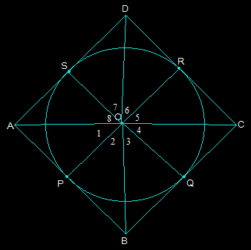 Now, consider the triangles OAP and OAS,
AP = AS (They are the tangents from the same point A)
OA = OA (It is the common side)
OP = OS (They are the radii of the circle)
So, by SSS congruency △OAP ≅ △OAS
So, ∠POA = ∠AOS
Which implies that∠1 = ∠8
Similarly, other angles will be,
∠4 = ∠5
∠2 = ∠3
∠6 = ∠7
Now by adding these angles we get,
∠1+∠2+∠3 +∠4 +∠5+∠6+∠7+∠8 = 360°
Now by rearranging,
(∠1+∠8)+(∠2+∠3)+(∠4+∠5)+(∠6+∠7) = 360°
2∠1+2∠2+2∠5+2∠6 = 360°
Taking 2 as common and solving we get,
(∠1+∠2)+(∠5+∠6) = 180°
Thus, ∠AOB+∠COD = 180°
Similarly, it can be proved that ∠BOC+∠DOA = 180°
Therefore, the opposite sides of any quadrilateral which is circumscribing a given circle will subtend supplementary angles at the center of the circle.
Now, consider the triangles OAP and OAS,
AP = AS (They are the tangents from the same point A)
OA = OA (It is the common side)
OP = OS (They are the radii of the circle)
So, by SSS congruency △OAP ≅ △OAS
So, ∠POA = ∠AOS
Which implies that∠1 = ∠8
Similarly, other angles will be,
∠4 = ∠5
∠2 = ∠3
∠6 = ∠7
Now by adding these angles we get,
∠1+∠2+∠3 +∠4 +∠5+∠6+∠7+∠8 = 360°
Now by rearranging,
(∠1+∠8)+(∠2+∠3)+(∠4+∠5)+(∠6+∠7) = 360°
2∠1+2∠2+2∠5+2∠6 = 360°
Taking 2 as common and solving we get,
(∠1+∠2)+(∠5+∠6) = 180°
Thus, ∠AOB+∠COD = 180°
Similarly, it can be proved that ∠BOC+∠DOA = 180°
Therefore, the opposite sides of any quadrilateral which is circumscribing a given circle will subtend supplementary angles at the center of the circle.