1. Differentiate between (a) Respiration and Combustion (b) Glycolysis and Krebs’ cycle (c) Aerobic respiration and Fermentation
Solution: a)Respiration and Combustion Respiration Combustion It is a biochemical process It is a physicochemical process. Temperature stays low Temperature drastically raises Occurs in living cells It is a non-cellular process Energy entrapped in the form of ATP ATP is not required for the combustion process b) Glycolysis and Krebs’ cycle Glycolysis Krebs Cycle The first step in respiration The second step in respiration Takes place in cytoplasm Takes place in mitochondria Occurs both aerobically and anaerobically Occurs only in aerobic Two ATPs are consumed ATPs are not consumed The net gain is 8 ATP’s The net gain is 24 ATP’s It is a linear pathway It is a circular pathway c) Aerobic respiration and Fermentation Aerobic respiration Fermentation Included in the exchange of gases Does not include exchange of gases Oxygen is necessary for aerobic respiration Oxygen should be absent for the fermentation process Respiratory material is completely oxidised Respiratory material is incompletely oxidised The end products are inorganic At least one product is organic
2. What are respiratory substrates? Name the most common respiratory substrate.
Solution: Organic substrates that are oxidised during respiration to liberate energy inside the living cells are respiratory substrates. Carbohydrates, proteins, fats and organic acids are the most common respiratory substrate.
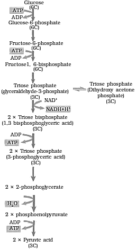
3. Give the schematic representation of glycolysis?
Solution: Schematic representation of glycolysis is as follows:
4. What are the main steps in aerobic respiration? Where does it take place?
Solution: Main steps in aerobic respiration are as follows Glycolysis: Occurs in the cytoplasm(cytosol) where glucose is broken down to pyruvic acid. Oxidative decarboxylation of pyruvic acid to acetyl coenzyme-A: Takes place inside the mitochondrial matrix. TCA or Krebs cycle takes place in Mitochondrial matrix where pyruvic acid is oxidized to transform the energy contained in these molecules into ATP. Electron transport chain occurs in mitochondrial membrane involves ATP synthase complex.
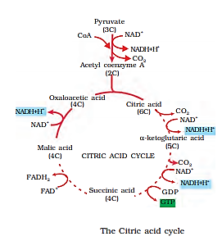
5. Give the schematic representation of an overall view of Krebs’ cycle.
Solution: The schematic representation of an overall view of Krebs’ cycle is as follows:
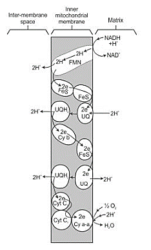
6. Explain ETS.
Solution: