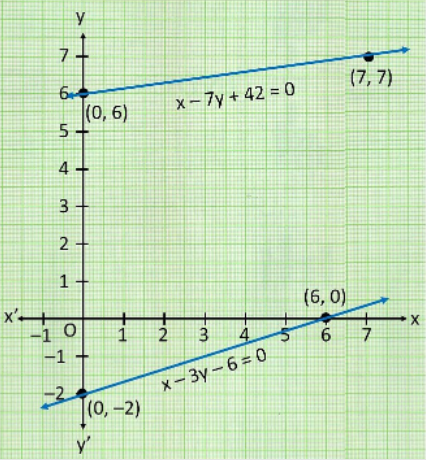
 For, x−3y = 6 or x = 6+3y
The solution table is
For, x−3y = 6 or x = 6+3y
The solution table is The graphical representation is:
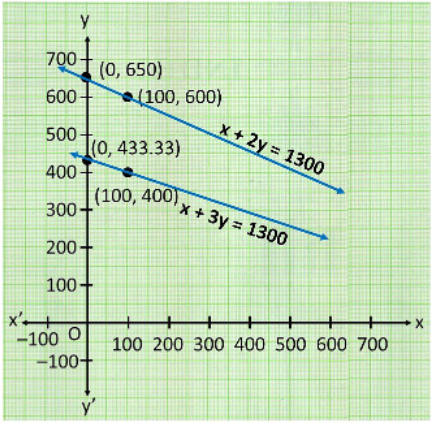
 2. The coach of a cricket team buys 3 bats and 6 balls for Rs.3900. Later, she buys another bat and 3 more balls of the same kind for Rs.1300. Represent this situation algebraically and geometrically.
 For, x+3y = 1300
Or x = 1300-3y
The solution table is
For, x+3y = 1300
Or x = 1300-3y
The solution table is The graphical representation is as follows.
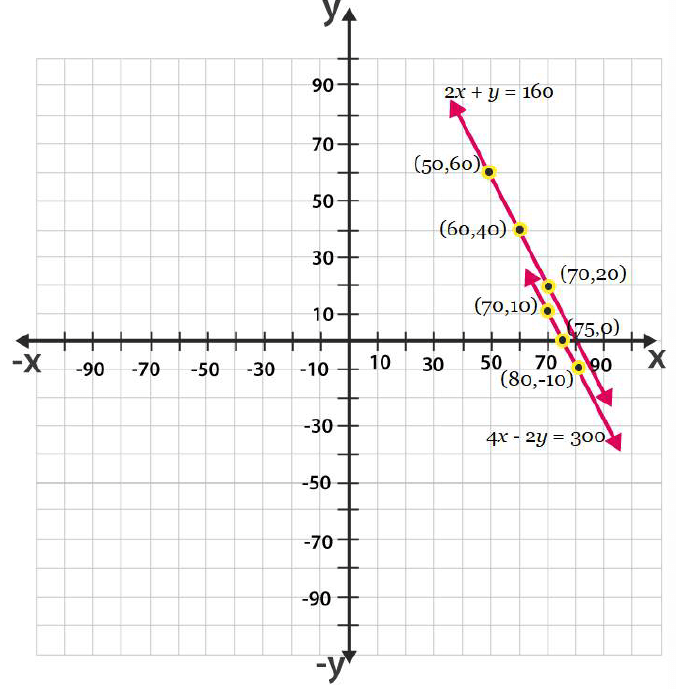
 3. The cost of 2 kg of apples and 1kg of grapes on a day was found to be Rs.160. After a month, the cost of 4 kg of apples and 2 kg of grapes is Rs.300. Represent the situation algebraically and geometrically.
 For 4x+2y = 300 or y = (300-4x)/2, the solution table is;
 The graphical representation is as follows;
 Exercise 3.2
 For x – y = 4 or x = 4 + y, the solutions are;
 The graphical representation is as follows;
 From the graph, it can be seen that the given lines cross each other at point (7, 3). Therefore, there are 7 girls and 3 boys in the class.
(ii) Let 1 pencil costs Rs.x and 1 pen costs Rs.y.
According to the question, the algebraic expression cab be represented as;
5x + 7y = 50
7x + 5y = 46
For, 5x + 7y = 50 or x = (50-7y)/5, the solutions are;
From the graph, it can be seen that the given lines cross each other at point (7, 3). Therefore, there are 7 girls and 3 boys in the class.
(ii) Let 1 pencil costs Rs.x and 1 pen costs Rs.y.
According to the question, the algebraic expression cab be represented as;
5x + 7y = 50
7x + 5y = 46
For, 5x + 7y = 50 or x = (50-7y)/5, the solutions are; For 7x + 5y = 46 or x = (46-5y)/7, the solutions are;
 Hence, the graphical representation is as follows;
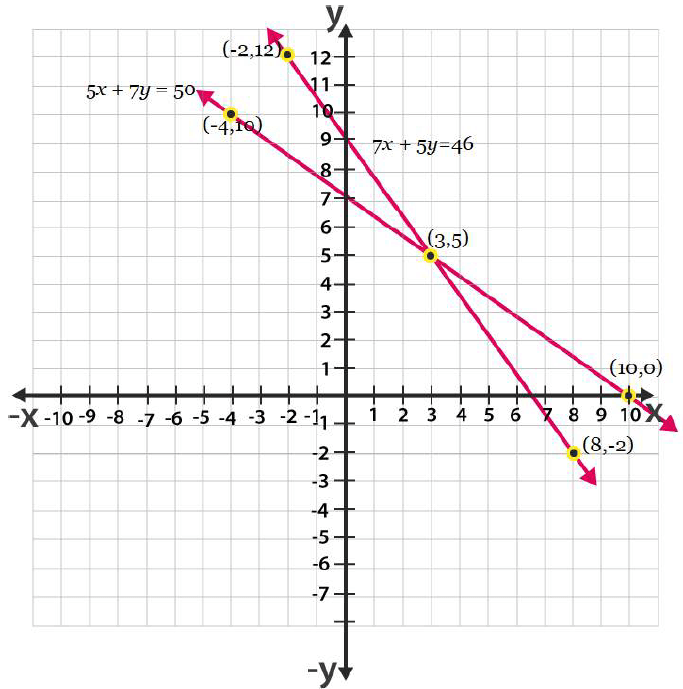 From the graph, it is can be seen that the given lines cross each other at point (3, 5).
So, the cost of a pencil is 3/- and cost of a pen is 5/-.
From the graph, it is can be seen that the given lines cross each other at point (3, 5).
So, the cost of a pencil is 3/- and cost of a pen is 5/-. For 2x + 2y = 10 or x = (10-2y)/2
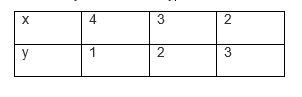 So, the equations are represented in graphs as follows:
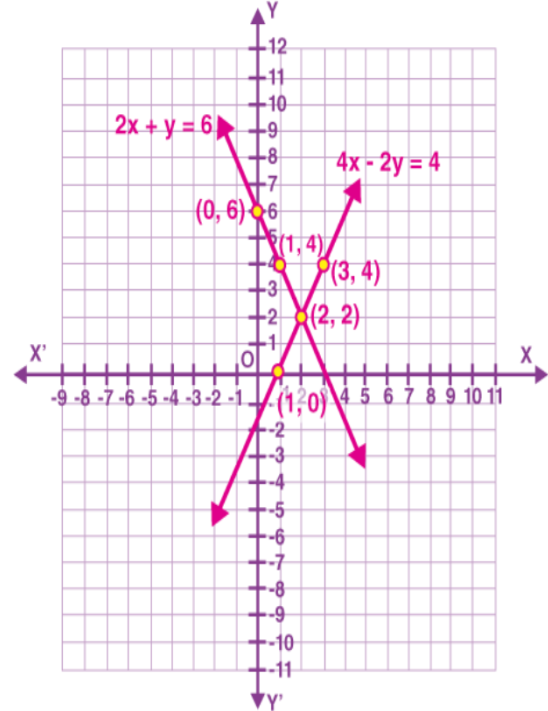 From the graph, it can be seen that these lines are intersecting each other at only one point,(2,2).
(iv) Given, 2x – 2y – 2 = 0 and 4x – 4y – 5 = 0
(a1/a2) = 2/4 = ½
(b1/b2) = -2/-4 = 1/2
(c1/c2) = 2/5
Since, a1/a2 = b1/b2 ≠ c1/c2
Thus, these linear equations have parallel and have no possible solutions. Hence, the pair of linear equations are inconsistent.
From the graph, it can be seen that these lines are intersecting each other at only one point,(2,2).
(iv) Given, 2x – 2y – 2 = 0 and 4x – 4y – 5 = 0
(a1/a2) = 2/4 = ½
(b1/b2) = -2/-4 = 1/2
(c1/c2) = 2/5
Since, a1/a2 = b1/b2 ≠ c1/c2
Thus, these linear equations have parallel and have no possible solutions. Hence, the pair of linear equations are inconsistent.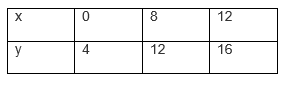 For y + x = 36, y = 36 – x
 The graphical representation of both the equation is as follows;
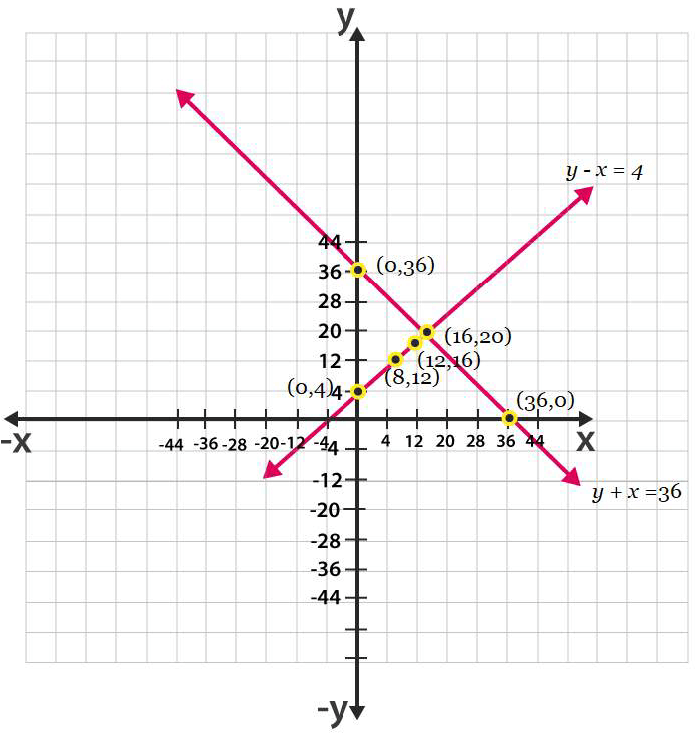 From the graph you can see, the lines intersects each other at a point(16, 20). Hence, the width of the garden is 16 and length is 20.
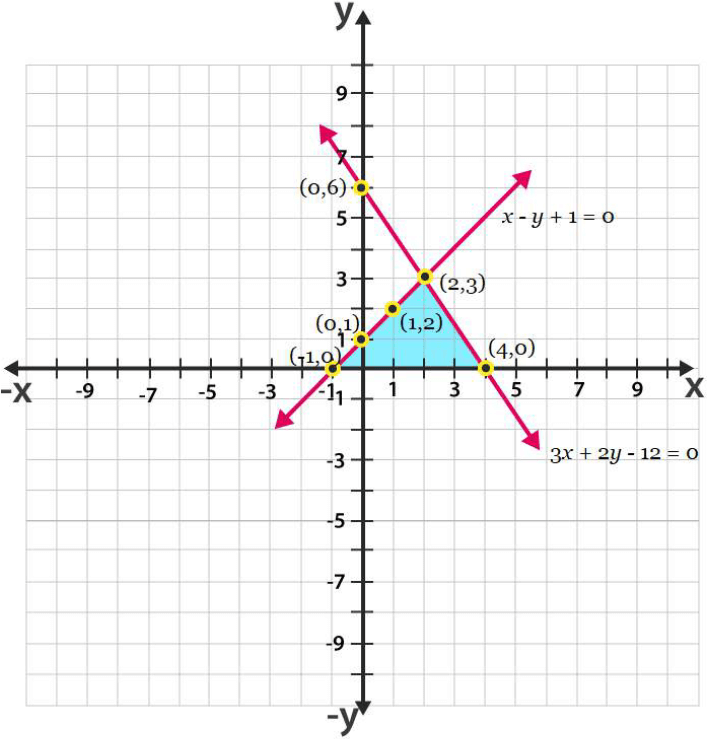
 For, 3x + 2y – 12 = 0 or x = (12-2y)/3
 Hence, the graphical representation of these equations is as follows;
 Exercise 3.3
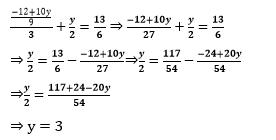 Now, substitute the value of y in equation (1), we get,
(3x/2) – 5(3)/3 = -2
⇒ (3x/2) – 5 = -2
⇒ x = 2
Therefore, x = 2 and y = 3.
Now, substitute the value of y in equation (1), we get,
(3x/2) – 5(3)/3 = -2
⇒ (3x/2) – 5 = -2
⇒ x = 2
Therefore, x = 2 and y = 3. Also given,3x – y = 3
y = 3x – 3
Also given,3x – y = 3
y = 3x – 3 The graphical representation o f these lines will be as follows:
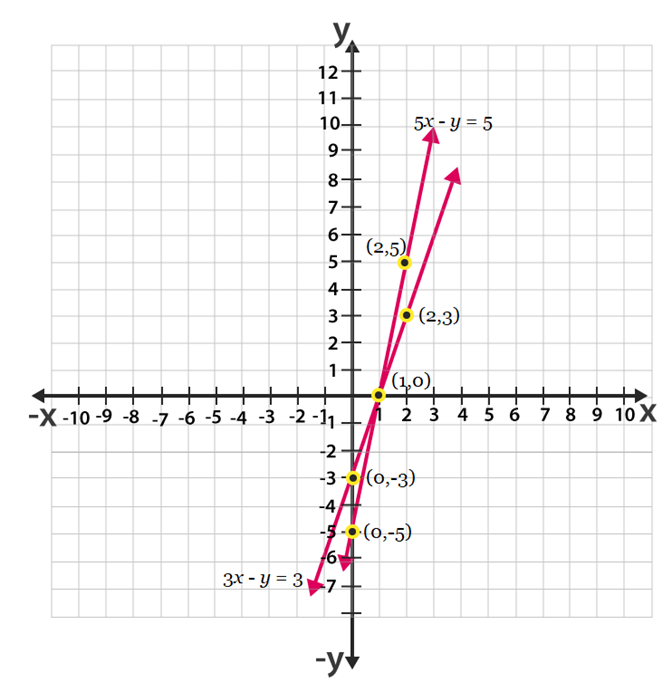 From the above graph we can see that the triangle formed is ∆ABC by the lines and the y axis. Also the coordinates of the vertices are A(1,0) , C(0,-5) and B(0,-3).
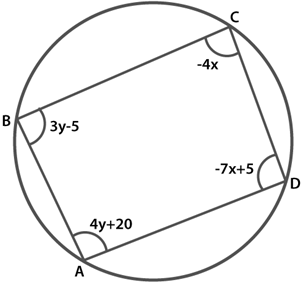 Solution:
It is known that the sum of the opposite angles of a cyclic quadrilateral is 180o
Thus, we have
∠C +∠A = 180
4y + 20− 4x = 180
− 4x + 4y = 160
x − y = − 40 ……………(1)
And, ∠B + ∠D = 180
3y − 5 − 7x + 5 = 180
− 7x + 3y = 180 ………..(2)
Multiplying 3 to equation (1), we get
3x − 3y = − 120 ………(3)
Adding equation (2) to equation (3), we get
− 7x + 3x = 180 – 120
− 4x = 60
x = −15
Substituting this value in equation (i), we get
x − y = − 40
-y−15 = − 40
y = 40-15
= 25
∠A = 4y + 20 = 20+4(25) = 120°
∠B = 3y − 5 = − 5+3(25) = 70°
∠C = − 4x = − 4(− 15) = 60°
∠D = 5-7x
∠D= 5− 7(−15) = 110°
Hence, all the angles are measured.
Solution:
It is known that the sum of the opposite angles of a cyclic quadrilateral is 180o
Thus, we have
∠C +∠A = 180
4y + 20− 4x = 180
− 4x + 4y = 160
x − y = − 40 ……………(1)
And, ∠B + ∠D = 180
3y − 5 − 7x + 5 = 180
− 7x + 3y = 180 ………..(2)
Multiplying 3 to equation (1), we get
3x − 3y = − 120 ………(3)
Adding equation (2) to equation (3), we get
− 7x + 3x = 180 – 120
− 4x = 60
x = −15
Substituting this value in equation (i), we get
x − y = − 40
-y−15 = − 40
y = 40-15
= 25
∠A = 4y + 20 = 20+4(25) = 120°
∠B = 3y − 5 = − 5+3(25) = 70°
∠C = − 4x = − 4(− 15) = 60°
∠D = 5-7x
∠D= 5− 7(−15) = 110°
Hence, all the angles are measured.