
Exercise 5.1
1. In which of the following situations, does the list of numbers involved make as arithmetic progression and why? (i) The taxi fare after each km when the fare is Rs 15 for the first km and Rs 8 for each additional km.
Solution: We can write the given condition as; Taxi fare for 1 km = 15 Taxi fare for first 2 kms = 15+8 = 23 Taxi fare for first 3 kms = 23+8 = 31 Taxi fare for first 4 kms = 31+8 = 39 And so on…… Thus, 15, 23, 31, 39 … forms an A.P. because every next term is 8 more than the preceding term.
(ii) The amount of air present in a cylinder when a vacuum pump removes 1/4 of the air remaining in the cylinder at a time.
Solution: Let the volume of air in a cylinder, initially, be V litres. In each stroke, the vacuum pump removes 1/4th of air remaining in the cylinder at a time. Or we can say, after every stroke, 1-1/4 = 3/4th part of air will remain. Therefore, volumes will be V, 3V/4 , (3V/4)2 , (3V/4)3…and so on Clearly, we can see here, the adjacent terms of this series do not have the common difference between them. Therefore, this series is not an A.P.
(iii) The cost of digging a well after every metre of digging, when it costs Rs 150 for the first metre and rises by Rs 50 for each subsequent metre.
Solution: We can write the given condition as; Cost of digging a well for first metre = Rs.150 Cost of digging a well for first 2 metres = Rs.150+50 = Rs.200 Cost of digging a well for first 3 metres = Rs.200+50 = Rs.250 Cost of digging a well for first 4 metres =Rs.250+50 = Rs.300 And so on.. Clearly, 150, 200, 250, 300 … forms an A.P. with a common difference of 50 between each term.
(iv) The amount of money in the account every year, when Rs 10000 is deposited at compound interest at 8% per annum.
Solution: We know that if Rs. P is deposited at r% compound interest per annum for n years, the amount of money will be: P(1+r/100)n Therefore, after each year, the amount of money will be; 10000(1+8/100), 10000(1+8/100)2, 10000(1+8/100)3…… Clearly, the terms of this series do not have the common difference between them. Therefore, this is not an A.P.
2. Write first four terms of the A.P. when the first term a and the common difference are given as follows: (i) a = 10, d = 10 (ii) a = -2, d = 0 (iii) a = 4, d = – 3 (iv) a = -1 d = 1/2 (v) a = – 1.25, d = – 0.25
Solutions: (i) a = 10, d = 10 Let us consider, the Arithmetic Progression series be a1, a2, a3, a4, a5 … a1 = a = 10 a2 = a1+d = 10+10 = 20 a3 = a2+d = 20+10 = 30 a4 = a3+d = 30+10 = 40 a5 = a4+d = 40+10 = 50 And so on… Therefore, the A.P. series will be 10, 20, 30, 40, 50 … And First four terms of this A.P. will be 10, 20, 30, and 40.
(ii) a = – 2, d = 0 Let us consider, the Arithmetic Progression series be a1, a2, a3, a4, a5 … a1 = a = -2 a2 = a1+d = – 2+0 = – 2 a3 = a2+d = – 2+0 = – 2 a4 = a3+d = – 2+0 = – 2 Therefore, the A.P. series will be – 2, – 2, – 2, – 2 … And, First four terms of this A.P. will be – 2, – 2, – 2 and – 2.
(iii) a = 4, d = – 3 Let us consider, the Arithmetic Progression series be a1, a2, a3, a4, a5 … a1 = a = 4 a2 = a1+d = 4-3 = 1 a3 = a2+d = 1-3 = – 2 a4 = a3+d = -2-3 = – 5 Therefore, the A.P. series will be 4, 1, – 2 – 5 … And, first four terms of this A.P. will be 4, 1, – 2 and – 5.
(iv) a = – 1, d = 1/2 Let us consider, the Arithmetic Progression series be a1, a2, a3, a4, a5 … a2 = a1+d = -1+1/2 = -1/2 a3 = a2+d = -1/2+1/2 = 0 a4 = a3+d = 0+1/2 = 1/2 Thus, the A.P. series will be-1, -1/2, 0, 1/2 And First four terms of this A.P. will be -1, -1/2, 0 and 1/2.
(v) a = – 1.25, d = – 0.25 Let us consider, the Arithmetic Progression series be a1, a2, a3, a4, a5 … a1 = a = – 1.25 a2 = a1 + d = – 1.25-0.25 = – 1.50 a3 = a2 + d = – 1.50-0.25 = – 1.75 a4 = a3 + d = – 1.75-0.25 = – 2.00 Therefore, the A.P series will be 1.25, – 1.50, – 1.75, – 2.00 …….. And first four terms of this A.P. will be – 1.25, – 1.50, – 1.75 and – 2.00.
3. For the following A.P.s, write the first term and the common difference. (i) 3, 1, – 1, – 3 … (ii) -5, – 1, 3, 7 … (iii) 1/3, 5/3, 9/3, 13/3 …. (iv) 0.6, 1.7, 2.8, 3.9 …
Solutions (i) Given series, 3, 1, – 1, – 3 … First term, a = 3 Common difference, d = Second term – First term ⇒ 1 – 3 = -2 ⇒ d = -2
(ii) Given series, – 5, – 1, 3, 7 … First term, a = -5 Common difference, d = Second term – First term ⇒ ( – 1)-( – 5) = – 1+5 = 4
(iii) Given series, 1/3, 5/3, 9/3, 13/3 …. First term, a = 1/3 Common difference, d = Second term – First term ⇒ 5/3 – 1/3 = 4/3
(iv) Given series, 0.6, 1.7, 2.8, 3.9 … First term, a = 0.6 Common difference, d = Second term – First term ⇒ 1.7 – 0.6 ⇒ 1.1
4. Which of the following are APs? If they form an A.P. find the common difference d and write three more terms. (i) 2, 4, 8, 16 … (ii) 2, 5/2, 3, 7/2 …. (iii) -1.2, -3.2, -5.2, -7.2 … (iv) -10, – 6, – 2, 2 … (v) 3, 3 + √2, 3 + 2√2, 3 + 3√2 (vi) 0.2, 0.22, 0.222, 0.2222 …. (vii) 0, – 4, – 8, – 12 … (viii) -1/2, -1/2, -1/2, -1/2 …. (ix) 1, 3, 9, 27 … (x) a, 2a, 3a, 4a … (xi) a, a2, a3, a4 … (xii) √2, √8, √18, √32 … (xiii) √3, √6, √9, √12 … (xiv) 12, 32, 52, 72 … (xv) 12, 52, 72, 73 …
Solution (i) Given to us, 2, 4, 8, 16 … Here, the common difference is; a2 – a1 = 4 – 2 = 2 a3 – a2 = 8 – 4 = 4 a4 – a3 = 16 – 8 = 8 Since, an+1 – an or the common difference is not the same every time. Therefore, the given series are not forming an A.P.
(ii) Given, 2, 5/2, 3, 7/2 …. Here, a2 – a1 = 5/2-2 = 1/2 a3 – a2 = 3-5/2 = 1/2 a4 – a3 = 7/2-3 = 1/2 Since, an+1 – an or the common difference is same every time. Therefore, d = 1/2 and the given series are in A.P. The next three terms are; a5 = 7/2+1/2 = 4 a6 = 4 +1/2 = 9/2 a7 = 9/2 +1/2 = 5
(iii) Given, -1.2, – 3.2, -5.2, -7.2 … Here, a2 – a1 = (-3.2)-(-1.2) = -2 a3 – a2 = (-5.2)-(-3.2) = -2 a4 – a3 = (-7.2)-(-5.2) = -2 Since, an+1 – an or common difference is same every time. Therefore, d = -2 and the given series are in A.P. Hence, next three terms are; a5 = – 7.2-2 = -9.2 a6 = – 9.2-2 = – 11.2 a7 = – 11.2-2 = – 13.2
(iv) Given, -10, – 6, – 2, 2 …
Here, the terms and their difference are; a2 – a1 = (-6)-(-10) = 4 a3 – a2 = (-2)-(-6) = 4 a4 – a3 = (2 -(-2) = 4 Since, an+1 – an or the common difference is same every time. Therefore, d = 4 and the given numbers are in A.P. Hence, next three terms are; a5 = 2+4 = 6 a6 = 6+4 = 10 a7 = 10+4 = 14
(v) Given, 3, 3+√2, 3+2√2, 3+3√2
Here, a2 – a1 = 3+√2-3 = √2 a3 – a2 = (3+2√2)-(3+√2) = √2 a4 – a3 = (3+3√2) – (3+2√2) = √2 Since, an+1 – an or the common difference is same every time. Therefore, d = √2 and the given series forms a A.P. Hence, next three terms are; a5 = (3+√2) +√2 = 3+4√2 a6 = (3+4√2)+√2 = 3+5√2 a7 = (3+5√2)+√2 = 3+6√2 (vi) 0.2, 0.22, 0.222, 0.2222 ….
Here, a2 – a1 = 0.22-0.2 = 0.02 a3 – a2 = 0.222-0.22 = 0.002 a4 – a3 = 0.2222-0.222 = 0.0002 Since, an+1 – an or the common difference is not same every time. Therefore, and the given series doesn’t forms a A.P.
(vii) 0, -4, -8, -12 …
Here, a2 – a1 = (-4)-0 = -4 a3 – a2 = (-8)-(-4) = -4 a4 – a3 = (-12)-(-8) = -4 Since, an+1 – an or the common difference is same every time. Therefore, d = -4 and the given series forms a A.P. Hence, next three terms are; a5 = -12-4 = -16 a6 = -16-4 = -20 a7 = -20-4 = -24
(viii) -1/2, -1/2, -1/2, -1/2 ….
Here, a2 – a1 = (-1/2) – (-1/2) = 0 a3 – a2 = (-1/2) – (-1/2) = 0 a4 – a3 = (-1/2) – (-1/2) = 0 Since, an+1 – an or the common difference is same every time. Therefore, d = 0 and the given series forms a A.P. Hence, next three terms are; a5 = (-1/2)-0 = -1/2 a6 = (-1/2)-0 = -1/2 a7 = (-1/2)-0 = -1/2
(ix) 1, 3, 9, 27 …
Here, a2 – a1 = 3-1 = 2 a3 – a2 = 9-3 = 6 a4 – a3 = 27-9 = 18 Since, an+1 – an or the common difference is not same every time. Therefore, and the given series doesn’t form a A.P.
(x) a, 2a, 3a, 4a … Here, a2 – a1 = 2a–a = a a3 – a2 = 3a-2a = a a4 – a3 = 4a-3a = a Since, an+1 – an or the common difference is same every time. Therefore, d = a and the given series forms a A.P. Hence, next three terms are; a5 = 4a+a = 5a a6 = 5a+a = 6a a7 = 6a+a = 7a
(xi) a, a2, a3, a4 … Here, a2 – a1 = a2–a = a(a-1) a3 – a2 = a3 – a2 = a2(a-1) a4 – a3 = a4 – a3 = a3(a-1) Since, an+1 – an or the common difference is not same every time. Therefore, the given series doesn’t forms a A.P.
(xii) √2, √8, √18, √32 …
Here, a2 – a1 = √8-√2 = 2√2-√2 = √2 a3 – a2 = √18-√8 = 3√2-2√2 = √2 a4 – a3 = 4√2-3√2 = √2 Since, an+1 – an or the common difference is same every time. Therefore, d = √2 and the given series forms a A.P. Hence, next three terms are; a5 = √32+√2 = 4√2+√2 = 5√2 = √50 a6 = 5√2+√2 = 6√2 = √72 a7 = 6√2+√2 = 7√2 = √98
(xiii) √3, √6, √9, √12 … Here, a2 – a1 = √6-√3 = √3×√2-√3 = √3(√2-1) a3 – a2 = √9-√6 = 3-√6 = √3(√3-√2) a4 – a3 = √12 – √9 = 2√3 – √3×√3 = √3(2-√3) Since, an+1 – an or the common difference is not same every time. Therefore, the given series doesn’t form a A.P.
(xiv) 12, 32, 52, 72 … Or, 1, 9, 25, 49 ….. Here, a2 − a1 = 9−1 = 8 a3 − a2 = 25−9 = 16 a4 − a3 = 49−25 = 24 Since, an+1 – an or the common difference is not same every time. Therefore, the given series doesn’t form a A.P.
(xv) 12, 52, 72, 73 … Or 1, 25, 49, 73 … Here, a2 − a1 = 25−1 = 24 a3 − a2 = 49−25 = 24 a4 − a3 = 73−49 = 24 Since, an+1 – an or the common difference is same every time. Therefore, d = 24 and the given series forms a A.P. Hence, next three terms are; a5 = 73+24 = 97 a6 = 97+24 = 121 a7 = 121+24 = 145
Exercise 5.2
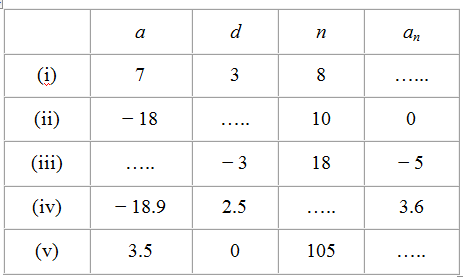
1. Fill in the blanks in the following table, given that a is the first term, d the common difference and an the nth term of the A.P.
 Solutions:
(i) Given,
First term, a = 7
Common difference, d = 3
Number of terms, n = 8,
We have to find the nth term, an = ?
As we know, for an A.P.,
an = a+(n−1)d
Putting the values,
=> 7+(8 −1) 3
=> 7+(7) 3
=> 7+21 = 28
Hence, an = 28
Solutions:
(i) Given,
First term, a = 7
Common difference, d = 3
Number of terms, n = 8,
We have to find the nth term, an = ?
As we know, for an A.P.,
an = a+(n−1)d
Putting the values,
=> 7+(8 −1) 3
=> 7+(7) 3
=> 7+21 = 28
Hence, an = 28
(ii) Given, First term, a = -18 Common difference, d = ? Number of terms, n = 10 Nth term, an = 0 As we know, for an A.P., an = a+(n−1)d Putting the values, 0 = − 18 +(10−1)d 18 = 9d d = 18/9 = 2 Hence, common difference, d = 2
(iii) Given, First term, a = ? Common difference, d = -3 Number of terms, n = 18 Nth term, an = -5 As we know, for an A.P., an = a+(n−1)d Putting the values, −5 = a+(18−1) (−3) −5 = a+(17) (−3) −5 = a−51 a = 51−5 = 46 Hence, a = 46
(iv) Given, First term, a = -18.9 Common difference, d = 2.5 Number of terms, n = ? Nth term, an = 3.6 As we know, for an A.P., an = a +(n −1)d Putting the values, 3.6 = − 18.9+(n −1)2.5 3.6 + 18.9 = (n−1)2.5 22.5 = (n−1)2.5 (n – 1) = 22.5/2.5 n – 1 = 9 n = 10 Hence, n = 10
(v) Given, First term, a = 3.5 Common difference, d = 0 Number of terms, n = 105 Nth term, an = ? As we know, for an A.P., an = a+(n −1)d Putting the values, an = 3.5+(105−1) 0 an = 3.5+104×0 an = 3.5 Hence, an = 3.5
2. Choose the correct choice in the following and justify: (i) 30th term of the A.P: 10,7, 4, …, is (A) 97 (B) 77 (C) −77 (D) −87 (ii) 11th term of the A.P. -3, -1/2, ,2 …. is (A) 28 (B) 22 (C) – 38 (D)

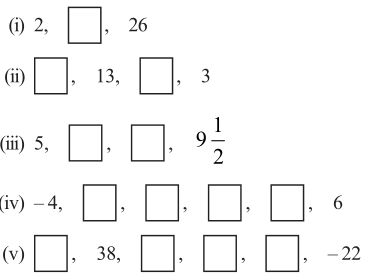 Solutions:
(i) For the given A.P., 2,2 , 26
The first and third term are;
a = 2
a3 = 26
As we know, for an A.P.,
an = a+(n −1)d
Therefore, putting the values here,
a3 = 2+(3-1)d
26 = 2+2d
24 = 2d
d = 12
a2 = 2+(2-1)12
= 14
Therefore, 14 is the missing term.
Solutions:
(i) For the given A.P., 2,2 , 26
The first and third term are;
a = 2
a3 = 26
As we know, for an A.P.,
an = a+(n −1)d
Therefore, putting the values here,
a3 = 2+(3-1)d
26 = 2+2d
24 = 2d
d = 12
a2 = 2+(2-1)12
= 14
Therefore, 14 is the missing term.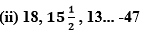 Solutions:
(i) Given, 7, 13, 19, …, 205 is the A.P
Therefore
First term, a = 7
Common difference, d = a2 − a1 = 13 − 7 = 6
Let there are n terms in this A.P.
an = 205
As we know, for an A.P.,
an = a + (n − 1) d
Therefore, 205 = 7 + (n − 1) 6
198 = (n − 1) 6
33 = (n − 1)
n = 34
Therefore, this given series has 34 terms in it.
Solutions:
(i) Given, 7, 13, 19, …, 205 is the A.P
Therefore
First term, a = 7
Common difference, d = a2 − a1 = 13 − 7 = 6
Let there are n terms in this A.P.
an = 205
As we know, for an A.P.,
an = a + (n − 1) d
Therefore, 205 = 7 + (n − 1) 6
198 = (n − 1) 6
33 = (n − 1)
n = 34
Therefore, this given series has 34 terms in it. First term, a = 18
Common difference, d = a2-a1 =
First term, a = 18
Common difference, d = a2-a1 = d = (31-36)/2 = -5/2
Let there are n terms in this A.P.
an = -47
As we know, for an A.P.,
an = a+(n−1)d
-47 = 18+(n-1)(-5/2)
-47-18 = (n-1)(-5/2)
-65 = (n-1)(-5/2)
(n-1) = -130/-5
(n-1) = 26
n = 27
Therefore, this given A.P. has 27 terms in it.
d = (31-36)/2 = -5/2
Let there are n terms in this A.P.
an = -47
As we know, for an A.P.,
an = a+(n−1)d
-47 = 18+(n-1)(-5/2)
-47-18 = (n-1)(-5/2)
-65 = (n-1)(-5/2)
(n-1) = -130/-5
(n-1) = 26
n = 27
Therefore, this given A.P. has 27 terms in it. = 11/2(2/15 + 10/60)
= 11/2 (9/30)
= 33/20
= 11/2(2/15 + 10/60)
= 11/2 (9/30)
= 33/20 (ii) 34 + 32 + 30 + ……….. + 10
(iii) − 5 + (− 8) + (− 11) + ………… + (− 230)
(ii) 34 + 32 + 30 + ……….. + 10
(iii) − 5 + (− 8) + (− 11) + ………… + (− 230) First term, a = 7
nth term, an = 84
First term, a = 7
nth term, an = 84 Let 84 be the nth term of this A.P., then as per the nth term formula,
an = a(n-1)d
84 = 7+(n – 1)×7/2
77 = (n-1)×7/2
22 = n−1
n = 23
We know that, sum of n term is;
Sn = n/2 (a + l) , l = 84
Sn = 23/2 (7+84)
Sn = (23×91/2) = 2093/2
Let 84 be the nth term of this A.P., then as per the nth term formula,
an = a(n-1)d
84 = 7+(n – 1)×7/2
77 = (n-1)×7/2
22 = n−1
n = 23
We know that, sum of n term is;
Sn = n/2 (a + l) , l = 84
Sn = 23/2 (7+84)
Sn = (23×91/2) = 2093/2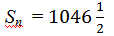
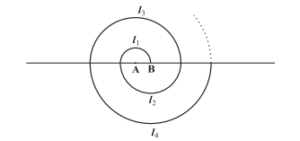 Solution:
We know,
Perimeter of a semi-circle = πr
Therefore,
P1 = π(0.5) = π/2 cm
P2 = π(1) = π cm
P3 = π(1.5) = 3π/2 cm
Where, P1, P2, P3 are the lengths of the semi-circles.
Hence we got a series here, as,
π/2, π, 3π/2, 2π, ….
P1 = π/2 cm
P2 = π cm
Common difference, d = P2 – P1 = π – π/2 = π/2
First term = P1= a = π/2 cm
By the sum of n term formula, we know,
Sn = n/2 [2a + (n – 1)d]
Therefor, Sum of the length of 13 consecutive circles is;
S13 = 13/2 [2(π/2) + (13 – 1)π/2]
= 13/2 [π + 6π]
=13/2 (7π)
= 13/2 × 7 × 22/7
= 143 cm
Solution:
We know,
Perimeter of a semi-circle = πr
Therefore,
P1 = π(0.5) = π/2 cm
P2 = π(1) = π cm
P3 = π(1.5) = 3π/2 cm
Where, P1, P2, P3 are the lengths of the semi-circles.
Hence we got a series here, as,
π/2, π, 3π/2, 2π, ….
P1 = π/2 cm
P2 = π cm
Common difference, d = P2 – P1 = π – π/2 = π/2
First term = P1= a = π/2 cm
By the sum of n term formula, we know,
Sn = n/2 [2a + (n – 1)d]
Therefor, Sum of the length of 13 consecutive circles is;
S13 = 13/2 [2(π/2) + (13 – 1)π/2]
= 13/2 [π + 6π]
=13/2 (7π)
= 13/2 × 7 × 22/7
= 143 cm Solution:
We can see that the numbers of logs in rows are in the form of an A.P.20, 19, 18…
For the given A.P.,
First term, a = 20 and common difference, d = a2−a1 = 19−20 = −1
Let a total of 200 logs be placed in n rows.
Thus, Sn = 200
By the sum of nth term formula,
Sn = n/2 [2a +(n -1)d]
S12 = 12/2 [2(20)+(n -1)(-1)]
400 = n (40−n+1)
400 = n (41-n)
400 = 41n−n2
n2−41n + 400 = 0
n2−16n−25n+400 = 0
n(n −16)−25(n −16) = 0
(n −16)(n −25) = 0
Either (n −16) = 0 or n−25 = 0
n = 16 or n = 25
By the nth term formula,
an = a+(n−1)d
a16 = 20+(16−1)(−1)
a16 = 20−15
a16 = 5
Similarly, the 25th term could be written as;
a25 = 20+(25−1)(−1)
a25 = 20−24
= −4
It can be seen, the number of logs in 16th row is 5 as the numbers cannot be negative.
Therefore, 200 logs can be placed in 16 rows and the number of logs in the 16th row is 5.
Solution:
We can see that the numbers of logs in rows are in the form of an A.P.20, 19, 18…
For the given A.P.,
First term, a = 20 and common difference, d = a2−a1 = 19−20 = −1
Let a total of 200 logs be placed in n rows.
Thus, Sn = 200
By the sum of nth term formula,
Sn = n/2 [2a +(n -1)d]
S12 = 12/2 [2(20)+(n -1)(-1)]
400 = n (40−n+1)
400 = n (41-n)
400 = 41n−n2
n2−41n + 400 = 0
n2−16n−25n+400 = 0
n(n −16)−25(n −16) = 0
(n −16)(n −25) = 0
Either (n −16) = 0 or n−25 = 0
n = 16 or n = 25
By the nth term formula,
an = a+(n−1)d
a16 = 20+(16−1)(−1)
a16 = 20−15
a16 = 5
Similarly, the 25th term could be written as;
a25 = 20+(25−1)(−1)
a25 = 20−24
= −4
It can be seen, the number of logs in 16th row is 5 as the numbers cannot be negative.
Therefore, 200 logs can be placed in 16 rows and the number of logs in the 16th row is 5. A competitor starts from the bucket, picks up the nearest potato, runs back with it, drops it in the bucket, runs back to pick up the next potato, runs to the bucket to drop it in, and she continues in the same way until all the potatoes are in the bucket. What is the total distance the competitor has to run?
[Hint: to pick up the first potato and the second potato, the total distance (in metres) run by a competitor is 2×5+2×(5+3)]
A competitor starts from the bucket, picks up the nearest potato, runs back with it, drops it in the bucket, runs back to pick up the next potato, runs to the bucket to drop it in, and she continues in the same way until all the potatoes are in the bucket. What is the total distance the competitor has to run?
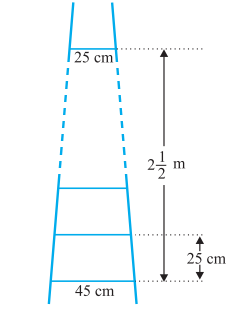
[Hint: to pick up the first potato and the second potato, the total distance (in metres) run by a competitor is 2×5+2×(5+3)] apart, what is the length of the wood required for the rungs? [Hint: Number of rungs = -250/25 ].
 Solution:
Given,
Distance between the rungs of the ladder is 25cm.
Distance between the top rung and bottom rung of the ladder is =
Solution:
Given,
Distance between the rungs of the ladder is 25cm.
Distance between the top rung and bottom rung of the ladder is = = 5/2 ×100cm
= 250cm
Therefore, total number of rungs = 250/25 + 1 = 11
As we can see from the figure, the ladder has rungs in decreasing order from top to bottom. Thus, we can conclude now, that the rungs are decreasing in an order of AP.
And the length of the wood required for the rungs will be equal to the sum of the terms of AP series formed.
So,
First term, a = 45
Last term, l = 25
Number of terms, n = 11
Now, as we know, sum of nth terms is equal to,
Sn= n/2(a+ l)
Sn= 11/2(45+25) = 11/2(70) = 385 cm
Hence, the length of the wood required for the rungs is 385cm.
= 5/2 ×100cm
= 250cm
Therefore, total number of rungs = 250/25 + 1 = 11
As we can see from the figure, the ladder has rungs in decreasing order from top to bottom. Thus, we can conclude now, that the rungs are decreasing in an order of AP.
And the length of the wood required for the rungs will be equal to the sum of the terms of AP series formed.
So,
First term, a = 45
Last term, l = 25
Number of terms, n = 11
Now, as we know, sum of nth terms is equal to,
Sn= n/2(a+ l)
Sn= 11/2(45+25) = 11/2(70) = 385 cm
Hence, the length of the wood required for the rungs is 385cm.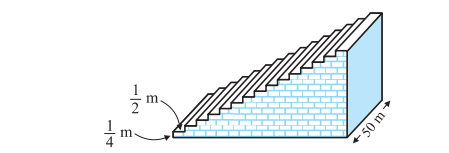 Solution:
As we can see from the given figure, the first step is ½ m wide, 2nd step is 1m wide and 3rd step is 3/2m wide. Thus we can understand that the width of step by ½ m each time when height is ¼ m. And also, given length of the steps is 50m all the time. So, the width of steps forms a series AP in such a way that;
½ , 1, 3/2, 2, ……..
Volume of steps = Volume of Cuboid
= Length × Breadth Height
Now,
Volume of concrete required to build the first step = ¼ ×1/2 ×50 = 25/4
Volume of concrete required to build the second step =¼ ×1×50 = 25/2
Volume of concrete required to build the second step = ¼ ×3/2 ×50 = 75/4
Now, we can see the volumes of concrete required to build the steps, are in AP series;
25/4 , 25/2 , 75/4 …..
Thus, applying the AP series concept,
First term, a = 25/4
Common difference, d = 25/2 – 25/4 = 25/4
As we know, the sum of n terms is;
Sn = n/2[2a+(n-1)d] = 15/2(2×(25/4 )+(15/2 -1)25/4)
Upon solving, we get,
Sn = 15/2 (100)
Sn=750
Hence, the total volume of concrete required to build the terrace is 750 m3.
Solution:
As we can see from the given figure, the first step is ½ m wide, 2nd step is 1m wide and 3rd step is 3/2m wide. Thus we can understand that the width of step by ½ m each time when height is ¼ m. And also, given length of the steps is 50m all the time. So, the width of steps forms a series AP in such a way that;
½ , 1, 3/2, 2, ……..
Volume of steps = Volume of Cuboid
= Length × Breadth Height
Now,
Volume of concrete required to build the first step = ¼ ×1/2 ×50 = 25/4
Volume of concrete required to build the second step =¼ ×1×50 = 25/2
Volume of concrete required to build the second step = ¼ ×3/2 ×50 = 75/4
Now, we can see the volumes of concrete required to build the steps, are in AP series;
25/4 , 25/2 , 75/4 …..
Thus, applying the AP series concept,
First term, a = 25/4
Common difference, d = 25/2 – 25/4 = 25/4
As we know, the sum of n terms is;
Sn = n/2[2a+(n-1)d] = 15/2(2×(25/4 )+(15/2 -1)25/4)
Upon solving, we get,
Sn = 15/2 (100)
Sn=750
Hence, the total volume of concrete required to build the terrace is 750 m3.