Biology (Class 12) Term 2 Question Paper 2024
SECTION - A Question Nos. 1 to 16 are Multiple Choice type Questions, carrying 1 mark each.1. A single gene that controls the expression of more than one trait is said to show
(A) Multiple allelism (B) Polygenic inheritance (C) Incomplete dominance (D) Pleiotropism2. A person with trisomy of 21st chromosome shows
(i) Furrowed tongue (ii) Characteristic palm crease (iii) Rudimentary ovaries (iv) Gynaecomastia Select the correct option, from the choices given below : (A) (ii) and (iv) (B) (i), (ii) and (iv) (C) (ii) and (iii) (D) (i) and (ii)3. Observe the schematic representation of assisted reproductive technology given below:
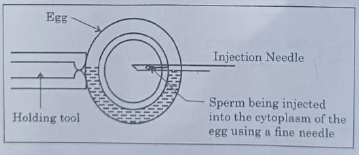 Identify the most appropriate technique depicted in the above diagram.
(A) IUT
(B) IUI
(C) ICSI
(D) ZIFT
Identify the most appropriate technique depicted in the above diagram.
(A) IUT
(B) IUI
(C) ICSI
(D) ZIFT
4. Interferons are proteins secreted by
(A) RBC (B) WBC (C) Bacteria infected cell (D) Virus infected cell5. During biological treatment of sewage, the masses of bacteria held together by fungal filaments to form mesh like structures are called
(A) primary sludge (B) flocs (C) activated sludge (D) anaerobic sludge6. Which one of the following statements is correct in the context of observing DNA separation by agarose gel electrophoresis ?
(A) DNA can be seen in visible light. (B) DNA can be seen without staining in visible light. (C) Ethidium bromide stained DNA can be seen in visible light (D) Ethidium bromide stained DNA can be seen under UV light.7. A phenomenon where a male insect mistakenly identified the patterns of a orchid flower as the female insect partner, and tries to copulate and thereby pollinates the flower is said to be:
(A) Pseudocopulation (B) Pseudopollination (C) Pseudoparthenocarpy (D) Pseudofertilisation8. Identify the correct labellings in the figure of a fertilised embryo sac of an angiosperm given below:
 (A) A - zygote, B - degenerating synergids, C - degenerating antipodals, D - PEN
(B) A - degenerating synergids, B - zygote, C - PEN, D - degenerating antipodals
(C) A - degenerating antipodals, B - PEN, C - degenerating, synergies, D - zygote
(D) A - degenerating synergids, B - zygote, C - degenerating antipodals, D - PEN
(A) A - zygote, B - degenerating synergids, C - degenerating antipodals, D - PEN
(B) A - degenerating synergids, B - zygote, C - PEN, D - degenerating antipodals
(C) A - degenerating antipodals, B - PEN, C - degenerating, synergies, D - zygote
(D) A - degenerating synergids, B - zygote, C - degenerating antipodals, D - PEN
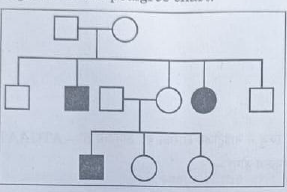
9. Study the pedigree chart of a family showing the inheritance pattern of a certain disorder. Select the option that correctly identifies the nature of the trait depicted in the pedigree chart.
 (A) Dominant X - linked
(B) Recessive X - linked
(C) Autosomal dominant
(D) Autosomal recessive
(A) Dominant X - linked
(B) Recessive X - linked
(C) Autosomal dominant
(D) Autosomal recessive
10. Match the following genes of the lac operon listed in column 'A' with their respective products listed in column 'B':
| A Gene | B Products |
| a. 'i' gene | (i) ß-galactosidase |
| b. 'z' gene | (ii) lac permease |
| c. 'a' gene | (iii) repressor |
| d. 'y' gene | (iv) transacetylase |
| a | b | c | d | |
| (A) | (i) | (iii) | (ii) | (iv) |
| (B) | (iii) | (i) | (ii) | (iv) |
| (C) | (iii) | (i) | (iv) | (ii) |
| (D) | (iii) | (iv) | (i) | (ii) |
11. If both the parents are carriers for thalassaemia, the chances of an afflicted child to be born to them is:
(A) 25% (B) 50% (C) 75% (D) 100%12. If the sequence of nitrogen bases of the coding strand in a transcription unit is 5' - ATGAATG - 3', the sequence of bases in its RNA transcript would be 1
(A) 5'- AUGAAUG - 3' (B) 5'-UACUUAC -3' (C) 5'-CAUUCAU-3' (D) 5' - GUAAGUA - 3' Question number 13 to 16 consist of two statements - Assertion (A) and Reason (R). Answer these questions selecting the appropriate option given below: (A) Both (A) and (R) are true and (R) is the correct explanation of (A). (B) Both (A) and (R) are true, but (R) is not the correct explanation of (A). (C) (A) is true, but (R) is false. (D) (A) is false, but (R) is true.13. Assertion (A) : AIDS is a syndrome caused by HIV. Reason (R) : HIV is a virus that damages the immune system with DNA as its genetic material.
14. Assertion (A) : In molecular diagnosis, single stranded DNA or RNA tagged with radioactive molecule is called a probe. Reason (R) : A probe always searches and hybridises with its complementary DNA in a clone of cells.
15. Assertion (A) : In birds the sex of the offspring is determined by males. Reason (R) : Males are homogametic while females are heterogametic.
16. Assertion (A) : Communities that comprise of more species tend to be more stable. Reason (R) : A higher number of species results in less year to year variation in total biomass.
SECTION - B17. (a) "Farmers prefer apomictic seeds to hybrid seeds." Justify giving two reasons.
OR(b) Mention one advantage and one disadvantage of amniocentesis.
18. 5'-GAATTC-3' 3'- CTTAAG-5'
(a) Name the restriction enzyme that recognizes the given specific sequence of bases. What are such sequences of bases referred to as?
(b) What are the arrows in the given figure indicating? Write the result Obtained thereafter.
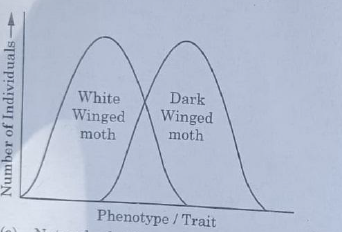
19. Observe the population growth curve and answer the questions given below:
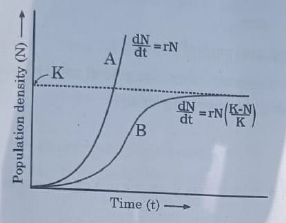
(a) State the conditions under which growth curve 'A' and growth curve B' plotted in the graph are possible.
(b) Mention what does K' in the graph represent.
20. Explain how are plants benefitted by their association with "Glomus species".
21. If the base adenine constitutes 31% of an isolated DNA fragment, then write what will be the expected percentage of the base cytosine in it. Explain how did you arrive at the answer given.
SECTION - C22. Identify a, b, c, d, e and fin the table given below :
| Sl. No. | Organism | Bioactive Molecule | Use |
| 1. | Monascus purpureus | a | b |
| 2. | c | d | Antibiotic |
| 3. | e | Cyclosporin A | f |
23(a) Tropical regions harbour more species than the temperate regions. How have biologists tried to explain this in their own ways? Explain.
OR(b) (i) What does an ecological pyramid represent ?
(ii) The Ecological pyramids may have an 'upright' or an 'inverted' shape. Justify with the help of suitable examples.
24. (a) What are transgeric animals ?
(b) Name the transgenie animal having the largest number amongst all the existing transgenic animals.
(c) State any 3 reasons for which these types of animals are being produced.
25. If the cells in the leaves of a maize plant contain 10 chromosomes each, write the number of chromosomes in its endosperm and zygote. Name and explain the process by which an endosperm and a zygote are formed in maize.
26. (a) Why does DNA replication occur within a replication fork and not in its entire length simultaneously?
(b) "DNA replication is continuous and discontinuous on the two strands within the replication fork." Explain with the help of a schematic representation.
27. Explain the processing of heterogeneous nuclear RNA (hRNA) into a fully functional mRNA in eukaryotes. Where does this processing occur in the cell?
28. The world is facing accelerated rates of species extinction largely due to human activities. Explain any three human activities responsible for accelerated rates of species extinction.
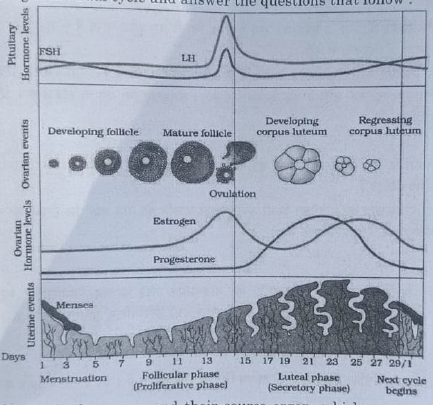
SECTION - D Q. No. 29 and 30 are case based questions. Each question has 3 sub-questions with internal choice in one sub-question.29. In a human female, the reproductive phase starts on the onset of puberty and ceases around middle age of the female. Study the graph given below regarding menstrual cycle and answer the questions that follow :