Political Science (Class 12) Term 2 Question Paper 2023
1. Assertion (A): The United Nations is expected to cope better with the Unipolar World.
Reason (R): After the disintegration of Soviet Union many new countries joined the United Nations.
Options:
A. Both (A) and (R) are true and (R), is the correct explanation of (A). B. Both (A) and (R) are true, but (R) is not the correct explanation of (A). C. (A) is true, but (R) is false. D. (A) is false, but (R) is true.
2. Assertion (A): During constitutional monarchy in 1990s, the political parties and the common people of Nepal wanted to have a more open and responsive system of government.
Reason (R): The King with the help of the army retained full control over the government and restricted the expansion of democracy in Nepal.
Options:
(a)Both (A) and (R) are true and (R), is the correct explanation of (A). (b)Both (A) and (R) are true, but (R) is not the correct explanation of (A). (c)(A) is true, but (R) is false. (d)(A) is false, but (R) is true.
4. For how many years are the non-permanent members of UN Security Council elected ?
(a)One year (b)Two years (c) Three years (d) Five years
5. Which one of the following is not the objective of NITI Aayog?
(a)To provide strategic input to the development process of India. (b)To serve as a Think Tank of the Union government. (c)To arrange funds for the developmental programmes. (d) To put an end to the tardy implementation of the policies.
6. Arrange the following in the chronological order :
(i)Appointment of Lal Bahadur Shastri as Prime Minister. (ii)Tashkent Agreement (iii)The fourth General Elections. (iv)Election of V.V. Giri as the President of India.
Choose the correct option:
(a)(i), (ii), (iii), (iv) (b)(ii), (iii), (iv), (i) (c)(iii), (iv), (i), (ii) (d) (ii), (iv), (i), (iii)
7. Which among the following statements about the “Bombay Plan” is incorrect?
A. It was a blueprint for India’s economic future B. It supported state ownership of industry C. It was made by some leading industrialists D. It strongly supported the idea of planning
8. Which one of the following statements about relations between India and Nepal is NOT correct?
(a)India and Nepal have a special treaty related to travel and work in the other country without Visa. (b)India shares the river water from Nepal. (c)Both countries have democratic form of government. (d)Nepal always follows the policies of India.
9. Identify the main reason behind the investments of MNCs in developing countries.
(a) For the welfare of the underprivileged people. (b) To increase their own assets and earn profits. (c) For the benefit of other countries. (d) To provide financial support to the developing countries.
10. The decade of _____ was the period of 'Second Democratic Upsurge' in India.
(a)1960s (b)1970s (c)1980s (d)1990s
11. Who among the following was the main leader of Dravid Movement ?
(a)K. Kamraj (b)E.V. Ramaswami Naicker (c)K. Karunanidhi (d)C. Annadurai
12. Fill in the following blank with an appropriate term from among the following:
______ means the progress that meets the needs of the present generation without compromising the need of future generation.
(a) Global commons (b) Development without destruction (c) Sustainable development (d) Politics of developed nations
SECTION - B
13. "The South Asian experience of democracy has expanded the global imagination of democracy." Justify the statement.
14. Why did India not sign the nuclear treaties like NPT and CTBT? Explain any two reasons.
15. Analyse the role played by India to help the Tibetan refugees to settle down.
16. Explain any two functions of International Labour Organisation (ILO).
17. Suggest any two measures to improve the relations between India and Pakistan.
18. Explain any two reasons for the formation of the NITI Aayog in place of the Planning Commission by the Union Government.
SECTION - C
19. Evaluate Sardar Patel's role in the integration of princely states with Indian Union.
20. Why were the fifth general elections held one year earlier in 1971 instead of 1972 ? Explain any two reasons.
21. Highlight any two international movements against the environmental degradation.
22. Assess any two steps taken by Union Government in response to the demand of autonomy raised by people in most of the regions of North East.
23. "The 'Arab Spring' was the people's revolution against injustice." Support the statement with any two examples.
SECTION - D
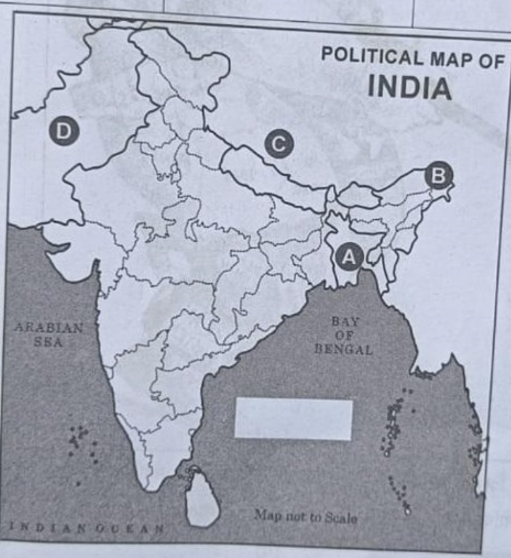
24. In the given political outline Map of India, four countries/states have been marked as A, B, C and D. Identify these on the basis of the information given below and write their correct names in your answer book along with their respective serial number of the information used and the concerned alphabet as per format that follows;
(i) The country with which India fought a battle in 1962. (ii) The country with which India has a dispute on Kashmir. (iii) The country which came into existence after the 1971 war. (iv) The Indian state which shares its border with China.
| Sr. No. of the information used | Concerned alphabet in the map | Name of the countries/states |
| (i) | ||
| (ii) | ||
| (iii) | ||
| (iv) |
 Note:
The following questions are for Visually Impaired Candidates only in lieu of Q. No. 24 :
(24.1) Name the country with which India fought a battle in 1962.
(24.2) With which country did India have conflict over Kashmir issue since independence?
(24.3) Name the country related to Sheikh Mujibur Rahman.
(24.4) Which Indian state in the North East shares its border with China?
Note:
The following questions are for Visually Impaired Candidates only in lieu of Q. No. 24 :
(24.1) Name the country with which India fought a battle in 1962.
(24.2) With which country did India have conflict over Kashmir issue since independence?
(24.3) Name the country related to Sheikh Mujibur Rahman.
(24.4) Which Indian state in the North East shares its border with China?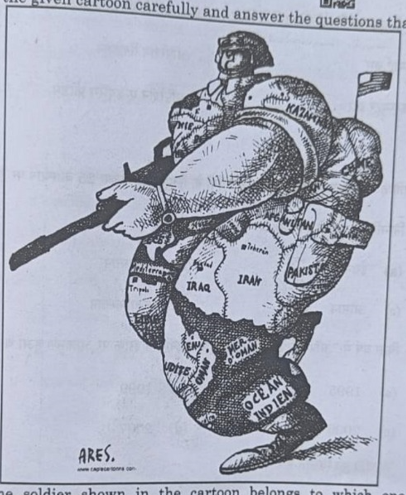 (i) The soldier shown in the cartoon belongs to which one of the following countries?
(a) USSR
(b) USA
(c) Iraq
(d) Iran
(i) The soldier shown in the cartoon belongs to which one of the following countries?
(a) USSR
(b) USA
(c) Iraq
(d) Iran