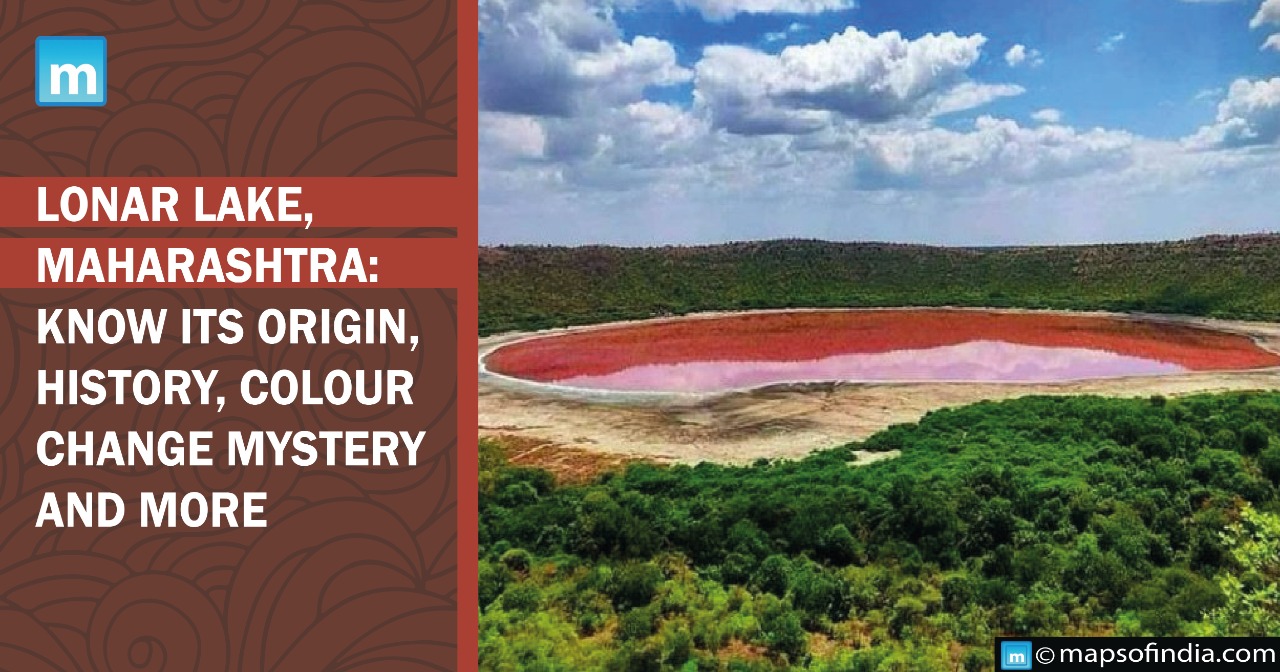
- Lonar Lake is located amid the enormous Deccan Traps, a massive basaltic deposit in India, and is the only known interplanetary impact crater in India.
- The lake was once considered volcanic in origin, but it is now recognised as an impact crater.
- As a result of the collision of a comet or an asteroid, Lonar Lake was formed.
- The presence of plagioclase, which has either been transformed into maskelynite or exhibits planar deformation patterns, has proven the crater's impact origin.
- Shock metamorphism high-velocity impacts are the only process capable of transforming plagioclase into maskelynite and producing planar deformation patterns.
- The crater is oval in structure. In addition, the meteorite struck at an inclination of 35 to 40 degrees from the east.
- In 2020, it was discovered that the water in Lonar lake in Maharashtra's Buldhana district was turning red.
- The district administration has recommended that the National Environmental Engineering Research Institute (NEERI), Nagpur, investigate the cause.
- The water of Maharashtra's Lonar lake, popularly known as the Lonar crater, has turned crimson\ red.
- When the lake receives rain, it is considered normal.
- An algal bloom, also known as an algae bloom, is a fast rise or accumulation of algae in fresh or marine water systems commonly identified by water discolouration.
- The colour change is often ascribed to algae bloom in the lake during the monsoon season.
- The salinity of the water has elevated due to evaporation. As a result, it is thought to be a factor in the colour shift.
- The colour change appears to be a biological change in the Lonar crater because there was no disturbance to the lake throughout the lockdown phase, and it naturally turned red.