1. ‘In recent years India has paid adequate attention to ASEAN’. Give two points to justify the statement. 1+1
Ans.1. In recent years India has paid adequate attention to ASEAN- (a) The ASEAN-India Free Trade Agreement came into effect in 2010. (b) On January 25th, 2018, silver jubilee of India and ASEAN partnership was commemorated. Leaders released postal stamps to mark the event.
ORExplain ‘Miracle on the Han River’. 1+1
Ans. Miracle on Han River- (a) South Korea emerged as a center of power in Asia. (b) Between the 1960s and the 1980s, it rapidly developed into an economic power, which is termed as 'Miracle on the Han River'.
2. South Asia stands for diversity in every sense and yet constitutes one geo-political space. Do you agree with the statement? Give two reasons for your answer.
Ans.2. (a) The mighty Himalayas in the north and the vast Indian Ocean, the Arabian Sea and the Bay of Bengal in the south west and east respectively provide a natural insularity to the region which is largely responsible for the linguistic, social and cultural distinctiveness of the subcontinent. (b) The various countries in South Asia do not have the same kind of political systems but democracy has become an accepted norm in this region. Thus, yes, South Asia stands for diversity in every sense and yet constitutes one geo- political space.
3. Why do you think India is now considered as an important centre of power?
Ans.3. The 21st century India is being seen as an important emerging global power- (a) The economic, cultural and strategic position of the country with the population of more than 135 crores is very strong. (b) From a strategic perspective, the military of India is selfsufficient with indigenous nuclear technology, making it another nuclear power. (c) From an economic perspective, targeting the goal of a $5 trillion economy, a competitive huge market, and ancient inclusive culture with 200 million people of Indian diaspora spreading across the globe impart distinct meaning and salience to India as a new center of power in the 21st century. (Any two points)
4. American involvement in South Asia has rapidly increased after the Cold War. Give two examples to illustrate.
Ans.4. (a) The United States has had good relations with both India and Pakistan since the end of the Cold War and increasingly works as a moderator in India- Pakistan relations. (b) The Economic reforms and liberal economic policies in both the countries have greatly increased the depth of American participation in the region. (c) The large South Asian Diasporas in the US and the huge size of the population and markets of the region also give America an added stake in the future of regional security and peace. (Any two points)
5. Evaluate the role of SAARC in facilitating the economic cooperation in the South Asian region.
Ans.5. (a) The South Asian Association for Regional Cooperation (SAARC) is a major regional initiative by the South Asian States to evolve cooperation through multilateral means. It began in 1985 SAARC members signed the South Asian Free Trade Agreement (SAFTA) in 2004 which promised the formation of a free trade zone for the whole of South Asia. (b) A new chapter of peace and cooperation might evolve in South Asia if all the countries in the region allow free trade across the borders.
6. The first general election was postponed twice. Give two reasons for the same.
Ans.6. The first general election was a mammoth exercise- (a) 17 crore eligible voters were to elect about 3,200 MLAs and 489 members of Lok Sabha. (b) Only 15% of the voters were literate. (c) In the first draft of the rolls, names of nearly 40 lakh women were not recorded in the list. (Any two points)
7. Explicate two features of a Coalition Government.
Ans.7. (a) When no single party gets a majority and two or more than two parties join together a form a government, it is called a Coalition Government. (b) Various small parties usually play a crucial role in forming a Coalition Government. (c) Position of the Head of Government usually remains weak as he/she has to appease all the stakeholders in the government. (Any two points)
8. Name the leader who led a peoples’ march to Parliament in 1975 and state as to what was unique about this march.
Ans.8. (a)Loknayak Jayprakash Narayan was the leader who led peoples’ march to Parliament. (b)This was one of the largest political rallies ever held in the capital during those times.
9. Compare the European Union with ASEAN
Ans.9. The European Union- (a) After the Second World War, the Organization for European Economic Cooperation (OECC) was established by America, under the Marshall Plan. (b) The process of economic integration of European capitalist countries proceeded systematically and the Council of Europe was established in 1949. (c) This led to the formation of the European Economic Community in 1957. After the collapse of Soviet bloc, EuropeanUnion was established in 1992. (d) It has its own flag, anthem, founding date and currency. European Union was the world’s largest economy in 2005. It had a GDP of more than US $ 12 trillion in 2005. (Any two points)
ASEAN-
(a) Association of South East Asian Nations (ASEAN) was established in 1967 by five countries of this region –Indonesia, Malaysia, the Philippines, Singapore and Thailand by signing the Bangkok Declaration. (b) ASEAN countries have adopted the “ASEAN Way” as a form of interaction that is informal, non-confrontationist and cooperative. (c) In 2003, ASEAN moved along the path of establishing an ASEAN Community comprising three pillars, namely, the ASEAN Security Community, the ASEAN Economic Community and the ASEAN Socio-Cultural Community. (d) ASEAN had several agreements in place by which member states promised to uphold peace, neutrality, cooperation, noninterference and respect for national differences and sovereign rights. ASEAN economy is growing much faster than other countries. (e) ASEAN has focused on creating a Free Trade Area (FTA) for investment, labor and services. ASEAN Vision 2020 had defined an outward- looking role for ASEAN in the international community. ASEAN policy has been to encourage negotiation over conflicts in the region. (Any two points)
10. Describe various issues regarding the National Emergency of 1975 in India.
Ans.10. The various issues regarding the National Emergency of 1975 in India are as follows: (a) There were arrests of political workers and undue restrictions on the press. (b) The Emergency directly affected the lives of common people in many cases. Fundamental Rights of the people were suspended. Torture and custodial deaths occurred during the Emergency and arbitrary relocation of poor people also took place. (c) The Constitution simply mentioned ‘internal disturbances’ as the reason for declaring Emergency. Before 1975, the Emergency was never proclaimed on this ground. (d) Although the then government argued that in a democracy, the opposition parties must allow the elected ruling party to govern according to its policies. It felt that frequent recourse to agitations; protests and collective action are not good fo democracy. (e) Supporters of the then Prime Minister also held that in a democracy, one cannot continuously have extra-parliamentary politics targeting the government. This leads to instability and distracts the administration from its routine task of ensuring development. (Any four points)
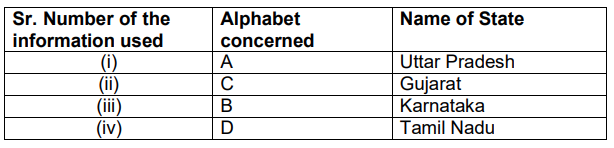
11. In the given outline political map of India, four states have been marked as (A), (B), (C), (D). Identify these states on the basis of the information given below and write their correct names in your answer book along with their respective serial number of the information used and the concerned alphabets as per the format that follows: 1+1+1+1 (i)The state to which Minister for Communications in the first ministry of free India belonged. (ii) The state to which the former Prime Minister Morarji Desai was related (iii). The state to which S. Nijalingappa belonged. (iv)The state related to former Congress President K. Kamraj.