SECTION - A
1 The table shows the electronic structures of four elements
| Element | Electronic Structure |
| P | 2,6 |
| Q | 2,8,1 |
| R | 2,8,7 |
| S | 2,8,8 |
a. Identify which element(s) will form covalent bonds with carbon. b. “Carbon reacts with an element in the above table to form several compounds.” Give suitable reason.
Ans : a. P and R b. Carbon has a valency four or Tetravalency & Catenation
2 The diagram below shows part of the periodic table. a. Which elements would react together to form covalent compounds? b. Between the two elements W and Z, which will have a bigger atomic radius? Why?
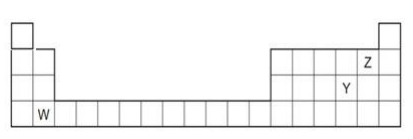 Ans : a. Y and Z
b. W is bigger,
Reason:
Down the group number of shells increases
Ans : a. Y and Z
b. W is bigger,
Reason:
Down the group number of shells increases
3 a. Trace the path a male gamete takes to fertilise a female gamete after being released from the penis.
b. State the number of sets of chromosomes present in a zygote
Ans : a. Male gamete (sperm) travels in the female reproductive tract after being released. The path which it takes to fertilise the female gamete (egg) is vagina, uterus, fallopian tube resulting in a zygote;
Alternatively accept the labelled figure of human female reproductive system indicating the passage of sperm from vagina to uterus and then to fallopian tube for fertilisation resulting in a zygote;
b. Zygote has 2 sets of chromosomes / alternatively accept 2n. No marks to be assigned for n or 3n.
4 Rajesh observed a patch of greenish black powdery mass on a stale piece of bread. a. Name the organism responsible for this and its specific mode of asexual reproduction. b. Name its vegetative and reproductive parts.
Ans : a. The greenish black powdery mass on a stale piece of bread is due to bread mould Rhizopus which reproduces by spore formation.
b. Hyphae or thread like structures are the vegetative part and tiny blob like structures or sporangia are the reproductive parts.
5 Mustard was growing in two fields- A and B. While Field A produced brown coloured seeds, field B produced yellow coloured seeds.
It was observed that in field A, the offsprings showed only the parental trait for consecutive generations, whereas in field B, majority of the offsprings showed a variation in the progeny.
What are the probable reasons for these?
ORIn an asexually reproducing species, if a trait X exists in 5% of a population and trait Y exists in 70% of the same population, which of the two trait is likely to have arisen earlier? Give reason.
Ans : In field A, the reason for parental trait in consecutive generations of the offsprings is self-pollination. In field B, variation is seen to occur because of recombination of genes as cross - pollination is taking place.
ORTrait Y which exists in 70% (larger fraction) of the population, is likely to have arisen earlier because in asexual reproduction, identical copies of DNA are produced and variations do not occur. New traits come in the population due to sudden mutation and then are inherited. 70% of the population with trait Y is likely to have been replicating that trait for a longer period than 5 % of population with trait X.
6 A simple motor is made in a school laboratory. A coil of wire is mounted on an axle between the poles of a horseshoe magnet, as illustrated.
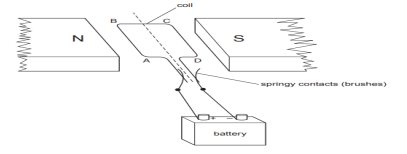 In the example above, coil ABCD is horizontal and the battery is connected as shown.
a. For this position, state the direction of the force on the arm AB.
b. Why does the current in the arm BC not contribute to the turning force on the coil?
In the example above, coil ABCD is horizontal and the battery is connected as shown.
a. For this position, state the direction of the force on the arm AB.
b. Why does the current in the arm BC not contribute to the turning force on the coil?
OR
A circuit contains a battery, a variable resistor and a solenoid. The figure below shows the magnetic field pattern produced by the current in the solenoid.
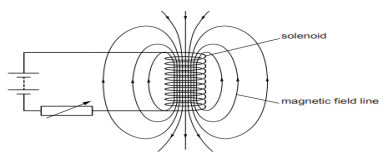 a. State how the magnetic field pattern indicates regions where the magnetic field is stronger.
b. What happens to the magnetic field when the current in the circuit is reversed?
a. State how the magnetic field pattern indicates regions where the magnetic field is stronger.
b. What happens to the magnetic field when the current in the circuit is reversed?
Ans : a. downwards b. Because BC is in the same direction as the direction of field lines. Force is minimum when the direction of current in the conductor is the same as that of the magnetic field. BC will not contribute as the force on this part of the coil will be cancelled by the force on DA.
ORa. Relative closeness of field lines indicates the strength of magnetic field. Since field lines are crowded around the ends of the solenoid, hence these are the regions of strongest magnetism. b. The direction of the field will also be reversed.
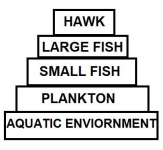
7 DDT was sprayed in a lake to regulate breeding of mosquitoes. How would it affect the trophic levels in the following food chain associated with a lake? Justify your answer.
 OR
OR
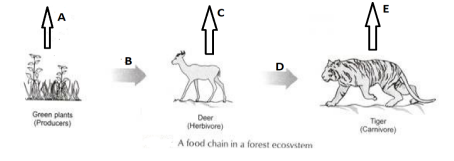
In the following food chain, vertical arrows indicate the energy lost to the environment and horizontal arrows indicate energy transferred to the next trophic level. Which one of the three vertical arrows (A, C and E) and which one of the two horizontal arrows (B and D) will represent more energy transfer? Give reason for your answer.
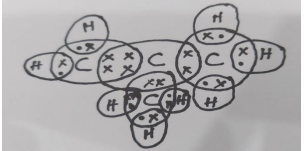 b. C4H8 and C5H10 are homologues as they differ in
● “- CH2-”
● differ in 14u molecular mass
● Same functional group
● Same general formula
b. C4H8 and C5H10 are homologues as they differ in
● “- CH2-”
● differ in 14u molecular mass
● Same functional group
● Same general formula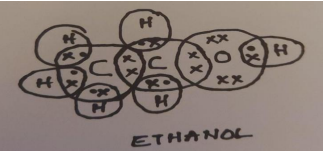 b. CH3OH and C3H7OH are homologues of ethanol
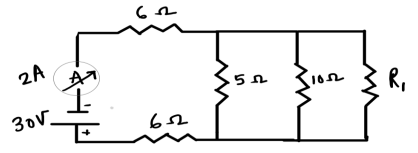 In the above circuit, if the current reading in the ammeter A is 2A, what would be the value of R1?
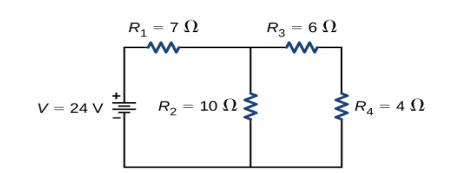 Calculate the total resistance of the circuit and find the total current in the circuit.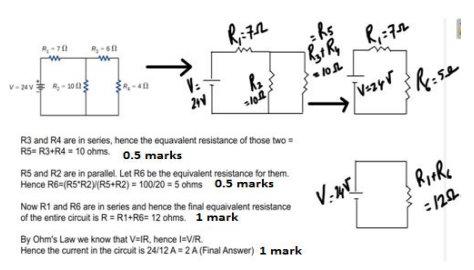
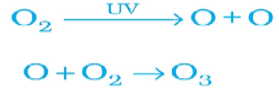 b. Ozone shields the surface of the earth / protects living organisms from ultraviolet (UV) radiation released by the sun.
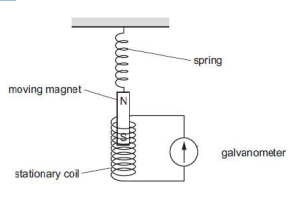 A magnet is attached to a spring. The magnet can go in and out of the stationary coil.