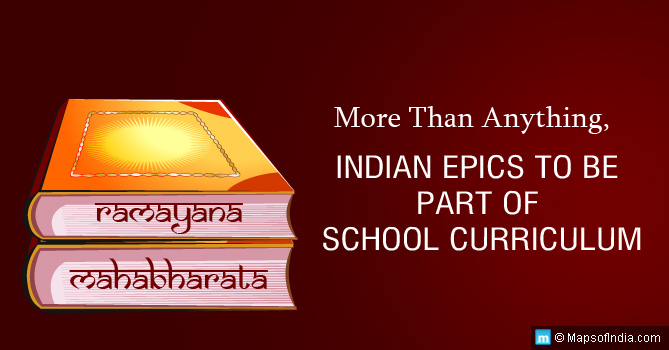
 During his speaking session, on his recently published book 'Remembering the Raj', at Jaipur Literary Festival on Sunday, Congress leader Shashi Tharoor said that including the great Indian Epics such as the Mahabharata and the Ramayana in the curriculum was in fact a very important change that the Education System in India should look into. The inclusion of these epics would make the younger generation of India more aware of the country’s rich literary past as well as help them gain lessons in life depicted through the mythological heroes in the epics.
Speaking about the English curriculum Shashi Tharoor said, "Shakespeare is being taught in schools and colleges in India, but there has not been enough emphasis on teaching Kalidasa." Tharoor argued that just like the Greek epics 'Iliad' and 'Odyssey', the great Indian Epics should be included in the curriculum of the schools and colleges.
Tharoor also spoke about his book 'Remembering the Raj' and said that while it was important to forgive, it was also essential that we never forget that when the British came here, India was the richest country; but the legacy of the British rules framed to serve the British interests resulted in reducing India to one of the poorest.
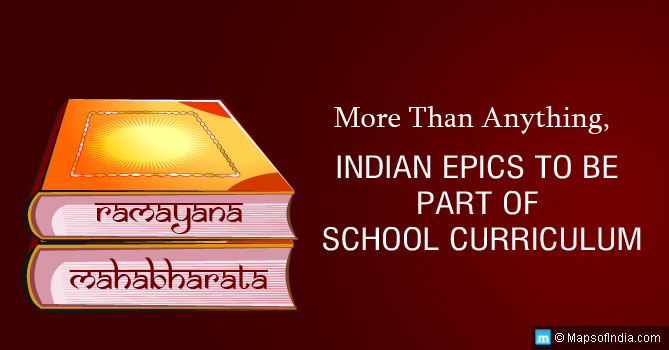
During his speaking session, on his recently published book 'Remembering the Raj', at Jaipur Literary Festival on Sunday, Congress leader Shashi Tharoor said that including the great Indian Epics such as the Mahabharata and the Ramayana in the curriculum was in fact a very important change that the Education System in India should look into. The inclusion of these epics would make the younger generation of India more aware of the country’s rich literary past as well as help them gain lessons in life depicted through the mythological heroes in the epics.
Speaking about the English curriculum Shashi Tharoor said, "Shakespeare is being taught in schools and colleges in India, but there has not been enough emphasis on teaching Kalidasa." Tharoor argued that just like the Greek epics 'Iliad' and 'Odyssey', the great Indian Epics should be included in the curriculum of the schools and colleges.
Tharoor also spoke about his book 'Remembering the Raj' and said that while it was important to forgive, it was also essential that we never forget that when the British came here, India was the richest country; but the legacy of the British rules framed to serve the British interests resulted in reducing India to one of the poorest.
Is the Curriculum politicised?
The curriculum in India has always reflected the ruling party’s agenda. The subject matter of history is an intellectual tussle where the left wing and the right wing are in a constant tug of war as to what should be the content of the books. Once the elections are held, the subject matter is according to the party that has won the maximum seats. A small example of this intellectual tussle can be seen in the following scenario which happened in the period 1998-2005.- In 1998 during the NDA government, right-wing historian, Meenakshi Jain’s book on medieval India was included in the school syllabus.
- She felt that there was an imbalance in the history taught at that time for while with the emergence of Islamic power in India, there was an encounter between two evolving civilisations, but the NCERT books elevated one side to the detriment of the other.
- However, in 2005, when the UPA came into power, Jain’s book was withdrawn from the curriculum for the new government wanted to "de-saffronise" the text book.
Wrong Information
Leave alone politicising of the text books, the NCERT books also have been found to have some bizarre information which reflects a regressive outlook of the autonomous organisation of the Government of India. Glaring mistakes, downright lies and embellishments that are so often found in its textbooks reflect its tied-to-flaws attitude towards shaping the future of the younger generations. Here are a few bizarre things found in the NCERT books in recent times:- In Chattisgarh, a text book for 15-year-olds in the state stated that the unemployment levels in India have risen because women have started working post-independence.
- In 2012, a national textbook for 11-year-old students stated that people who eat meat "easily cheat, tell lies, forget promises, are dishonest and tell bad words, steal, fight and turn to violence and commit sex crimes".
- In a textbook, in 2006, housewives were compared to donkeys.
- In a complete distortion of history, a textbook in Gujarat stated that Japan had launched a Nuclear attack on the United States of America during the World War II. The same textbook also got the assassination date of Mahatma Gandhi wrong.
- A textbook in Maharashtra taught the students that "Sewage" Canal is one of the most important shipping lanes of the world, only that they got the spelling of "Suez" wrong!!