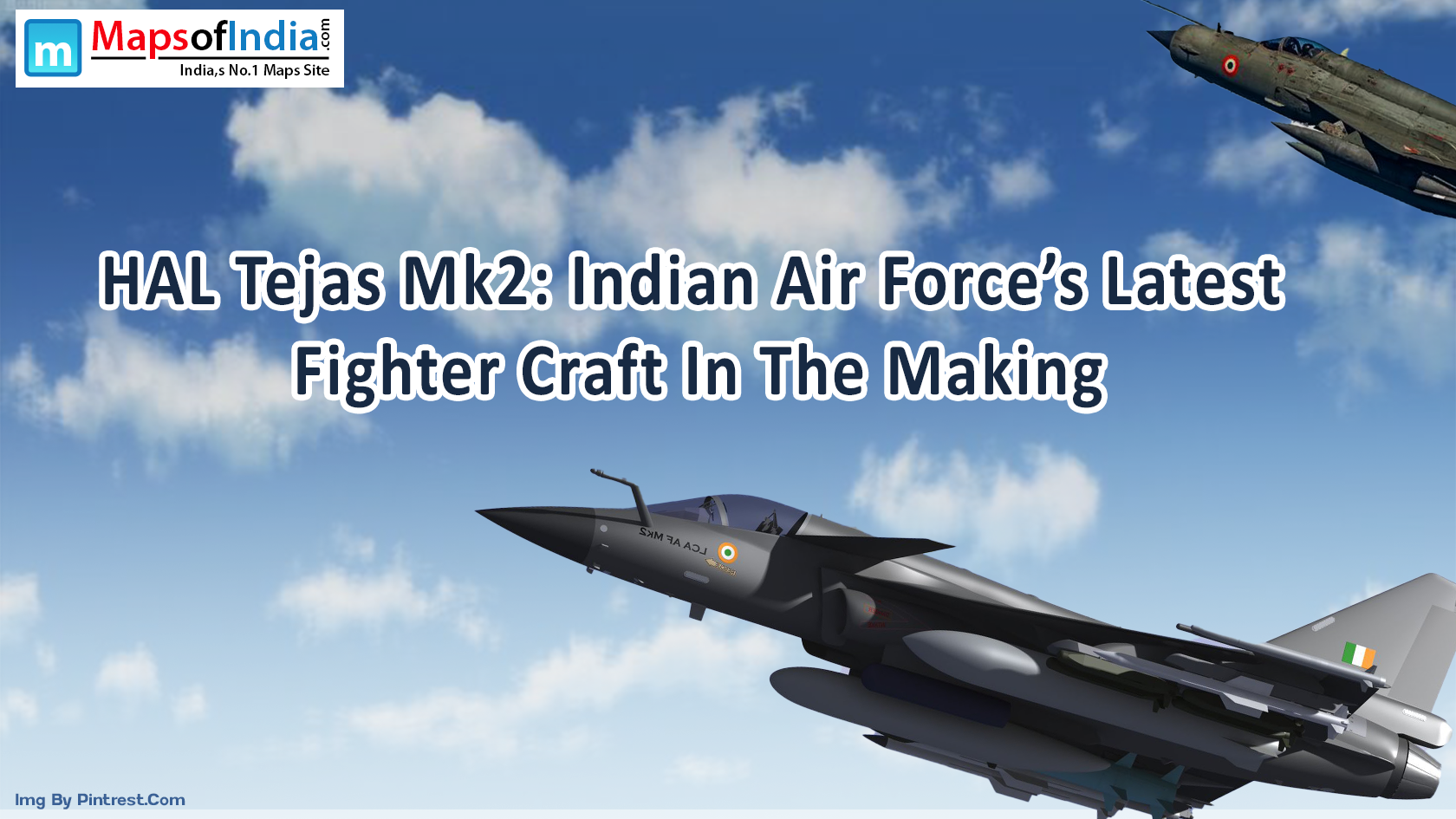
Development of Tejas Program
The Tejas program began in the 1980s as part of India's Light Combat Aircraft (LCA) project to replace the country's ageing fleet of MiG-21 fighter aircraft. The Tejas Mk1, which India has been able to gift itself to join the league of countries that can produce fighter jets at home, has been designed and developed through a collaboration between HAL and the Aeronautical Development Agency (ADA). Although the Tejas Mk1 and its enhanced derivative, the Mk1A, have demonstrated operational prowess, their low range and payload capacity made a stronger platform necessary. Enter the Tejas Mk2, a medium-weight multirole fighter intended to fill the gap between the lightweight Tejas Mk1 and heavier offerings like the Rafale.Key Features of HAL Tejas Mk2
- Size and Payload Capacity: Larger and more powerful than the preceding Tejas Mk1, the Tejas Mk2 has many other upgrades. With a length of 14.6 meters and a wingspan of 8.5 meters, the Mk2 is larger than the Mk1, which measures just 13.2 meters long with a wingspan of 8.2 meters. This extra size means a larger payload of 6500 kilograms, nearly double that of the Mk1.
- Engine and Performance: The General Electric F414-INS6 engine that will power the Mk2 musters 98 kN of thrust, while the Mk1 has the F404-GE-IN20 engine that produces 84 kN. This increased power translates into increased speed, manoeuvrability, and range, with the aircraft achieving a top speed of Mach 1.8 and a combat radius of around 1,500 kilometres.
- Stealth and Survivability: It uses stealth features, including a reduced radar cross-section (RCS) and an infrared signature. Structures such as composite materials, radar-absorbing coating, and internal weapons bay contribute to its lesser detectability, making it an effective adversary in modern air combat.
- Avionics and Sensors: The Tejas Mk2 is fitted with advanced avionics, including an indigenous Active Electronically Scanned Array (AESA) radar, Infrared Search and Track (IRST) system, and Electronic Warfare (EW) suite.
- Multirole Capability: Tejas Mk2 is expected to be a true multirole fighter capable of air superiority, ground attack, maritime strike and reconnaissance roles.
- Digital Cockpit and Pilot-Centric Design: The aircraft incorporates a fully digital cockpit and utilises advanced fly-by-wire systems, All touch-screen displays, and a Holographic head-up display (HUD). The cockpit layout is focused on decreasing pilot workload to enable better executions.