Importance of Chinar Trees in Kashmir
Weaving through Kashmir’s landscape and folklore are chinar trees, and Platanus orientalis. Locally called “booune,” these trees can survive hundreds of years, some are believed to be more than 600 years old. Then there are the wide leaves that turn a bright red and gold in autumn, creating sweeping scenes that attract tourists and photographers. Apart from their ornamental value, the Chinar trees hold immense importance for the ecological balance of the region. Trees offer shade, reduce soil erosion, and serve as natural air purifiers. The ancient Chinar tree has historical connections also as the tree has been mentioned in Mughal Kashmir. These trees were widely planted for the very first time in the Kashmir Valley by the Mughals, and several prominent gardens in the region, like Shalimar Bagh and Nishat Bagh, make chinar trees a central focus. The tree is also celebrated in Kashmiri poetry, art and music, symbolising lushness and resilience.The Menaces to Chinar Trees
Chinar trees, despite their cultural and ecological significance, have faced threats in recent years. Their numbers have plummeted due to rapid urbanisation, deforestation and changes in land use. The illegal cutting of these trees for timber and wood has only made the problem worse. The absence of oversight and appropriate management has severely impeded the preservation of these precious ecosystems. The number is believed by some estimates to have dwindled in Kashmir over the past few decades from tens of thousands to a few thousand chinar trees. The dramatic decline in their numbers has shocked, green groups, policymakers and local communities, and spurred calls to action to save those trees.The Solution: Unique Identification Codes with Geo-Tagging
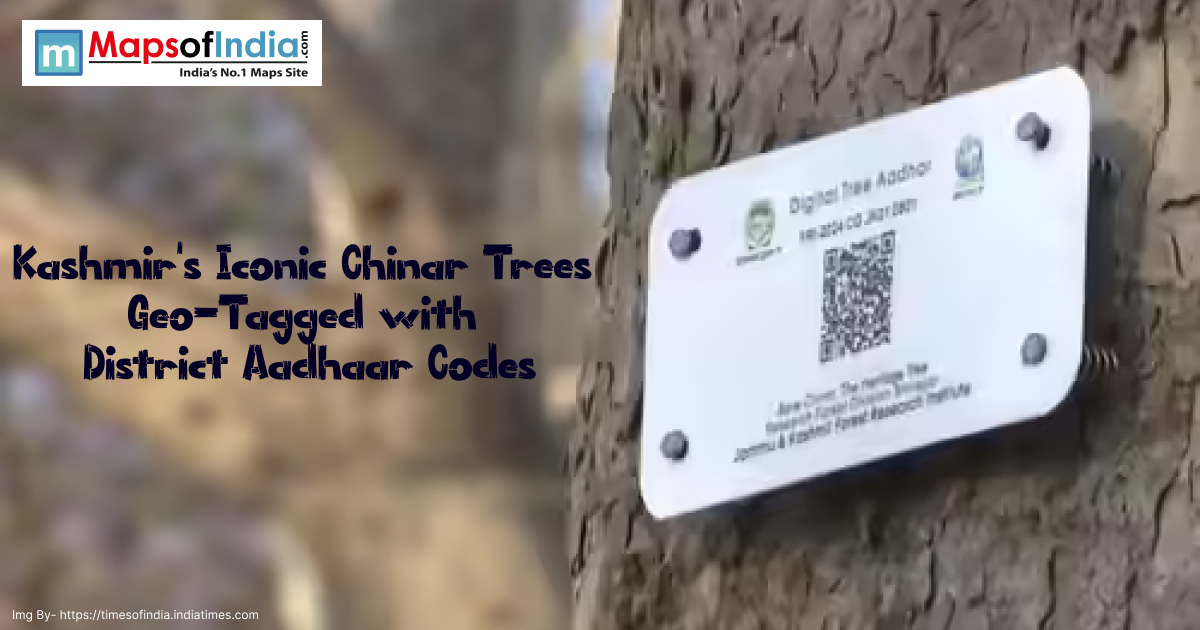
To tackle this problem, the Jammu and Kashmir administration has launched a first-of-its-kind geo-tagging & coding project for laser-unique identification of all chinar trees in the region. This initiative also aims to create a comprehensive digital web of chinar trees allowing improved tracking, monitoring, management, etc. These trees are then geo-tagged using GPS technology to capture their exact position. Moreover, every single tree is given a unique code, akin to an Aadhaar number, which acts as its digital identity. Tap on this unique code to access detailed information about the tree, such as its age, health status, height, girth and canopy spread.Objectives of the Initiative
The geo-tagging initiative aims to achieve the following:- For Preservation and Conservation: The mapping process can have preservation and conservation implications; once the trees are mapped, the authorities are better equipped to protect them.
- Preventing Illegal Fellings: This diminishes the opportunity for illegal logging and ultimately puts at risk one of the greatest assets that will remain untouched in particular regions– the trees.
- Relevance to Ecosystem and Climate: Researchers aiming to understand the ecological and climatic role of chinar trees find the database invaluable.
- Raise Awareness: As part of the initiative, it seeks to make the public aware of its importance and motivate local people to take conservation measures.