 Sweet Boondi[/caption]
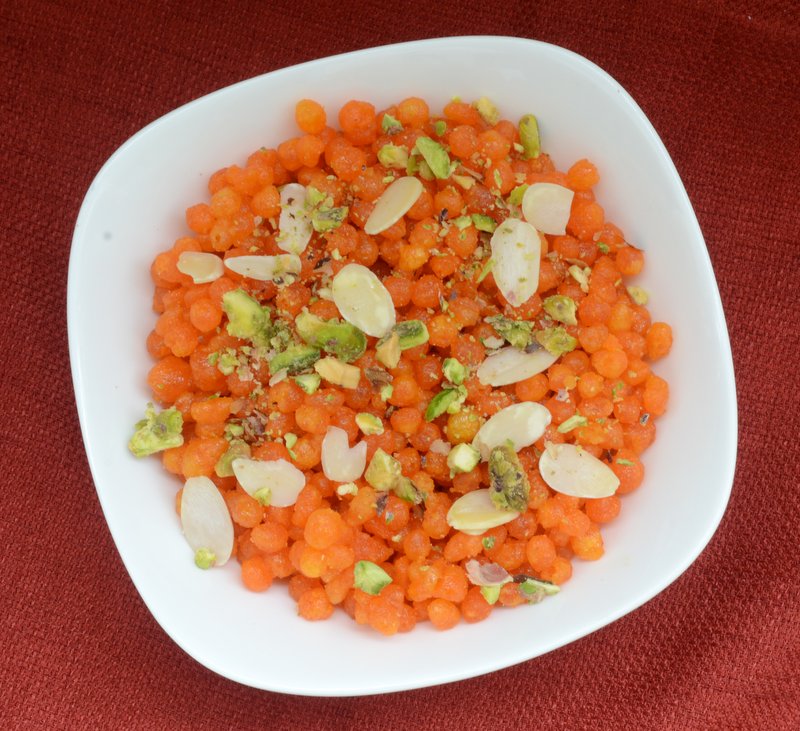
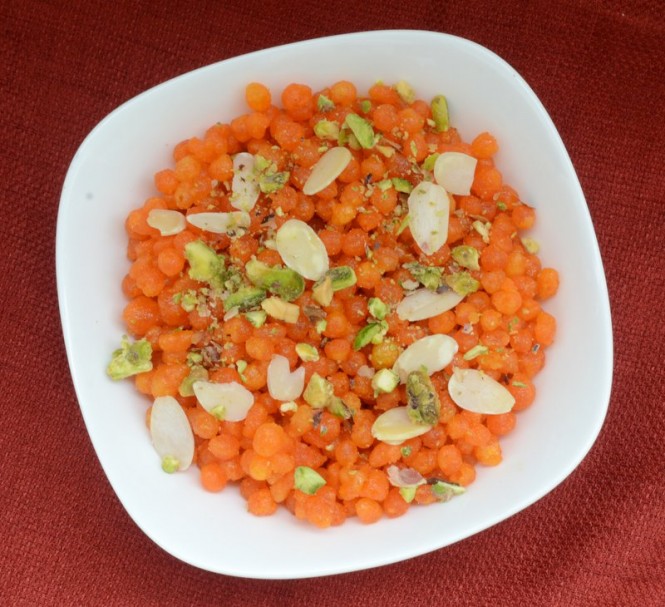
Sweet Boondi has a special significance in the north India, where its consumption increases many fold specially on Tuesdays when it is offered to Lord Hanuman as prasad. On these days, Sweet Boondi can be found in literally all sweet shops kept in a large parat (a big plate with raised edges), generally silver or golden in colour giving it a royal look. As kids we used to look forward to go to temples and have this as prasad. Since then I've loved a handful of Sweet Boondi after meals. Boondi is made with besan (gram flour) and could be had as itself, or even be presented in the form of boondi laddu. As it is deep fried, it can be kept for a few days although the taste starts to loose out after the second day. I also like to have some dry fruits sprinkled over the sweet which further enhances the appeal. Whatever way you like it, prepare it with this simple recipe, offer it as prasad, or just enjoy at home.
Sweet Boondi[/caption]
Sweet Boondi has a special significance in the north India, where its consumption increases many fold specially on Tuesdays when it is offered to Lord Hanuman as prasad. On these days, Sweet Boondi can be found in literally all sweet shops kept in a large parat (a big plate with raised edges), generally silver or golden in colour giving it a royal look. As kids we used to look forward to go to temples and have this as prasad. Since then I've loved a handful of Sweet Boondi after meals. Boondi is made with besan (gram flour) and could be had as itself, or even be presented in the form of boondi laddu. As it is deep fried, it can be kept for a few days although the taste starts to loose out after the second day. I also like to have some dry fruits sprinkled over the sweet which further enhances the appeal. Whatever way you like it, prepare it with this simple recipe, offer it as prasad, or just enjoy at home.
Sweet Boondi[/caption]
Sweet Boondi has a special significance in the north India, where its consumption increases many fold specially on Tuesdays when it is offered to Lord Hanuman as prasad. On these days, Sweet Boondi can be found in literally all sweet shops kept in a large parat (a big plate with raised edges), generally silver or golden in colour giving it a royal look. As kids we used to look forward to go to temples and have this as prasad. Since then I've loved a handful of Sweet Boondi after meals. Boondi is made with besan (gram flour) and could be had as itself, or even be presented in the form of boondi laddu. As it is deep fried, it can be kept for a few days although the taste starts to loose out after the second day. I also like to have some dry fruits sprinkled over the sweet which further enhances the appeal. Whatever way you like it, prepare it with this simple recipe, offer it as prasad, or just enjoy at home.
Sweet Boondi[/caption]
Sweet Boondi has a special significance in the north India, where its consumption increases many fold specially on Tuesdays when it is offered to Lord Hanuman as prasad. On these days, Sweet Boondi can be found in literally all sweet shops kept in a large parat (a big plate with raised edges), generally silver or golden in colour giving it a royal look. As kids we used to look forward to go to temples and have this as prasad. Since then I've loved a handful of Sweet Boondi after meals. Boondi is made with besan (gram flour) and could be had as itself, or even be presented in the form of boondi laddu. As it is deep fried, it can be kept for a few days although the taste starts to loose out after the second day. I also like to have some dry fruits sprinkled over the sweet which further enhances the appeal. Whatever way you like it, prepare it with this simple recipe, offer it as prasad, or just enjoy at home.