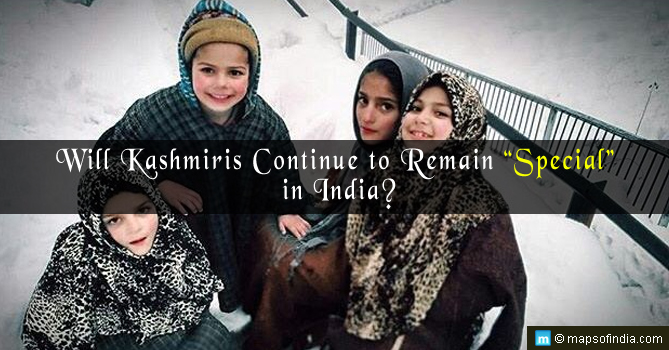
 Article 370 provides autonomous status to Jammu and Kashmir, drafted in Constitution’s Part XXI.[/caption]
The question whether Kashmiris will continue to remain “special” in India is revisited after a recent central ordinance that has extended reservations to both Scheduled Castes (SCs) and Scheduled Tribes (STs) in Jammu and Kashmir. This ordinance has put the spotlight on Article 35A and Article 370 (from which 35A has been derived). The recent central ordinance has shaken the regional political leadership and they have warned the Union Government against any attempt at diluting Article 35A.
To discuss further on this issue it is important to check the constitutional articles – the parent provision Article 370 and its offshoot Article 35A. Let’s take a closer look.
Article 370 provides autonomous status to Jammu and Kashmir, drafted in Constitution’s Part XXI.[/caption]
The question whether Kashmiris will continue to remain “special” in India is revisited after a recent central ordinance that has extended reservations to both Scheduled Castes (SCs) and Scheduled Tribes (STs) in Jammu and Kashmir. This ordinance has put the spotlight on Article 35A and Article 370 (from which 35A has been derived). The recent central ordinance has shaken the regional political leadership and they have warned the Union Government against any attempt at diluting Article 35A.
To discuss further on this issue it is important to check the constitutional articles – the parent provision Article 370 and its offshoot Article 35A. Let’s take a closer look.
Article 370 provides autonomous status to Jammu and Kashmir, drafted in Constitution’s Part XXI.[/caption]
The question whether Kashmiris will continue to remain “special” in India is revisited after a recent central ordinance that has extended reservations to both Scheduled Castes (SCs) and Scheduled Tribes (STs) in Jammu and Kashmir. This ordinance has put the spotlight on Article 35A and Article 370 (from which 35A has been derived). The recent central ordinance has shaken the regional political leadership and they have warned the Union Government against any attempt at diluting Article 35A.
To discuss further on this issue it is important to check the constitutional articles – the parent provision Article 370 and its offshoot Article 35A. Let’s take a closer look.
Article 370 provides autonomous status to Jammu and Kashmir, drafted in Constitution’s Part XXI.[/caption]
The question whether Kashmiris will continue to remain “special” in India is revisited after a recent central ordinance that has extended reservations to both Scheduled Castes (SCs) and Scheduled Tribes (STs) in Jammu and Kashmir. This ordinance has put the spotlight on Article 35A and Article 370 (from which 35A has been derived). The recent central ordinance has shaken the regional political leadership and they have warned the Union Government against any attempt at diluting Article 35A.
To discuss further on this issue it is important to check the constitutional articles – the parent provision Article 370 and its offshoot Article 35A. Let’s take a closer look.