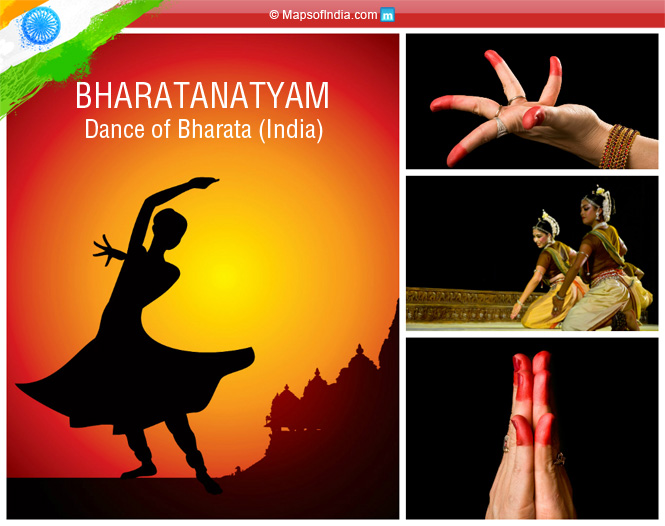
 Sadir, Chinnamelan and Dasi Attam or Daasiyattam are the original names of the classical Indian dance form Bharatanatyam that is said to be originated in the temples of Thanjavoor, Tamil Nadu performed by Devdasis. Devdasis were the women who dedicated their entire life to God and used to pay their obeisance through dance. With time Rajanartakis started performing Bharatanatyam at the royal courts. Present form of the dance has been recreated from Sadir. Lord Shiva is the God of Bharatanatyam.
Name Bharatanatyam has originated from three fundamental concepts i.e. Bhava (expressions), Raga (melody) and Tala (rhythm). Literally Bharat Natyam means the dance of Bharata (India).
Historical Background
Natya Shastra, the oldest dissertation on dance written around 500 BC to 500 AD contains the details of various old dance forms. According to this treatise . Devdasis who were the young beautiful girls married to God and devoted their entire life to God used to perform Bharatanatyam to worship him. They also used to perform it as a sacred dance during temple ceremonies. Devdasis were very influential figures and no temple ceremony used to take place without them and their performance.
Then came a change in the hereditary of Bharatnatyam and temple support. Modification in these moved Bharatnatyam from temples to courts. It became a source of entertainment rather than worshipping. Further downfall has been noticed in the dance as well as dancing girls with British rule.
To stop further degradation and downfall some dance enthusiasts started preserving the oldest art form of India. Many families of devdasis and dance teachers preserved it and made it a family tradition.
With collective efforts, Bharatanatyam has regained its lost glory and now it has moved to stage as a highly specialized classical dance form.
Aspects of Bharatanatyam
Nritta – Dance based on music in which the dancer interprets the rhythm. Dance is executed by forming geometrical patterns in space. Viewers get easily connected as no technical background is required to understand this dance. It is the most popular form of Bharatanatayam.
Natya – Dancer dances to bring out the meaning of a poem. Movements, expressions and gestures of dancer dance out the meaning and everything looks like a part of the story. Sometimes a solo dancer impersonate up to 3-4 characters.
Nritya –Nritta and Natya are combined to give a balanced Nritya in Bharatanatyam. Dancer needs to be very cautious while performing Nritya.
Sadir, Chinnamelan and Dasi Attam or Daasiyattam are the original names of the classical Indian dance form Bharatanatyam that is said to be originated in the temples of Thanjavoor, Tamil Nadu performed by Devdasis. Devdasis were the women who dedicated their entire life to God and used to pay their obeisance through dance. With time Rajanartakis started performing Bharatanatyam at the royal courts. Present form of the dance has been recreated from Sadir. Lord Shiva is the God of Bharatanatyam.
Name Bharatanatyam has originated from three fundamental concepts i.e. Bhava (expressions), Raga (melody) and Tala (rhythm). Literally Bharat Natyam means the dance of Bharata (India).
Historical Background
Natya Shastra, the oldest dissertation on dance written around 500 BC to 500 AD contains the details of various old dance forms. According to this treatise . Devdasis who were the young beautiful girls married to God and devoted their entire life to God used to perform Bharatanatyam to worship him. They also used to perform it as a sacred dance during temple ceremonies. Devdasis were very influential figures and no temple ceremony used to take place without them and their performance.
Then came a change in the hereditary of Bharatnatyam and temple support. Modification in these moved Bharatnatyam from temples to courts. It became a source of entertainment rather than worshipping. Further downfall has been noticed in the dance as well as dancing girls with British rule.
To stop further degradation and downfall some dance enthusiasts started preserving the oldest art form of India. Many families of devdasis and dance teachers preserved it and made it a family tradition.
With collective efforts, Bharatanatyam has regained its lost glory and now it has moved to stage as a highly specialized classical dance form.
Aspects of Bharatanatyam
Nritta – Dance based on music in which the dancer interprets the rhythm. Dance is executed by forming geometrical patterns in space. Viewers get easily connected as no technical background is required to understand this dance. It is the most popular form of Bharatanatayam.
Natya – Dancer dances to bring out the meaning of a poem. Movements, expressions and gestures of dancer dance out the meaning and everything looks like a part of the story. Sometimes a solo dancer impersonate up to 3-4 characters.
Nritya –Nritta and Natya are combined to give a balanced Nritya in Bharatanatyam. Dancer needs to be very cautious while performing Nritya.
Sadir, Chinnamelan and Dasi Attam or Daasiyattam are the original names of the classical Indian dance form Bharatanatyam that is said to be originated in the temples of Thanjavoor, Tamil Nadu performed by Devdasis. Devdasis were the women who dedicated their entire life to God and used to pay their obeisance through dance. With time Rajanartakis started performing Bharatanatyam at the royal courts. Present form of the dance has been recreated from Sadir. Lord Shiva is the God of Bharatanatyam.
Name Bharatanatyam has originated from three fundamental concepts i.e. Bhava (expressions), Raga (melody) and Tala (rhythm). Literally Bharat Natyam means the dance of Bharata (India).
Historical Background
Natya Shastra, the oldest dissertation on dance written around 500 BC to 500 AD contains the details of various old dance forms. According to this treatise . Devdasis who were the young beautiful girls married to God and devoted their entire life to God used to perform Bharatanatyam to worship him. They also used to perform it as a sacred dance during temple ceremonies. Devdasis were very influential figures and no temple ceremony used to take place without them and their performance.
Then came a change in the hereditary of Bharatnatyam and temple support. Modification in these moved Bharatnatyam from temples to courts. It became a source of entertainment rather than worshipping. Further downfall has been noticed in the dance as well as dancing girls with British rule.
To stop further degradation and downfall some dance enthusiasts started preserving the oldest art form of India. Many families of devdasis and dance teachers preserved it and made it a family tradition.
With collective efforts, Bharatanatyam has regained its lost glory and now it has moved to stage as a highly specialized classical dance form.
Aspects of Bharatanatyam
Nritta – Dance based on music in which the dancer interprets the rhythm. Dance is executed by forming geometrical patterns in space. Viewers get easily connected as no technical background is required to understand this dance. It is the most popular form of Bharatanatayam.
Natya – Dancer dances to bring out the meaning of a poem. Movements, expressions and gestures of dancer dance out the meaning and everything looks like a part of the story. Sometimes a solo dancer impersonate up to 3-4 characters.
Nritya –Nritta and Natya are combined to give a balanced Nritya in Bharatanatyam. Dancer needs to be very cautious while performing Nritya.
Sadir, Chinnamelan and Dasi Attam or Daasiyattam are the original names of the classical Indian dance form Bharatanatyam that is said to be originated in the temples of Thanjavoor, Tamil Nadu performed by Devdasis. Devdasis were the women who dedicated their entire life to God and used to pay their obeisance through dance. With time Rajanartakis started performing Bharatanatyam at the royal courts. Present form of the dance has been recreated from Sadir. Lord Shiva is the God of Bharatanatyam.
Name Bharatanatyam has originated from three fundamental concepts i.e. Bhava (expressions), Raga (melody) and Tala (rhythm). Literally Bharat Natyam means the dance of Bharata (India).
Historical Background
Natya Shastra, the oldest dissertation on dance written around 500 BC to 500 AD contains the details of various old dance forms. According to this treatise . Devdasis who were the young beautiful girls married to God and devoted their entire life to God used to perform Bharatanatyam to worship him. They also used to perform it as a sacred dance during temple ceremonies. Devdasis were very influential figures and no temple ceremony used to take place without them and their performance.
Then came a change in the hereditary of Bharatnatyam and temple support. Modification in these moved Bharatnatyam from temples to courts. It became a source of entertainment rather than worshipping. Further downfall has been noticed in the dance as well as dancing girls with British rule.
To stop further degradation and downfall some dance enthusiasts started preserving the oldest art form of India. Many families of devdasis and dance teachers preserved it and made it a family tradition.
With collective efforts, Bharatanatyam has regained its lost glory and now it has moved to stage as a highly specialized classical dance form.
Aspects of Bharatanatyam
Nritta – Dance based on music in which the dancer interprets the rhythm. Dance is executed by forming geometrical patterns in space. Viewers get easily connected as no technical background is required to understand this dance. It is the most popular form of Bharatanatayam.
Natya – Dancer dances to bring out the meaning of a poem. Movements, expressions and gestures of dancer dance out the meaning and everything looks like a part of the story. Sometimes a solo dancer impersonate up to 3-4 characters.
Nritya –Nritta and Natya are combined to give a balanced Nritya in Bharatanatyam. Dancer needs to be very cautious while performing Nritya.