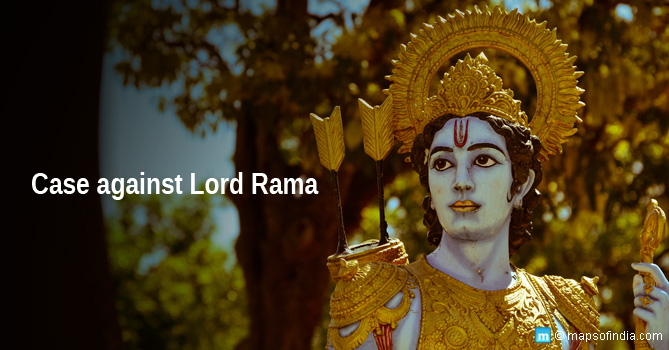
 A petition has been filed against Lord Ram for abandoning his wife Sita in the aftermath of her return from Lanka. The petition was filed against both Lord Rama and his brother Laxman, in a Bihar court, by a local lawyer Thakur Chandan Kumar Singh, seeking justice for Sita, since she was the daughter of Mithila and came from Bihar.
The case was heard by a Chief Judicial Magistrate in Sitamarhi on 1 February 2016 who asked the petitioner why he was filing a case on an incident that supposedly took place in ancient times? He also asked who would be the witness in the case and sought the date when the incident happened.
While the case will take its own legal time and turn, it does raise two important issues – should the courts allow cases to be filed for mythological stories, characters, incidents and issues? The second issue pertains to the potential debate and polarization that such cases may generate in contemporary society.
In Hindu mythology there are over 25,000 gods, with all kinds of related stories, incidents and interpretations associated with each god. Therefore, any number of cases could be filed on any number of issues and by any number of communities or sections of society that would interpret them in their own way.
Just as this case is likely to take up precious time of the court in lieu of other cases that need urgent attention, if not rejected outright, courts could soon be flooded by similar cases, each filed to serve their own agendas.
But the case does open us to an academic debate on the interpretation of the epic and on the ethics pertaining to Lord Rama’s decision to send his wife Sita to live alone in the jungle, just because one washerwoman happened to make an unsavoury remark regarding Lord Rama’s decision to take back Sita.
We first need to understand that the Ramayana was written a very long time back when society was very different from what it is today and therefore, the value systems were based on social conditions that were prevailing at the time. To take up an incident or decision taken during that period and try and find justification in contemporary times, may not be entirely fair, though many lessons can be taken and interpreted to serve as a guide in our lives today. That choice of interpretation must be left to each individual.
However, for the sake of debate, let’s look at the Ramayana. There are several versions with different interpretations, but I have taken C. Rajagopalachari’s English translation of the Ramayana as a reference.
A petition has been filed against Lord Ram for abandoning his wife Sita in the aftermath of her return from Lanka. The petition was filed against both Lord Rama and his brother Laxman, in a Bihar court, by a local lawyer Thakur Chandan Kumar Singh, seeking justice for Sita, since she was the daughter of Mithila and came from Bihar.
The case was heard by a Chief Judicial Magistrate in Sitamarhi on 1 February 2016 who asked the petitioner why he was filing a case on an incident that supposedly took place in ancient times? He also asked who would be the witness in the case and sought the date when the incident happened.
While the case will take its own legal time and turn, it does raise two important issues – should the courts allow cases to be filed for mythological stories, characters, incidents and issues? The second issue pertains to the potential debate and polarization that such cases may generate in contemporary society.
In Hindu mythology there are over 25,000 gods, with all kinds of related stories, incidents and interpretations associated with each god. Therefore, any number of cases could be filed on any number of issues and by any number of communities or sections of society that would interpret them in their own way.
Just as this case is likely to take up precious time of the court in lieu of other cases that need urgent attention, if not rejected outright, courts could soon be flooded by similar cases, each filed to serve their own agendas.
But the case does open us to an academic debate on the interpretation of the epic and on the ethics pertaining to Lord Rama’s decision to send his wife Sita to live alone in the jungle, just because one washerwoman happened to make an unsavoury remark regarding Lord Rama’s decision to take back Sita.
We first need to understand that the Ramayana was written a very long time back when society was very different from what it is today and therefore, the value systems were based on social conditions that were prevailing at the time. To take up an incident or decision taken during that period and try and find justification in contemporary times, may not be entirely fair, though many lessons can be taken and interpreted to serve as a guide in our lives today. That choice of interpretation must be left to each individual.
However, for the sake of debate, let’s look at the Ramayana. There are several versions with different interpretations, but I have taken C. Rajagopalachari’s English translation of the Ramayana as a reference.
A petition has been filed against Lord Ram for abandoning his wife Sita in the aftermath of her return from Lanka. The petition was filed against both Lord Rama and his brother Laxman, in a Bihar court, by a local lawyer Thakur Chandan Kumar Singh, seeking justice for Sita, since she was the daughter of Mithila and came from Bihar.
The case was heard by a Chief Judicial Magistrate in Sitamarhi on 1 February 2016 who asked the petitioner why he was filing a case on an incident that supposedly took place in ancient times? He also asked who would be the witness in the case and sought the date when the incident happened.
While the case will take its own legal time and turn, it does raise two important issues – should the courts allow cases to be filed for mythological stories, characters, incidents and issues? The second issue pertains to the potential debate and polarization that such cases may generate in contemporary society.
In Hindu mythology there are over 25,000 gods, with all kinds of related stories, incidents and interpretations associated with each god. Therefore, any number of cases could be filed on any number of issues and by any number of communities or sections of society that would interpret them in their own way.
Just as this case is likely to take up precious time of the court in lieu of other cases that need urgent attention, if not rejected outright, courts could soon be flooded by similar cases, each filed to serve their own agendas.
But the case does open us to an academic debate on the interpretation of the epic and on the ethics pertaining to Lord Rama’s decision to send his wife Sita to live alone in the jungle, just because one washerwoman happened to make an unsavoury remark regarding Lord Rama’s decision to take back Sita.
We first need to understand that the Ramayana was written a very long time back when society was very different from what it is today and therefore, the value systems were based on social conditions that were prevailing at the time. To take up an incident or decision taken during that period and try and find justification in contemporary times, may not be entirely fair, though many lessons can be taken and interpreted to serve as a guide in our lives today. That choice of interpretation must be left to each individual.
However, for the sake of debate, let’s look at the Ramayana. There are several versions with different interpretations, but I have taken C. Rajagopalachari’s English translation of the Ramayana as a reference.
A petition has been filed against Lord Ram for abandoning his wife Sita in the aftermath of her return from Lanka. The petition was filed against both Lord Rama and his brother Laxman, in a Bihar court, by a local lawyer Thakur Chandan Kumar Singh, seeking justice for Sita, since she was the daughter of Mithila and came from Bihar.
The case was heard by a Chief Judicial Magistrate in Sitamarhi on 1 February 2016 who asked the petitioner why he was filing a case on an incident that supposedly took place in ancient times? He also asked who would be the witness in the case and sought the date when the incident happened.
While the case will take its own legal time and turn, it does raise two important issues – should the courts allow cases to be filed for mythological stories, characters, incidents and issues? The second issue pertains to the potential debate and polarization that such cases may generate in contemporary society.
In Hindu mythology there are over 25,000 gods, with all kinds of related stories, incidents and interpretations associated with each god. Therefore, any number of cases could be filed on any number of issues and by any number of communities or sections of society that would interpret them in their own way.
Just as this case is likely to take up precious time of the court in lieu of other cases that need urgent attention, if not rejected outright, courts could soon be flooded by similar cases, each filed to serve their own agendas.
But the case does open us to an academic debate on the interpretation of the epic and on the ethics pertaining to Lord Rama’s decision to send his wife Sita to live alone in the jungle, just because one washerwoman happened to make an unsavoury remark regarding Lord Rama’s decision to take back Sita.
We first need to understand that the Ramayana was written a very long time back when society was very different from what it is today and therefore, the value systems were based on social conditions that were prevailing at the time. To take up an incident or decision taken during that period and try and find justification in contemporary times, may not be entirely fair, though many lessons can be taken and interpreted to serve as a guide in our lives today. That choice of interpretation must be left to each individual.
However, for the sake of debate, let’s look at the Ramayana. There are several versions with different interpretations, but I have taken C. Rajagopalachari’s English translation of the Ramayana as a reference.