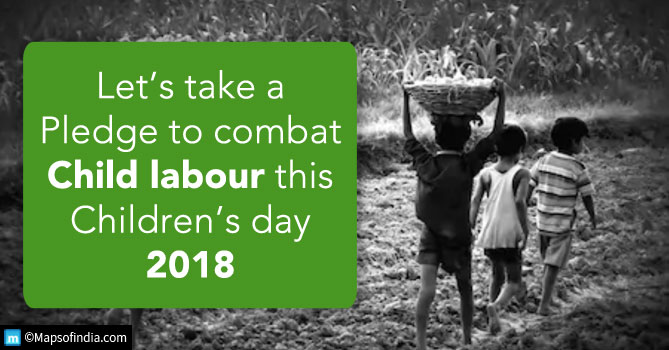
 Let's take a pledge to combat Child Labour this Children's Day 2019[/caption]
Children are the future of any nation. They are the very foundation on which the development and success of a nation can be established. India celebrates its children on November 14 every year. Known as Children’s Day (Baal Divas), this day commemorates the birth date of the erstwhile Prime Minister of India, Pandit Jawaharlal Nehru.
Pandit Nehru, fondly known as Chacha Nehru was very fond of children, and worked towards their development and progress through the establishment of various educational institutions; as well as planning for their free primary education, free meals including milk to the school children in order to prevent child malnutrition in India. Children’s Day is a time to re-establish the awareness among the people of India of the importance of safeguarding the rights and privileges of the children, for they are the future of our nation.
India and its Children
While India celebrates Children’s Day on November 14 every year, the state of children in the nation is a far cry from what it is supposed to be. Child labour is a menace and India is at the forefront in this regard. India is sadly the home to the largest number of child labourers in the world.
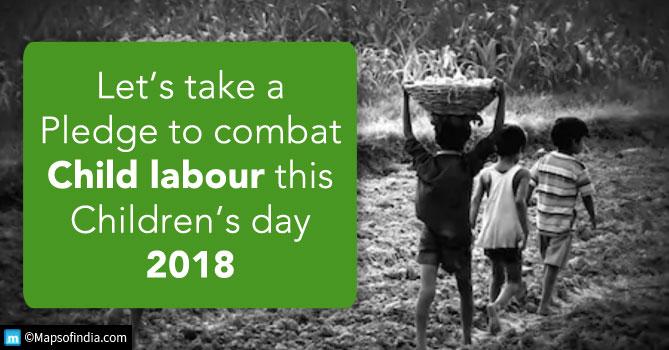
Let's take a pledge to combat Child Labour this Children's Day 2019[/caption]
Children are the future of any nation. They are the very foundation on which the development and success of a nation can be established. India celebrates its children on November 14 every year. Known as Children’s Day (Baal Divas), this day commemorates the birth date of the erstwhile Prime Minister of India, Pandit Jawaharlal Nehru.
Pandit Nehru, fondly known as Chacha Nehru was very fond of children, and worked towards their development and progress through the establishment of various educational institutions; as well as planning for their free primary education, free meals including milk to the school children in order to prevent child malnutrition in India. Children’s Day is a time to re-establish the awareness among the people of India of the importance of safeguarding the rights and privileges of the children, for they are the future of our nation.
India and its Children
While India celebrates Children’s Day on November 14 every year, the state of children in the nation is a far cry from what it is supposed to be. Child labour is a menace and India is at the forefront in this regard. India is sadly the home to the largest number of child labourers in the world.
- As per a census conducted in 2011, there are 82 lakh child labourers in India. About 4,00,000 children, mostly girls, are employed in cottonseed production across the country, toiling 14-16 hours a day.
- 40% of the labour in a precious stone cutting sector is children.
- Child labourers are being employed in the mining industry in Bellary District in Karnataka in spite of a harsh ban on the same.
- The Zari and Embroidery industries in urban areas employ children as unskilled labour.
- Even in this day of progress and development, India faces the issue of bonded labour, where children are under a bond to work against a sum of money taken as a loan by the parents.
- While the agricultural sector sees the maximum number of child bonded labour, in recent times this menace has seeped into other sectors including beedi-rolling, brick kilns, carpet weaving, commercial sexual exploitation, construction, fireworks and matches factories, hotels, hybrid cottonseed production, leather, mines, quarries, silk, synthetic gems, and many others.
- Last but not least is the employment of children as domestic workers where there is no regulation. Children are literally slaves and work for very low wages. Cases of sexual, physical and emotional abuse are very common in the case of children working as domestic help.
- Laws that protect children from hazardous labour are not being implemented properly, and therefore, ineffective.
- The actual number of child labourers goes undetected because of the vast area and population of the country.
- There is a lack of quality education in the country, which is resulting in school dropouts among the poor children, who then join the labour force with no skills whatsoever.
- As per Article 24, children below the age of 14 are not to be employed in any factory or in any hazardous employment.
- Article 39 (f) protects children and youth from exploitation and moral and material abandonment.
- Article 45 requires the State to provide free and compulsory education for all children until they complete the age of 14 years.
- Article 14 provides equality before the law and equal protection of laws.
- Article 15 (3) empowers the State to make special legal provision for children. It makes a mandate to the government to ensure children’s welfare constitutionally.
- Article 23 puts the total ban on forced labour & is punishable under the Act.
- Article 51 A clause (k) & (j) states that the parent or the guardian has to provide opportunities for education to his child or as the case may be ward between the age of 6- 14 yrs.
- Preamble Commitment: Justice, liberty, equality, & fraternity for all the citizens including children are the main purpose of the Constitution.
- Directive principles in the Constitution of India also provide protection for children such as Article 41, Article 42, Article 45, & Article 47.
- The Factories Act of 1948 prevents the employment of children below 14 years in any factory.
- The Mines Act of 1952 prohibits the employment of children below the age of 18 years.
- The Child Labour (Prohibition and Regulation) Act of 1986 prevents the employment of children below the age of 14 years in life-threatening occupations identified in a list by the law.
- The Juvenile Justice (Care and Protection) of Children Act of 2000 made the employment of children a punishable offense.
- Strict implementation of labour laws is essential in order to prevent exploitation of children by parties or multinational companies.
- Amendments are required in the present child labour prohibition law in order to implement strict measures to control the situation.
- The minimum working age of fourteen years needs to be increased to at least eighteen.
- The Government should take steps towards abolition of child trafficking, elimination of poverty, free and compulsory education, and providing the basic standards of living to one and all.
- The World Bank and International Monetary Fund should be approached for a loan for the purpose of removing the vast gap between the rich and poor in India.
- Let’s stop employing children in our homes as domestic help.
- Let’s fund the education of at least one poor child in our lifetime.
- Let’s inform the nearest NGO when we see child beggars at traffic signals or children employed in tea stalls and roadside eateries.