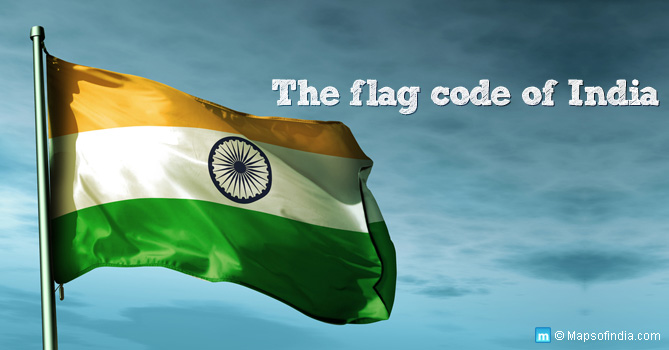
- The Indian Tricolour flag is made up of three equal rectangular bands - saffron on top, white in the middle, and green in the bottom. The length height ratio of the flag is 3:2.
- The dark blue Ashoka Chakra in the middle band has 24 spokes.
- A standard flag is made of handspun cotton or silk or khadi.
| Standard Flag Dimensions | |
| Flag size No. | Dimensions in millimetres |
| 1 | 6300 × 4200 |
| 2 | 3600 × 2400 |
| 3 | 2700 × 1800 |
| 4 | 1800 × 1200 |
| 5 | 1350 × 900 |
| 6 | 900 × 600 |
| 7 | 450 × 300 |
| 8 | 225 × 150 |
| 9 | 150 × 100 |
- The Indian national flag should always occupy a position of honour and should be distinctly placed in any setting.
- When flown over public buildings the national flag should be flown from sunrise to sunset.
- The flag should always be hoisted at a brisk pace and lowered slowly.
- The saffron band must always be displayed the top most band or the right (of the flag) band (in case of vertical display). It is an offence to display the flag in an inverted position (saffron side down).
- Display of a damaged or a disheveled flag is also an offence. The national flag should not be dipped on any occasion.
- The national flag of India should not be used as a festoon or a decoration, or allowed to touch the ground. It is not to be used as an advertisement, garment or wrap of any sort.
- It cannot be torn, damaged, burnt, or disrespected in any manner. The disposal of a flag should be done as a whole, in private, preferably by burning.
- It is also an offence to draw or deface the flag with any inscription or graffiti.
- Only in the event of the funeral of an armed forces personnel or member of the state or central para military forces, may the flag be used to cover the coffin but must be removed before the person is buried or cremated.
- While hoisting and lowering the flag or during a parade, all people present should face the flag and stand at attention while persons in uniform should stand at attention and salute.
- When displayed with flags of other countries, the Indian national flag should be displayed to the extreme right of the row (left of the audience) or at the start of the circle.
- The flag should be flown in the official residences of the President, Vice President, Governor, Lt Governor, and atop public buildings such as High Courts, Secretariats, Commissioners’ Offices, Collectorates, Jails and offices of the District Boards, Municipalities and Zilla Parishads and Departmental/Public Sector Undertakings.
- Only dignitaries mentioned in the code such as President, Vice-President, Governors and Lieutenant Governors, PM and Cabinet Ministers, Heads of Indian Missions/Posts abroad, Chief Justice of India and a few others are allowed use of national flag in their cars.
- The Indian National flag is flown at half mast throughout the country as a mark of national mourning in the event of the death of the President or Vice-president or the Prime Minister of India.
- In case of the death of a Governor, Lt. Governor, Chief Minister, the national flag is flown at half mast through the state or the Union Territory.
- In case of Indian missions abroad, the Indian national flag is flown at half mast only in event of the death of the Head of State or the Head of Government of the state in which the mission is located.
- Before lowering the national flag to half mast mark, it is raised to the top of the mast. This is to position the pride of the nation and its honour over all other concerns at all times.
- Pingali Venkayya was an Indian freedom fighter who designed an early version of the tricolour on which the Indian national flag is now based.
- On July 22, 1947, the Constituent Assembly adopted the Indian national flag in its current form during one of its meetings.
- On May 29, 1953, when Edmund Hillary and Tenzing Norgay conquered Mt Everest for the first time, they hoisted the Indian flag along with the Union Jack and the flags of Nepal and the UN.
- Wing Commander Rakesh Sharma took the Indian national flag to outer space when he became the first Indian national to fly into space in 1984.
- On April 21, 1996, Sqn Ldr Sanjay Thapar became the first Indian to hoist the Indian flag on the North Pole when he bailed out of an MI 8 chopper at 10,000 feet.
- On January 23, 2004, the honourable Supreme Court held that the Right to fly the National Flag freely with respect and dignity is a fundamental right of a citizen within the meaning of Article 19(1) (a) of the Constitution of India. But the fundamental right to fly National Flag is not an absolute right but a qualified one being subject to reasonable restrictions under clause 2 of Article 19 of the Constitution of India. The Emblems and Names (Prevention of Improper Use) Act, 1950 and the Prevention of Insults to National Honour Act, 1971 regulate the use of the National Flag.
- On December 7, 2014, 50,000 people formed a human (Indian) national flag setting Guinness Record for Largest Human Flag in the world.
- On January 23, 2016, the tallest Indian flag was hoisted on a 293-foot pole. The flag itself measured 99x66 feet.
- On February 18, 2016, the MHRD decreed that the national flag will fly on a minimum 207-feet high mast on the premises of all centre sponsored universities of India.