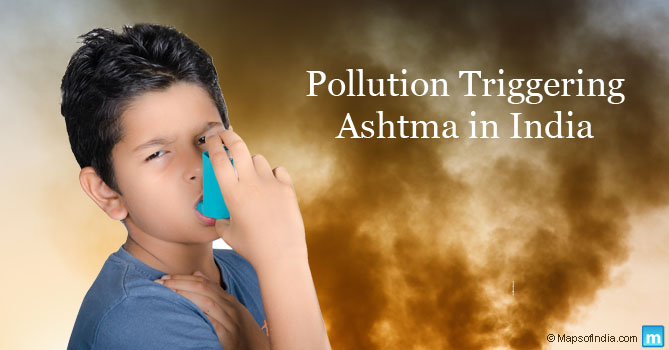
 Recently, a nation-wide survey called ‘Breath Blue 15’ concluded that the lung health of children in metropolitan cities of India is poor. In all, 2000 children in the age group of 8-14 years were screened for lung health status. 40% of children in Delhi were found to have ratings of ‘bad’ to ‘poor’ lung health, while Bengaluru followed closely with 36%, Kolkata with 35%, and Mumbai with 27%. It is no coincidence that these cities are some of the most polluted cities in the world. Air pollution levels in these cities is at an all-time high, owing to multiple factors such as overcrowding, mass immigration, rise in vehicular population and consequent smoke emission and industrial activity.
Asthma is a chronic non-communicable condition that affects the lungs, and can be a debilitating condition if it is not controlled well. With World Asthma Day being observed on the first Tuesday of May and the entire month being observed as the Asthma Awareness Month, it is time that this condition gets the due attention that it deserves from urban planners and the general public alike. Asthma causes breathlessness, wheezing, respiratory insufficiency, and tightness. It is an allergic response to certain triggering agents, allergens, which is generally dust, pollens, cigarette smoke, pollution, viral infection and other unknown agents.
The World Health Organisation estimates that 235 million people suffer from asthma across the world, and no country, whether developed or developing, is exempt from the public health burden due to the condition. It is a major non-communicable disease among children, and mothers who smoke, or are exposed to passive smoking during pregnancy. They are likely to give birth to asthma-prone children. While studies have not conclusively proved that air pollution can cause new cases of asthma, pre-existing cases are certainly known to worsen when exposed to air pollution. Asthma, along with the other related respiratory condition; chronic obstructive pulmonary disease (COPD), is on the rise across the country, especially in urban areas.
Recently, a nation-wide survey called ‘Breath Blue 15’ concluded that the lung health of children in metropolitan cities of India is poor. In all, 2000 children in the age group of 8-14 years were screened for lung health status. 40% of children in Delhi were found to have ratings of ‘bad’ to ‘poor’ lung health, while Bengaluru followed closely with 36%, Kolkata with 35%, and Mumbai with 27%. It is no coincidence that these cities are some of the most polluted cities in the world. Air pollution levels in these cities is at an all-time high, owing to multiple factors such as overcrowding, mass immigration, rise in vehicular population and consequent smoke emission and industrial activity.
Asthma is a chronic non-communicable condition that affects the lungs, and can be a debilitating condition if it is not controlled well. With World Asthma Day being observed on the first Tuesday of May and the entire month being observed as the Asthma Awareness Month, it is time that this condition gets the due attention that it deserves from urban planners and the general public alike. Asthma causes breathlessness, wheezing, respiratory insufficiency, and tightness. It is an allergic response to certain triggering agents, allergens, which is generally dust, pollens, cigarette smoke, pollution, viral infection and other unknown agents.
The World Health Organisation estimates that 235 million people suffer from asthma across the world, and no country, whether developed or developing, is exempt from the public health burden due to the condition. It is a major non-communicable disease among children, and mothers who smoke, or are exposed to passive smoking during pregnancy. They are likely to give birth to asthma-prone children. While studies have not conclusively proved that air pollution can cause new cases of asthma, pre-existing cases are certainly known to worsen when exposed to air pollution. Asthma, along with the other related respiratory condition; chronic obstructive pulmonary disease (COPD), is on the rise across the country, especially in urban areas.
Recently, a nation-wide survey called ‘Breath Blue 15’ concluded that the lung health of children in metropolitan cities of India is poor. In all, 2000 children in the age group of 8-14 years were screened for lung health status. 40% of children in Delhi were found to have ratings of ‘bad’ to ‘poor’ lung health, while Bengaluru followed closely with 36%, Kolkata with 35%, and Mumbai with 27%. It is no coincidence that these cities are some of the most polluted cities in the world. Air pollution levels in these cities is at an all-time high, owing to multiple factors such as overcrowding, mass immigration, rise in vehicular population and consequent smoke emission and industrial activity.
Asthma is a chronic non-communicable condition that affects the lungs, and can be a debilitating condition if it is not controlled well. With World Asthma Day being observed on the first Tuesday of May and the entire month being observed as the Asthma Awareness Month, it is time that this condition gets the due attention that it deserves from urban planners and the general public alike. Asthma causes breathlessness, wheezing, respiratory insufficiency, and tightness. It is an allergic response to certain triggering agents, allergens, which is generally dust, pollens, cigarette smoke, pollution, viral infection and other unknown agents.
The World Health Organisation estimates that 235 million people suffer from asthma across the world, and no country, whether developed or developing, is exempt from the public health burden due to the condition. It is a major non-communicable disease among children, and mothers who smoke, or are exposed to passive smoking during pregnancy. They are likely to give birth to asthma-prone children. While studies have not conclusively proved that air pollution can cause new cases of asthma, pre-existing cases are certainly known to worsen when exposed to air pollution. Asthma, along with the other related respiratory condition; chronic obstructive pulmonary disease (COPD), is on the rise across the country, especially in urban areas.
Recently, a nation-wide survey called ‘Breath Blue 15’ concluded that the lung health of children in metropolitan cities of India is poor. In all, 2000 children in the age group of 8-14 years were screened for lung health status. 40% of children in Delhi were found to have ratings of ‘bad’ to ‘poor’ lung health, while Bengaluru followed closely with 36%, Kolkata with 35%, and Mumbai with 27%. It is no coincidence that these cities are some of the most polluted cities in the world. Air pollution levels in these cities is at an all-time high, owing to multiple factors such as overcrowding, mass immigration, rise in vehicular population and consequent smoke emission and industrial activity.
Asthma is a chronic non-communicable condition that affects the lungs, and can be a debilitating condition if it is not controlled well. With World Asthma Day being observed on the first Tuesday of May and the entire month being observed as the Asthma Awareness Month, it is time that this condition gets the due attention that it deserves from urban planners and the general public alike. Asthma causes breathlessness, wheezing, respiratory insufficiency, and tightness. It is an allergic response to certain triggering agents, allergens, which is generally dust, pollens, cigarette smoke, pollution, viral infection and other unknown agents.
The World Health Organisation estimates that 235 million people suffer from asthma across the world, and no country, whether developed or developing, is exempt from the public health burden due to the condition. It is a major non-communicable disease among children, and mothers who smoke, or are exposed to passive smoking during pregnancy. They are likely to give birth to asthma-prone children. While studies have not conclusively proved that air pollution can cause new cases of asthma, pre-existing cases are certainly known to worsen when exposed to air pollution. Asthma, along with the other related respiratory condition; chronic obstructive pulmonary disease (COPD), is on the rise across the country, especially in urban areas.