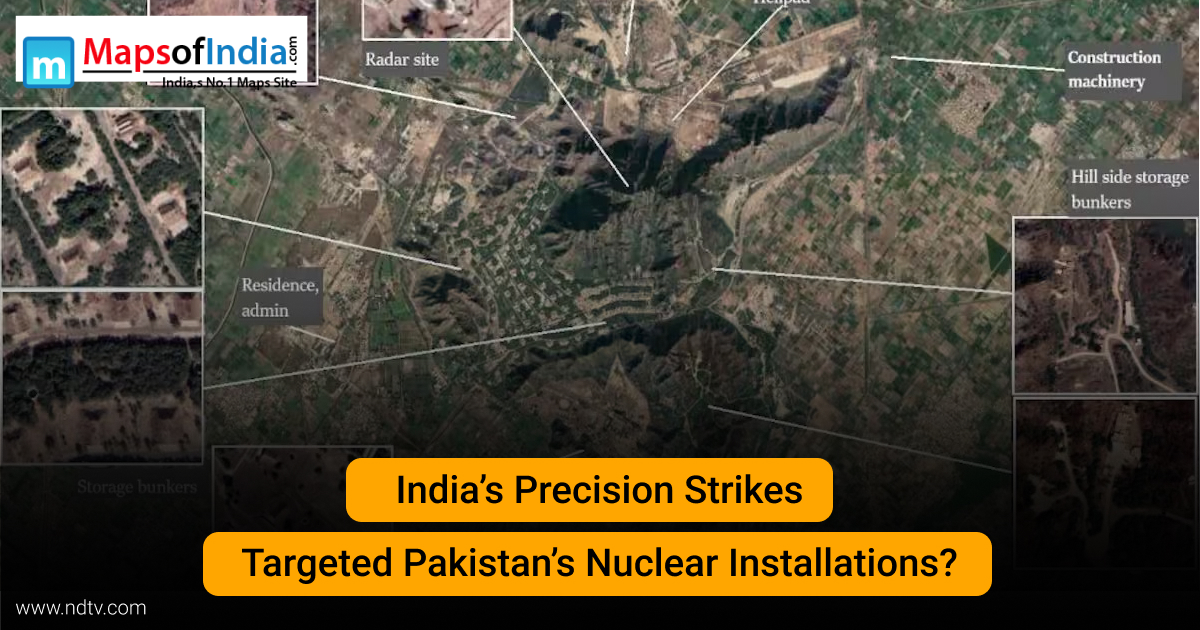
India’s Precision Strikes Targeted Pakistan’s Nuclear Installations?
As a consequence that has kindled fears of escalation in South Asia, reports have emerged indicating that India’s recent wave of accurate strikes may have contained attempts, direct or symbolic, at targeting Pakistan’s nuclear infrastructure. While official statements from both nations remain guarded, independent satellite imagery, open-source intelligence (OSINT), and whispers within diplomatic corridors point toward a dangerous new chapter in Indo-Pak relations. If proven true, such a strike, covert or otherwise, would mark an unprecedented breach of nuclear redlines in the subcontinent, raising the spectre of a wider regional battle.Background: The Escalating Context
The strikes occurred in the backdrop of a surge in cross-border violence, drone incursions, and proxy militant actions. India has alleged that Pakistan-backed proactive companies were accountable for a string of recent aggression in Jammu and Kashmir, including the deadly Pulwama-style convoy surprise in April 2025 that killed 19 Indian paramilitary personnel. Over the past month, India has replied with a string of air and drone strikes across the Line of Control (LoC), targeting terror camps, logistics nodes, and—according to the available information sharp military assets. The timing coincides with India's intensified military exercises in the Arabian Sea and a renewed focus on what officials describe as “strategic preemption.” The question now gripping analysts worldwide: did India cross the nuclear threshold, not by launching nuclear weapons, but by striking infrastructure associated with Pakistan’s nuclear deterrent?The Intelligence Trail: What We Know
Satellite imagery analysed between May 3 and May 10 shows visible disturbances near Pakistan’s known nuclear infrastructure zones—particularly the Khushab Nuclear Complex in Punjab, the Fatehjang missile storage area, and a lesser-known command-and-control node near Sargodha. In at least two of these locations, before-and-after imagery reveals signs of limited structural disruption, unusual heat signatures, and subsequent troop movements.Khushab: A Subtle Message?
The Khushab complex, home to Pakistan’s heavy water reactors and a plutonium production facility, appeared intact on May 5. However, satellite passes on May 8 revealed what analysts from Jane’s Defence Weekly described as “scorch marks and support vehicle displacement” in the northern quadrant of the compound. Although there’s no evidence of a direct hit, nearby roads exhibit signs of emergency roadblocks and blast protection installations that weren’t present previously. A former RAW (Research and Analysis Wing) officer, speaking anonymously, remarked, “India’s ISR [Intelligence, Surveillance, and Reconnaissance] capabilities can target within meters. If these images are accurate, the message may not be about destruction, but deterrence signalling.Pakistan’s Reaction: Denial, Panic, or Preparedness?
The Pakistani military has categorically denied any strikes on or near its nuclear facilities. In a May 10 press conference, ISPR (Inter-Services Public Relations) spokesperson Maj. Gen. Babar Iftikhar stated, “These rumours are malicious fabrications aimed at provoking panic and misrepresentation of facts. Our nuclear command remains secure, operational, and untouched.” Yet internal movements tell another story. On May 9, airspace near Multan, Bahawalpur, and Dera Ghazi Khan was restricted without prior notice. This region is believed to house mobile launch systems and elements of Pakistan’s Strategic Plans Division (SPD). Eyewitnesses in Dera Ghazi Khan reported witnessing unusually high numbers of military convoys during the night, with locals being barred from approaching certain roads. Other conspiracy theories derive from mentions by Pakistani Prime Minister Shehbaz Sharif, who, in a nationwide speech on May 11, stated: “Any attempt to risk our sovereignty, especially our strategic assets, will be met with an unflinching reaction. We will protect every inch of Pakistan.” His words, though vague, were interpreted by many as an indirect exposure of the gravity of India’s current service moves.India’s Silence: Strategic Ambiguity or Tactical Triumph?
 As with previous operations, India has refrained from formally acknowledging the full extent of its strikes. The Indian Ministry of Defence issued a routine statement noting “successful neutralisation of terror-linked infrastructure across the LoC and deep inside hostile territories.”
However, comments from a former National Security Adviser suggest otherwise. “In the new Indian doctrine of proactive deterrence, we may not always seek public credit. Silent strikes serve dual purposes—degrading capabilities and psychologically destabilising the adversary,” said the former official, requesting anonymity.
Some believe this ambiguity serves India’s strategic goals by avoiding direct escalation, yet still communicating resolve. India’s media landscape has also been tightly controlled. While mainstream outlets hinted at “deep penetration operations,” there has been no overt mention of nuclear sites.
As with previous operations, India has refrained from formally acknowledging the full extent of its strikes. The Indian Ministry of Defence issued a routine statement noting “successful neutralisation of terror-linked infrastructure across the LoC and deep inside hostile territories.”
However, comments from a former National Security Adviser suggest otherwise. “In the new Indian doctrine of proactive deterrence, we may not always seek public credit. Silent strikes serve dual purposes—degrading capabilities and psychologically destabilising the adversary,” said the former official, requesting anonymity.
Some believe this ambiguity serves India’s strategic goals by avoiding direct escalation, yet still communicating resolve. India’s media landscape has also been tightly controlled. While mainstream outlets hinted at “deep penetration operations,” there has been no overt mention of nuclear sites.