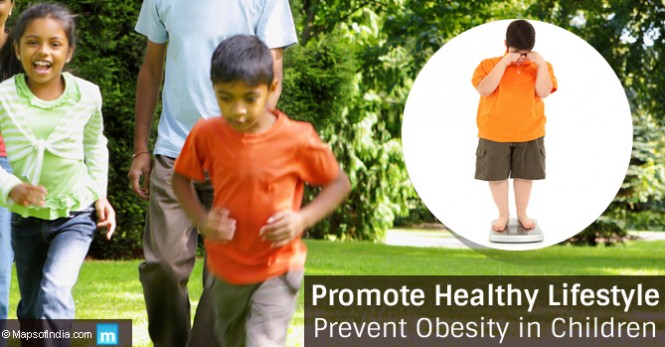
 According to statistics, about 10-20% of children in India are obese. This number increases to up to 30% among adolescents. About 2/3rd of children with obesity continue to be obese in adult life. While obesity was once considered to be a sign of affluence in India, it is now being observed even among the middle and lower middle class populations.
While body-mass index (BMI) is used traditionally as a measure of obesity in adults, it is found to be inappropriate in children. It has to be considered with reference to the child’s age and sex for a more accurate reading. Other measures such as skin-fold thickness, waist-hip ratio, waist circumference, and various scanning techniques are also used to measure obesity in children. Generally, if your child has more than usual flabbiness in arms, thighs and abdomen, if he or she huffs and puffs after minimal physical exertion, or struggles to keep pace with other children, then he or she is likely to have obesity.
According to statistics, about 10-20% of children in India are obese. This number increases to up to 30% among adolescents. About 2/3rd of children with obesity continue to be obese in adult life. While obesity was once considered to be a sign of affluence in India, it is now being observed even among the middle and lower middle class populations.
While body-mass index (BMI) is used traditionally as a measure of obesity in adults, it is found to be inappropriate in children. It has to be considered with reference to the child’s age and sex for a more accurate reading. Other measures such as skin-fold thickness, waist-hip ratio, waist circumference, and various scanning techniques are also used to measure obesity in children. Generally, if your child has more than usual flabbiness in arms, thighs and abdomen, if he or she huffs and puffs after minimal physical exertion, or struggles to keep pace with other children, then he or she is likely to have obesity.
According to statistics, about 10-20% of children in India are obese. This number increases to up to 30% among adolescents. About 2/3rd of children with obesity continue to be obese in adult life. While obesity was once considered to be a sign of affluence in India, it is now being observed even among the middle and lower middle class populations.
While body-mass index (BMI) is used traditionally as a measure of obesity in adults, it is found to be inappropriate in children. It has to be considered with reference to the child’s age and sex for a more accurate reading. Other measures such as skin-fold thickness, waist-hip ratio, waist circumference, and various scanning techniques are also used to measure obesity in children. Generally, if your child has more than usual flabbiness in arms, thighs and abdomen, if he or she huffs and puffs after minimal physical exertion, or struggles to keep pace with other children, then he or she is likely to have obesity.
According to statistics, about 10-20% of children in India are obese. This number increases to up to 30% among adolescents. About 2/3rd of children with obesity continue to be obese in adult life. While obesity was once considered to be a sign of affluence in India, it is now being observed even among the middle and lower middle class populations.
While body-mass index (BMI) is used traditionally as a measure of obesity in adults, it is found to be inappropriate in children. It has to be considered with reference to the child’s age and sex for a more accurate reading. Other measures such as skin-fold thickness, waist-hip ratio, waist circumference, and various scanning techniques are also used to measure obesity in children. Generally, if your child has more than usual flabbiness in arms, thighs and abdomen, if he or she huffs and puffs after minimal physical exertion, or struggles to keep pace with other children, then he or she is likely to have obesity.