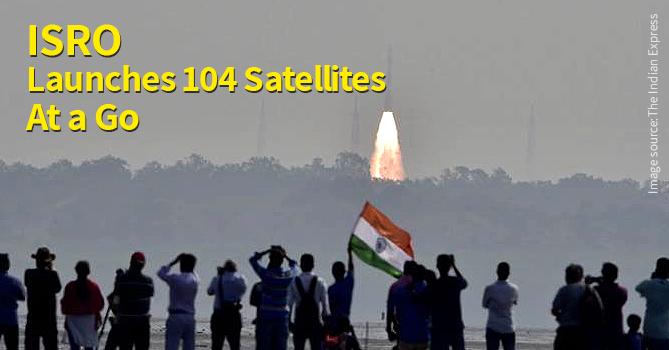
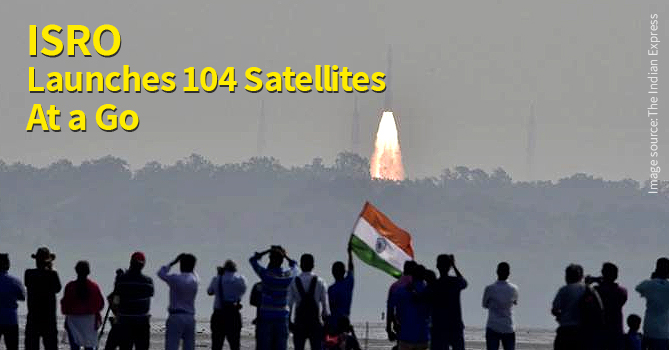
 The Indian Space Research Organisation (ISRO) successfully launched a record 104 satellites in one go on Wednesday morning, February 15, 2017, on board a single rocket from the Satish Dhawan Space Centre in Sriharikota, Andhra Pradesh.
India’s dependable workhorse, the Polar Satellite Launch Vehicle (PSLV), set out on its 39th flight after the Mission Readiness Review committee and Launch Authorisation Board gave its approval for lift off, ISRO said.
With a payload of 104 satellites, India has now put a wide margin between itself and the Russian Space Agency holding the next best record of launching 37 satellites in one go in 2014. The closest in competition to the second best is NASA, with its launch of 29 satellites at one go in 2015.
The Indian Space Research Organisation (ISRO) successfully launched a record 104 satellites in one go on Wednesday morning, February 15, 2017, on board a single rocket from the Satish Dhawan Space Centre in Sriharikota, Andhra Pradesh.
India’s dependable workhorse, the Polar Satellite Launch Vehicle (PSLV), set out on its 39th flight after the Mission Readiness Review committee and Launch Authorisation Board gave its approval for lift off, ISRO said.
With a payload of 104 satellites, India has now put a wide margin between itself and the Russian Space Agency holding the next best record of launching 37 satellites in one go in 2014. The closest in competition to the second best is NASA, with its launch of 29 satellites at one go in 2015.
The Payload
The PSLV-C37/ Cartosat 2 Series satellite mission carried a satellite mass of about 1,378 kg.- The primary satellite is the Cartosat 2 weighing 714 kg, which is being sent for earth observation. It will help provide remote sensing services. With a mission life of five years, the images sent by Cartosat 2 will help towards coastal land use and regulation, road network monitoring, distribution of water and creation of land use maps, etc.
- The launch also included two Indian nano satellites -- INS-1A and INS-1B, weighing about 30 kg. The INS (ISRO Nano Satellite) has been specifically developed to accompany bigger satellites on PSLV as a co-passenger.
- INS-1A carries Surface Bidirectional Reflectance Distribution Function Radiometer and INS-1B caries Earth Exosphere Lyman Alpha Analyser as payloads. These payloads will help to provide an opportunity for ISRO technology demonstration payloads, provide a standard bus for launch on demand services.
- 101 nano satellites of which 96 belongs to the USA and one each from other international customers including Israel, Kazakhstan, Netherlands, Switzerland and United Arab Emirates. The combined weight of these satellites is 634 kg.
- The commercial arm of ISRO, Antrix Corporation Ltd (ANTRIX) launched the satellites belonging to the international customers.
The Launch
This was the most complicated space mission as per ISRO with the countdown time being the shortest for PSLV missions. Here are some significant facts about the mission:- The PSLV took off at Satish Dhawan Space Centre in Sriharikota at 9.28 am.
- Heat shields were separated from the PSLV in the second stage at 9:31 am
- Eight minutes since lift off, PSLV-C37/ Cartosat 2 Series satellite reached the fourth stage when satellite engines were switched on.
- Satellite launch continued to gain altitude indicating a successful launch.
- PSLV had crossed about 4180 km in 13 mins since it was launched.
- Engines were switched off once PSLV reached the orbit.
- Cartosat 2, India’s nano satellites were separated from launch vehicle.
- Remaining nano satellites were also separated in pairs.
- All 104 satellites were successfully launched at 10 am and India created history.