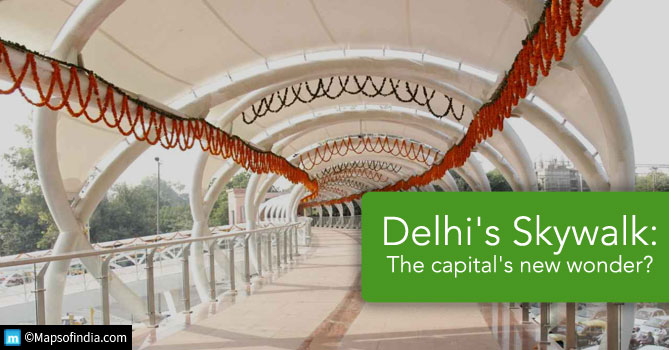
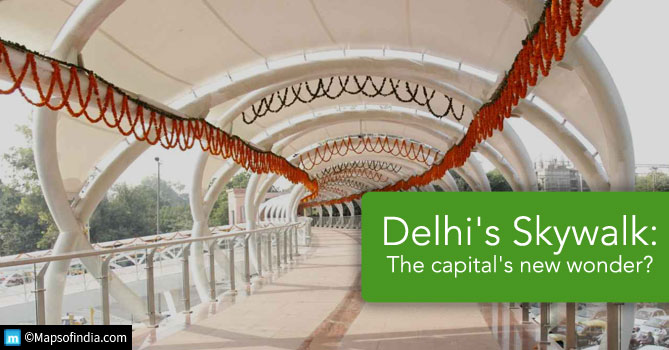
 ITO Skywalk in Delhi[/caption]
Opened to the public on October 15th this year, the ITO Skywalk in Delhi has been Delhi Public Works Department's (PWD) proud projects. In August 2018, the Deputy Chief Minister of Delhi, Manish Sisodia called the skywalk “a pride for people of Delhi”.
“(It) will also give major relief to the people. It will connect several junctions around the area, helping around 30,000 pedestrians every day”, said Sisodia, addressing the media. However, while the officials have declared it a new-age wonder, the sky is not entirely clear. The skywalk has its own set of glitches. So, what is the entire picture like?
ITO Skywalk in Delhi[/caption]
Opened to the public on October 15th this year, the ITO Skywalk in Delhi has been Delhi Public Works Department's (PWD) proud projects. In August 2018, the Deputy Chief Minister of Delhi, Manish Sisodia called the skywalk “a pride for people of Delhi”.
“(It) will also give major relief to the people. It will connect several junctions around the area, helping around 30,000 pedestrians every day”, said Sisodia, addressing the media. However, while the officials have declared it a new-age wonder, the sky is not entirely clear. The skywalk has its own set of glitches. So, what is the entire picture like?
The ITO Skywalk: Salient features
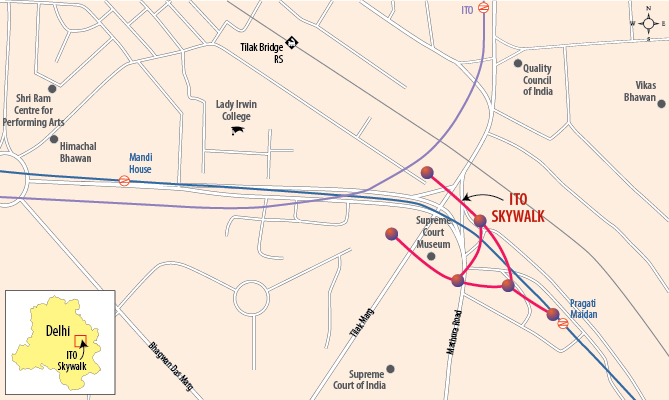
With its construction finishing in a little over one year, the ITO skywalk in Delhi is one of a kind. It has been conceptualized to help pedestrians along Mathura Road, Sikandra Road, Tilak Marg, and Bahadur Shah Zafar Marg, featuring multiple entry/exit points. Here are a few highlighting features of Delhi's very own skywalk: a. Delhi's largest foot-over bridge, it is 570m long. b. The plan for the bridge was first introduced in 2003, construction began in 2017. c. Starting from Pragati Maidan, it has a total of 7 entry/exit points. d. The ITO skywalk has been built with an approximate cost of Rs 54 crores. e. It is said to have lifts, wi-fi, CCTV cameras etc.How does the connectivity work?
From its starting point (Pragati Maidan), the skywalk further extends into three arms. One arm will take the pedestrians from the metro station to gate number 9 of Pragati Maidan. Out of the remaining two, one will go till the entry gate of Tilak Lane railway station, while the other will open at ITO. While expected to ease commutation of about 30-40,000 pedestrians every day, the skywalk will also reduce safety concerns. Fundings for the skywalk were provided by the Ministry of Housing and Urban Affairs, constructed by the PWD.Map of the ITO Skywalk