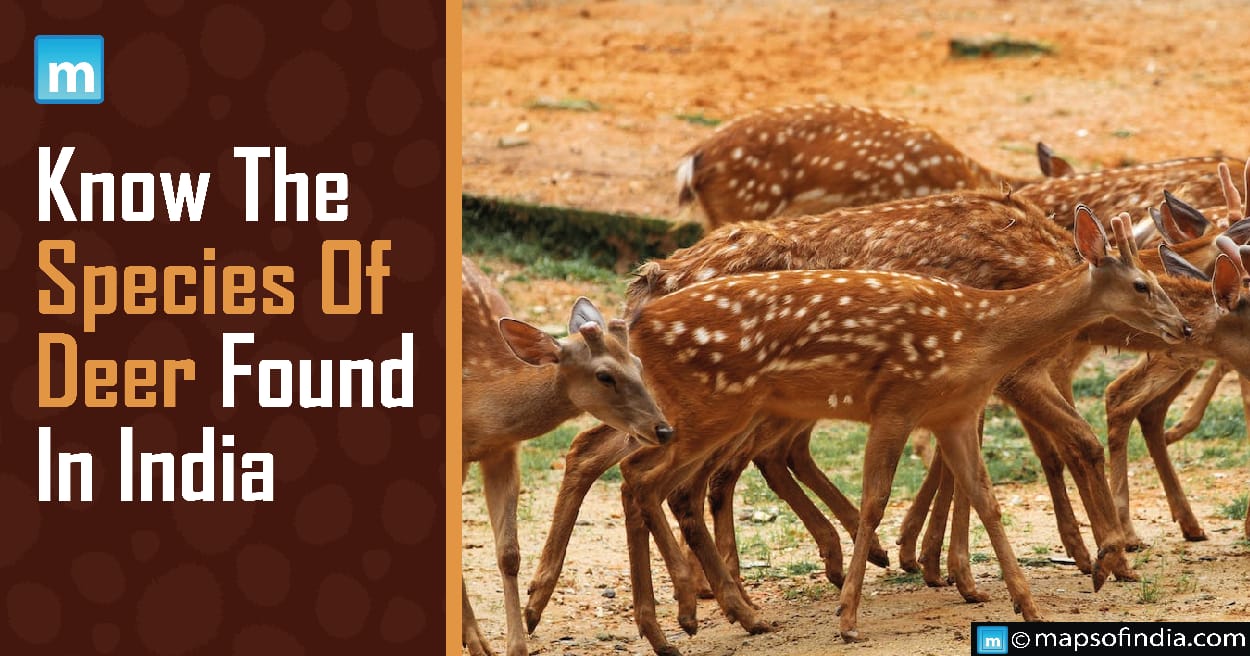
- India is home to these gregarious and possibly the most artistically appealing deer. These golden-rufous coloured deer, who have a lifetime of 15 to 25 years, are the state animal of Telangana.
- These delicate animals are extensively distributed throughout the Indian Subcontinent, ranging from the lower sections of the Himalayas to the south and eastwards to the Gangetic plain. They like to dwell in grasslands, marshy meadows, and scrublands.
- This mysterious taxon is a small dog-like ungulate with no antlers that may weigh between 12 and 18 kilos.
- They are found from Himachal Pradesh to Sikkim in the Himalayan regions.
- Unlike all other deer, this cautious mammal has a minimal home range and can be found at elevations ranging from 2500m to 4400m in dense bamboo woods, rhododendron forests, and moderate to high alpine forests.
- The Sambar deer is India's biggest woodland ruminant, with the longest antlers and deep brown hair, weighing up to 200 kilos.
- Males have massive three-tined horns reaching up to one metre in length.
- Except for the high Himalayas, the desert, Kutch, and the coast, they may be found across India. Their habitat includes dry to moist deciduous woodland, scrublands, wetlands, tropical evergreen forests, and pine and oak forests.
- It is the state animal of J&K and is presently categorised as a critically endangered species by the IUCN.
- The Kashmir Red Deer, a scruffy-looking deer with a brown coat and an orange-white patch on the rump, is as vital in the Himalayas as the tiger.
- They blend in nicely with their environment since their colour changes from time to time according to seasons, and their motion becomes migratory as the seasons change.
- Their habitat is distinct from wet, broad-leaved, and coniferous forests and is limited to Dachigam National Park and Chandaji Nullah in J&K.
- Swamp deer have a wonderful narrative about the Indian forests since this majestic species was saved from extinction.
- This magnificent deer with a yellow to reddish-brown coat with 10-12 tined antlers is considered the jewel of the Indian woods.
- They are selective eaters since they exclusively consume one type of grass: Saccharum spontaneum.
- A medium-sized grassland ruminant found throughout the plains of the Indus River, Ganga, and some of its tributaries, spanning from Punjab to Assam and Arunachal Pradesh in the northeast.
- This robustly formed taxon has a huge torso, short legs, and no long antlers.
- It is common for mothers to conceal their fawns in secure areas since they do not have a distinctive scent.
- Deer have excellent eyesight because their eyes are located on the side of their heads, giving them a field of view of 310 degrees.
- For each predator, each variety of deer has a unique alarm sound.
- Deer are opportunistic eaters, eating not just reeds and grass but also birds and eggs to supplement their protein intake.
- The Pudu, a variety of deer, is the world's most miniature deer, weighing roughly 9 kilos, whereas the Alaskan Moose is the world's biggest deer.
- Deer eat their antlers when they shed them because they are high in calcium, phosphorus, and salt. Other species, such as foxes, squirrels, and porcupines, consume their lost antlers.