Ad
Ad
Advertisement
India

List of All Prime Ministers of India Till Now | From 1947 to 2023 With Their Names and Tenure

Ramandeep Kaur February 9, 2023

Overview of All Prime Ministers of India

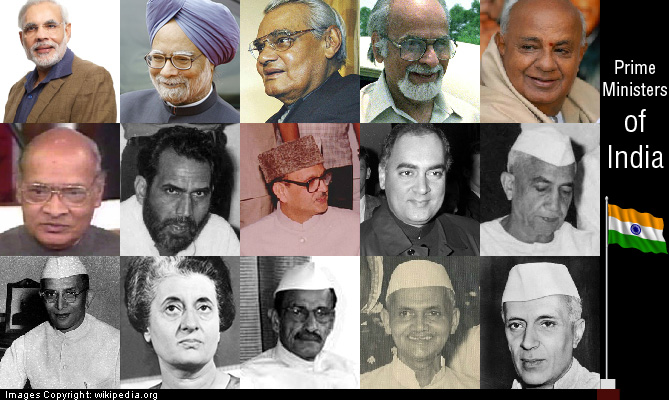
Since its Independence, India has seen 14 full-time Prime Ministers. Pt. Jawaharlal Nehru of the Indian National Congress was the first Prime Minister (PM) of free India. Gulzarilal Nanda was appointed as the acting PM for two short periods in 1964 and 1966. At present, the office is headed by Mr. Narendra Modi of the BJP. He was the 15th PM elected in 2014, to the post vacated by Dr. Manmohan Singh of the Congress-led United Progressive Alliance (UPA). Narendra Modi continues as the PM of India from May 30, 2019, onward, after BJP and its allies notched a landslide victory in the general elections held across the country in April and May 2019. Below are the details of all Prime Ministers of India.

List of All Prime Ministers of India in chronological order:

S.No. Name Birth-Death Tenure Interesting Facts
1 Jawahar Lal Nehru (1889–1964) 15 August 1947-27 May 1964 16 years, 286 days. First and the longest serving prime minister of independent India. The first serving PM who died in office.
2 Gulzarilal Nanda (1898–1998) 27 May 1964 to 9 June 1964 13 days. The first acting PM of the country took charge after the untimely death of Nehru.
3 Lal Bahadur Shastri (1904–1966) 9 June 1964 to 11 January 1966 1 year, 216 days. He was the pioneer of the slogan 'Jai Jawan Jai Kisan' during the Indo-Pak war in 1965.
4 Gulzarilal Nanda (1898-1998) 11 January 1966, 24 January 1966 13 days. The only man who served twice as an acting PM of India.
5 Indira Gandhi (1917–1984) 24 January 1966 to 24 March 1977 11 years, 59 days. The first lady who took oath as the Prime Minister of India.
6 Morarji Desai (1896–1995) 24 March 1977 – 28 July 1979 2 years, 126 days. First PM after the emergency in 1977. The oldest PM of India took oath at the age of 81, the first to resign from office. He was born on 29th February, so he used to celebrate his birthday once in a four-year.
7 Charan Singh (1902–1987) 28 July 1979 to 14 January 1980 170 days. Only PM who never faced the Parliament.
8 Indira Gandhi (1917–1984) 14 Jan.1980 to 31 Oct. 1984 4 years, 291 days. The first PM came back in power in 1980 after the 1977 debacle. Like her father, she also died in office.
9 Rajiv Gandhi (1944–1991) 31 Oct 1984 to 2 Dec 1989 5 years, 32 days. He became the youngest PM of India at the age of 40.
10 V. P. Singh (1931–2008) 2 Dec 1989 to 10 Nov 1990 343 days. The first PM who resigned after voting of no confidence.
11 Chandra Shekhar (1927–2007) 10 Nov 1990 to 21 June 1991 223 days. He never worked as a minister in any ministry.
12 P. V. Narasimha Rao (1921–2004) 21 June 1991 to 16 May 1996, 4 years, 330 days. He was from Andhra Pradesh and became the first South Indian PM of the country.
13 Atal Bihari Vajpayee (1924-2018) 16 May 1996 to 1 June 1996 16 days. PM for just 16 days shortest tenure of any Indian PM.
14 H. D. Deve Gowda (born 1933) 1 June 1996 to 21 April 1997 324 days. He became the second PM of South India. He is from Karnataka. However, he stayed in the office for less than a year.
15 Inder Kumar Gujral  (1919–2012)  21 April 1997 to 19 March 1998 332 days. Third PM to be from the Upper House after Indra Gandhi & Deve Gowda.
16 Atal Bihari Vajpayee  (born 1924-2018) 19 March 1998 to 22 May 2004 6 years, 64 days. First non-congress PM of independent India who completed his full term as PM.
17 Manmohan Singh  (born 1932) 22 May 2004 to 26 May 2014 10 years, 4 days. First PM from the minority community.
18 Narendra Modi (born 1950)  2014-Present Before Modi, three PMs served two terms or more. He has also joined this coveted list in 2019.

Given are the details of all Prime Ministers of India's tenure since independence:

(Please click Next > to get details)

Jawaharlal Nehru - Indian National Congress

Tenure - 15th Aug 1947 – 27th May 1964 for 16 years, 286 days Jawaharlal Nehru was the first Prime Minister of independent India and played a significant role in shaping modern India by imparting modern values and thinking. He was a social reformer and one of his major works for society was the reform of the ancient Hindu civil code. It permitted Hindu widows to enjoy equal rights with men as far as property and inheritance were concerned. He is also the author of several books like 'Glimpses of History', Discovery of India, etc.

Gulzarilal Nanda - Indian National Congress

Tenure - 27 May 1964 – 9th June 1964 for 13 days Tenure – 11th January 1966 – 24th January 1966 for 13 days He was the first Interim Prime Minister of India. Gulzarilal Nanda was the first Interim Prime Minister of India. He served twice, first as an interim PM in 1964 after the death of Jawaharlal Nehru, and in 1966 when Lal Bahadur Shastri passed away. He is also the recipient of India's highest civilian honor Bharat Ratna (1997).

Lal Bahadur Shastri - Indian National Congress

Tenure – 9th June 1964 – 11 January 1966 for 1 year, 216 days He was a loyal follower of Mahatma Gandhi and gave the popular slogan ‘Jai Jawan Jai Kisan’. Shastri was a soft-spoken person who promoted the ‘White Revolution’ to increase the production of milk in India. Lal Bahadur Shastri died in USSR during his visit. He also gave the slogan Jai Jawan Jai Kisan after the 1965 India-Pakistan War.

Indira Gandhi - Indian National Congress

Tenure – 24th January 1966 – 24th March 1977 for 11 years, 59 days Tenure – 14th January 1980 – 31st October 1984 for 4 years, 291 days Indira Gandhi was the first woman Prime Minister of India and the world’s longest-serving woman Prime Minister. Her courage and boldness made India win over Pakistan in 1971. She made a significant contribution to improving international relations with neighbouring countries. Indira Gandhi was killed by her own bodyguards at her official residence in New Delhi.

Morarji Desai - Janata Party

Tenure – 24th March 1977 – 28th July 1979 for 2 years, 126 days Morarji Desai was the first non-Congress Prime Minister of India. He and his minister formally ended the state of emergency which was imposed by Indira Gandhi. Morarji Desai was one of the oldest individuals to take over the responsibilities of the Prime Minister and also was the Indian PM to resign during his tenure.

Charan Singh - Janata Party (Secular)

Tenure – 28th July 1979 – 14th January 1980 for 170 days As a Revenue Minister of Uttar Pradesh Charan Singh removed the Zamindari system and brought in Land Reform Acts. Later in 1970 Charan Singh also became the Chief Minister of Uttar Pradesh.

Rajiv Gandhi - Indian National Congress

Tenure – 31st October 1984 – 2nd December 1989 for 5 years, 32 days Rajiv Gandhi became Prime Minister at the age of 40 becoming the youngest to take the office and played a major role in bringing computers to India. He actually modernized the Indian administration. He improved bilateral relationships with the US and expanded economic cooperation. He is also the second Indian Prime Minister to have been killed during his tenure, the first one being Indira Gandhi.

V.P. Singh - Janata Dal

Tenure – 2nd December 1989 – 10th November 1990 for 343 days Shri Vishwanath Pratap Singh was a scholarly man, who was the founder of Gopal Vidyalaya, Allahabad. He was first appointed as a Chief Minister of Uttar Pradesh by Indira Gandhi and tackled several issues of the state. Later he became the Prime Minister of India. V.P. Singh worked to improve the condition of the poor in the country. It was under his tenure the decision to provide 27% reservation to OBC was implemented. Also, the first Indian Prime Minister had to step down after a no-confidence motion.

Chandra Shekhar - Samajwadi Janata Party

Tenure – 10th November 1990 to 21st June 1991 for 223 days During his political career, Chandra Shekhar was a part of various political parties. First, he was a member of the Socialist Party and later joined the Congress, and then the Janata Dal Party. He was the President of the Janata Party from 1977 to 1988. He served as the 9th Prime Minister of India.

P. V. Narasimha Rao - Indian National Congress

Tenure – 21st June 1991 – 16th May 1996 for 4 years 330 days P. V. Narasimha Rao was one of the ablest administrators who brought major economic reforms. He is also known as the Father of Indian Economic Reforms. He dismantled the License Raj and reversed the socialist policies of Rajiv Gandhi’s government. Because of his immense ability, he was also referred to as Chanakya.

Atal Bihari Vajpayee - Bhartiya Janata Party

Tenure – 16th May 1996 – 1st June 1996 for 16 days Tenure –19th March 1998 – 22nd May 2004 for 6 years 64 days Atal Bihari Vajpayee was one of the finest Prime Ministers of India. During his tenure, inflation was very low in India. He worked on economic reforms and policies, especially for rural India. It was during his tenure that the India-Pakistan relationship got slightly better. The Telecom industry touched new heights. He is one of the only leaders who has won six Lok Sabha constituencies from four different states (Uttar Pradesh, Delhi, Madhya Pradesh and Gujarat).

H. D. Deve Gowda - Janata Dal

Tenure – 1st June 1996 – 21st April 1997 for 324 days During this period, Deve Gowda also held additional charges of Home Affairs, Petroleum, and Chemicals, Urban Employment, Food processing, Personnel, etc. He had been collectively elected leader of the United Front coalition government.

I.K. Gujral - Janata Dal

Tenure- 21st April 1997 – 19th March 1998 for 332 days The most important task during his term as PM was his resistance in signing CTBT(Comprehensive Test Ban Treaty). It made a clear way to conduct the Pokhran nuclear tests. He worked towards improving the relationship with Pakistan and gave a five-point doctrine known as Gujral Doctrine.

Manmohan Singh - Indian National Congress

Tenure - 22nd May 2004 – May 2014 During the tenure of Manmohan Singh, work was done to reform the banking as well as the financial sector along with public companies. His government brought in the value-added tax and worked on pro-industry policies. The National Rural Health Mission was started in 2005. Eight additional IITs were opened in Andhra Pradesh, Bihar, Gujarat, Orissa, Punjab, Madhya Pradesh, Rajasthan, and Himachal Pradesh.

Narendra Modi - Bhartiya Janata Party

Tenure - May 2014- May 2019 Narendra Damodardas Modi assumed office on May 26, 2014. He is the 15th Prime Minister of India. Since the beginning of his tenure in 2014, Modi has laid down a strict and disciplined system of governance. He has enforced many policies such as the Jan Dhan Yojana, Swachh Bharat Abhiyan - aimed toward cleanliness marking the 150th birth anniversary of Mahatma Gandhi in 5 years, the Clean Ganga project, etc. for the upliftment of the nation. Narendra Modi swore as the 16th Prime Minister to serve the second tenure from May 30, 2019. He is the first BJP Minister to be elected for the second time after completion of his first five-year tenure.