 India is nestled at the foothills of one of the most gorgeous ranges of the world- The Himalayas. Apart from the magnificent Himalayas, India is also home to several other important mountain ranges with some very noteworthy and high peaks.
Here are the most important mountain ranges of India and their highest peaks:
The Himalayas
India is nestled at the foothills of one of the most gorgeous ranges of the world- The Himalayas. Apart from the magnificent Himalayas, India is also home to several other important mountain ranges with some very noteworthy and high peaks.
Here are the most important mountain ranges of India and their highest peaks:
The Himalayas
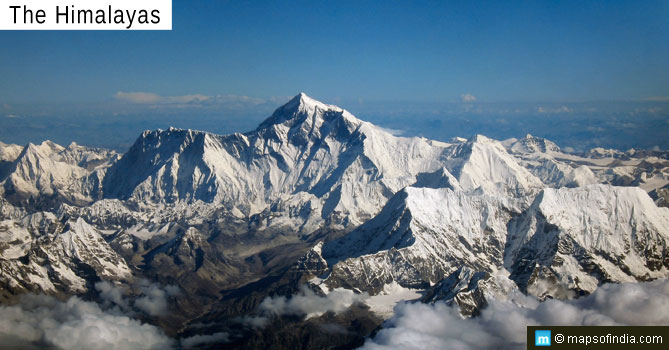 Himalaya is a Sanskrit word – Him+Alay, literally meaning the abode of snow. The Himalayan Mountain Range is a new fold mountain formed when two tectonic plates collided with each other. The Himalayas stretches over a distance of 2400 Kilometre in length and 400 Km-150Km in breadth and is home to some of the highest peaks of the world. There are a close to 100 peaks with an average height of more than 7200m. Standing tallest at 8848 m, the Mt Everest is the highest peak in the world. However, this peak is located in Nepal. On the Indian side, the highest peaks of the Himalayas include the Kanchenjunga, Nanda Devi, and the Kamet.
Kanchenjunga Peak is 8586 m high and is the third highest summit in the world. It is located in the Great Himalaya Range in Sikkim.
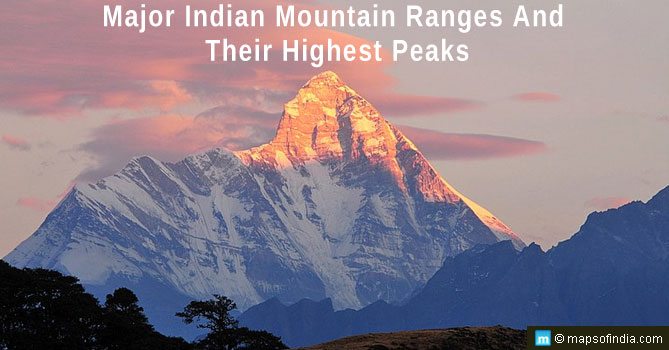
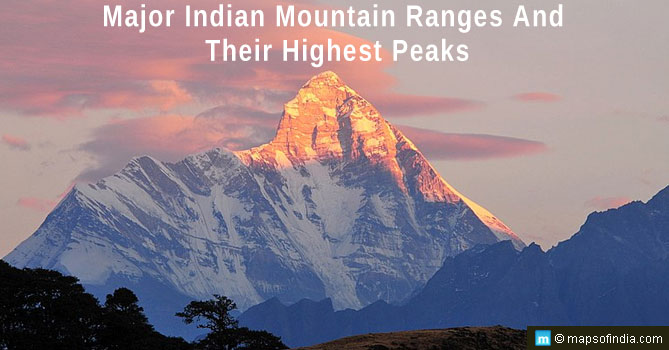
Nanda Devi is 7816 m high and is situated in the Garhwal Himalayas region in Uttarakhand. It is one of the highest peaks in the world.
Kamet is 7756 m high, and is the highest summit of the Zanskar range of Garhwal region and is also located in Uttarakhand.
The Himalayas are a very important feature of the geography of India.
Himalaya is a Sanskrit word – Him+Alay, literally meaning the abode of snow. The Himalayan Mountain Range is a new fold mountain formed when two tectonic plates collided with each other. The Himalayas stretches over a distance of 2400 Kilometre in length and 400 Km-150Km in breadth and is home to some of the highest peaks of the world. There are a close to 100 peaks with an average height of more than 7200m. Standing tallest at 8848 m, the Mt Everest is the highest peak in the world. However, this peak is located in Nepal. On the Indian side, the highest peaks of the Himalayas include the Kanchenjunga, Nanda Devi, and the Kamet.
Kanchenjunga Peak is 8586 m high and is the third highest summit in the world. It is located in the Great Himalaya Range in Sikkim.
Nanda Devi is 7816 m high and is situated in the Garhwal Himalayas region in Uttarakhand. It is one of the highest peaks in the world.
Kamet is 7756 m high, and is the highest summit of the Zanskar range of Garhwal region and is also located in Uttarakhand.
The Himalayas are a very important feature of the geography of India.
- They help in regulating the weather of India by keeping out the cold Siberian air masses.
- The Himalayas are the source of many perennial rivers including the Ganges, the Brahmaputra, and the Indus.
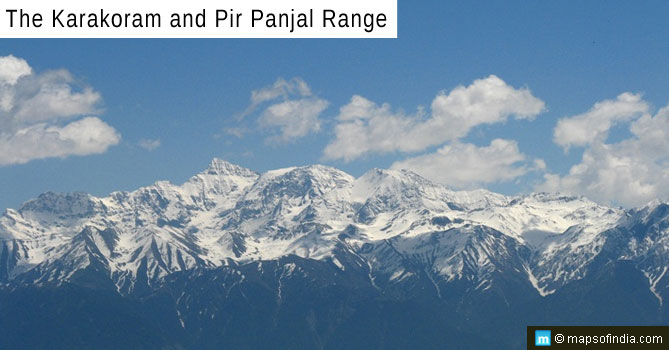 Located to the North-west and South of the Himalayas, the Karakoram and Pir Panjal Range are also known as the Lower Himalayas. The Karakoram range lies in the disputed region of India-Pakistan border, and thus both the countries have laid a claim over it. The Karakoram Range stretches over a distance of 500 Km and a part of it extends into Afghanistan and is known as Hindu-Kush there. The Karakoram is home to the world’s second and third largest glaciers, the Siachen Glacier and the Biafo Glacier.
The Pir Panjal Range begins from Himachal Pradesh and ends in Jammu & Kashmir. This range is the source of rivers like Ravi, Chenab, and Jhelum.
K2, at a height of 8611 m lies in the Karakoram Range and is the second highest peak in the world.
Purvanchal Range
Located to the North-west and South of the Himalayas, the Karakoram and Pir Panjal Range are also known as the Lower Himalayas. The Karakoram range lies in the disputed region of India-Pakistan border, and thus both the countries have laid a claim over it. The Karakoram Range stretches over a distance of 500 Km and a part of it extends into Afghanistan and is known as Hindu-Kush there. The Karakoram is home to the world’s second and third largest glaciers, the Siachen Glacier and the Biafo Glacier.
The Pir Panjal Range begins from Himachal Pradesh and ends in Jammu & Kashmir. This range is the source of rivers like Ravi, Chenab, and Jhelum.
K2, at a height of 8611 m lies in the Karakoram Range and is the second highest peak in the world.
Purvanchal Range
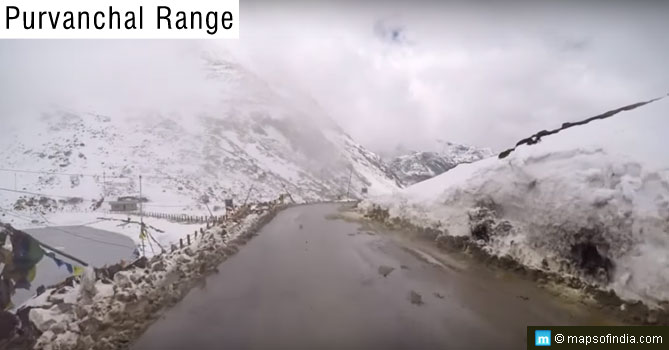 Located in the Eastern part of India, this range is considered to be an extension of the Himalayas, though not as high. The range extends across all the states in Eastern India, known as the Seven Sisters, namely, Mizoram, Arunachal Pradesh, Manipur, Assam, Meghalaya, Nagaland, and Tripura. The wettest place on earth, Cherrapunji, with maximum rainfall, is located in Khasi Hills of the Purvanchal Range.
The Nokrek Peak at a height of 1412 m, is the highest peak of this range. It is situated in the Garo Hills of the Purvanchal Range.
The Aravalli Range
Located in the Eastern part of India, this range is considered to be an extension of the Himalayas, though not as high. The range extends across all the states in Eastern India, known as the Seven Sisters, namely, Mizoram, Arunachal Pradesh, Manipur, Assam, Meghalaya, Nagaland, and Tripura. The wettest place on earth, Cherrapunji, with maximum rainfall, is located in Khasi Hills of the Purvanchal Range.
The Nokrek Peak at a height of 1412 m, is the highest peak of this range. It is situated in the Garo Hills of the Purvanchal Range.
The Aravalli Range
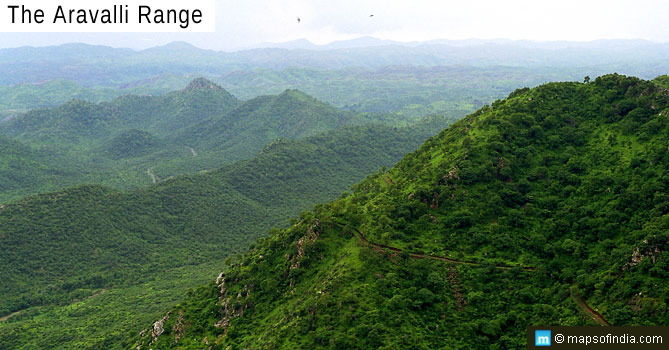 The Aravalli range is the oldest mountain range of India and spans over a length of 800 Km covering Delhi, Haryana, Rajasthan, and Gujarat. The Thar Desert is in the rain shadow region of the Aravalli range, thus receiving very little rainfall from the South-West Monsoon winds. The rivers Banas, Luni, and Sabarmati flow through this range.
The highest peak of the Aravalli Range is the Guru Shikhar at an elevation of 1722 m.
The Satpura & Vindhya Range
The Aravalli range is the oldest mountain range of India and spans over a length of 800 Km covering Delhi, Haryana, Rajasthan, and Gujarat. The Thar Desert is in the rain shadow region of the Aravalli range, thus receiving very little rainfall from the South-West Monsoon winds. The rivers Banas, Luni, and Sabarmati flow through this range.
The highest peak of the Aravalli Range is the Guru Shikhar at an elevation of 1722 m.
The Satpura & Vindhya Range
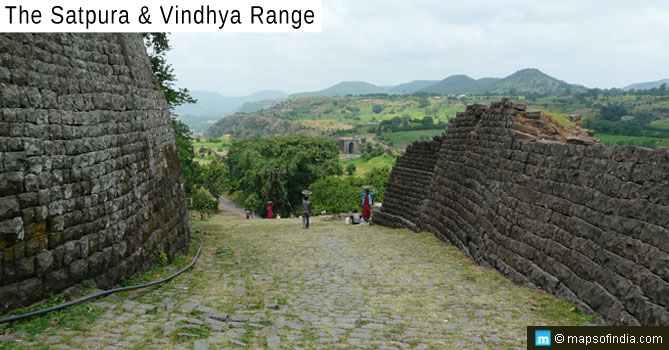 These ranges run parallel to each other, and lie in Central India, mainly in Madhya Pradesh and Maharashtra. Some portions of the ranges also extend into Gujarat, Chhattisgarh, and Uttar Pradesh. The ranges are sources for rivers Narmada and Tapti.
Kalurmar Peak at an elevation of 752 m is the highest peak of the Vindhya.
Duphgarh Peak at an elevation of 1350 m is the highest peak of the Satpura.
These ranges run parallel to each other, and lie in Central India, mainly in Madhya Pradesh and Maharashtra. Some portions of the ranges also extend into Gujarat, Chhattisgarh, and Uttar Pradesh. The ranges are sources for rivers Narmada and Tapti.
Kalurmar Peak at an elevation of 752 m is the highest peak of the Vindhya.
Duphgarh Peak at an elevation of 1350 m is the highest peak of the Satpura.