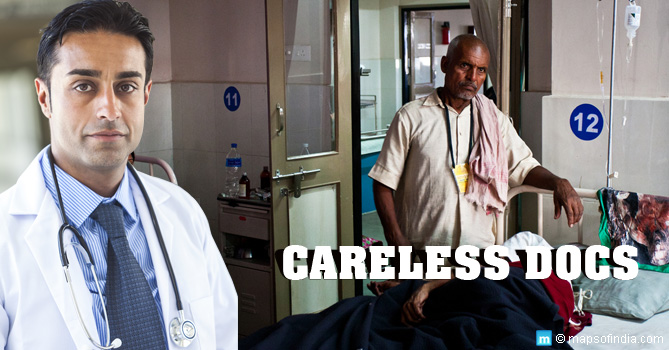
 Medical services and infrastructure is expanding rapidly in India and is fast turning into an industry in terms of its size, employment capability, service provided and most of all, focus on profitability. The problem is that the rapid growth and expansion of medical services, under both government and private sector, has not been supported by laws that adequately provide for checks and balances.
Today, it is very easy for a doctor to set up a private practice anywhere in the country and start offering his services. There are no checks or balances on the quality of his education or experience and once he receives his medical qualification, there is no intervention from the government or any other agency thereafter to benchmark his services or monitor the quality of his infrastructure.
This becomes the starting point of medical negligence at an initial level in the private sector. At a larger level, lies the unchecked growth of private clinics and mini hospitals that operate with minimal attention to health or hygiene, and to pre and post hospitalization care. In most such places, post-surgical infections and post-surgical complications are frequent, but there is very little recourse for the suffering patient and their family members.
The situation is no better in government-run hospitals where the overall maintenance and hygiene resembles a railway station toilet. In most of these hospitals, very little attention is given or investment is made to maintain facilities. As a result, the sheer presence of filth within the hospital premises becomes a breeding ground for primary and secondary infections of all kinds.
The situation is so bad that concepts like monitoring of pathogens in the air that enter through air conditioning ducts is unheard of in government-run hospitals and most of the smaller private hospitals. These are only now becoming standard practices is some of the larger private sector hospitals, but they are commercially out of reach for most of the population.
This adds to the overwhelming number of patients in each hospital which puts the attending doctor and support staff under severe work pressure. Under these circumstances, it is only natural that cases of medical negligence on part of the doctor or support staff occur.
However, the lack of infrastructure and shortage of medical staff is still no reason or justification for medical negligence. Very often, we hear of cases where the doctor has left an instrument inside a patient during surgery or cases where a patient has adversely reacted to a medication prescribed by a doctor, who would not have prescribed it to the patient in the first place, if he had properly probed the patient’s medical history. And when such cases of negligence do occur, where a patient loses his life or a limb, there is very little recourse to justice or compensation.
Medical services and infrastructure is expanding rapidly in India and is fast turning into an industry in terms of its size, employment capability, service provided and most of all, focus on profitability. The problem is that the rapid growth and expansion of medical services, under both government and private sector, has not been supported by laws that adequately provide for checks and balances.
Today, it is very easy for a doctor to set up a private practice anywhere in the country and start offering his services. There are no checks or balances on the quality of his education or experience and once he receives his medical qualification, there is no intervention from the government or any other agency thereafter to benchmark his services or monitor the quality of his infrastructure.
This becomes the starting point of medical negligence at an initial level in the private sector. At a larger level, lies the unchecked growth of private clinics and mini hospitals that operate with minimal attention to health or hygiene, and to pre and post hospitalization care. In most such places, post-surgical infections and post-surgical complications are frequent, but there is very little recourse for the suffering patient and their family members.
The situation is no better in government-run hospitals where the overall maintenance and hygiene resembles a railway station toilet. In most of these hospitals, very little attention is given or investment is made to maintain facilities. As a result, the sheer presence of filth within the hospital premises becomes a breeding ground for primary and secondary infections of all kinds.
The situation is so bad that concepts like monitoring of pathogens in the air that enter through air conditioning ducts is unheard of in government-run hospitals and most of the smaller private hospitals. These are only now becoming standard practices is some of the larger private sector hospitals, but they are commercially out of reach for most of the population.
This adds to the overwhelming number of patients in each hospital which puts the attending doctor and support staff under severe work pressure. Under these circumstances, it is only natural that cases of medical negligence on part of the doctor or support staff occur.
However, the lack of infrastructure and shortage of medical staff is still no reason or justification for medical negligence. Very often, we hear of cases where the doctor has left an instrument inside a patient during surgery or cases where a patient has adversely reacted to a medication prescribed by a doctor, who would not have prescribed it to the patient in the first place, if he had properly probed the patient’s medical history. And when such cases of negligence do occur, where a patient loses his life or a limb, there is very little recourse to justice or compensation.
Medical services and infrastructure is expanding rapidly in India and is fast turning into an industry in terms of its size, employment capability, service provided and most of all, focus on profitability. The problem is that the rapid growth and expansion of medical services, under both government and private sector, has not been supported by laws that adequately provide for checks and balances.
Today, it is very easy for a doctor to set up a private practice anywhere in the country and start offering his services. There are no checks or balances on the quality of his education or experience and once he receives his medical qualification, there is no intervention from the government or any other agency thereafter to benchmark his services or monitor the quality of his infrastructure.
This becomes the starting point of medical negligence at an initial level in the private sector. At a larger level, lies the unchecked growth of private clinics and mini hospitals that operate with minimal attention to health or hygiene, and to pre and post hospitalization care. In most such places, post-surgical infections and post-surgical complications are frequent, but there is very little recourse for the suffering patient and their family members.
The situation is no better in government-run hospitals where the overall maintenance and hygiene resembles a railway station toilet. In most of these hospitals, very little attention is given or investment is made to maintain facilities. As a result, the sheer presence of filth within the hospital premises becomes a breeding ground for primary and secondary infections of all kinds.
The situation is so bad that concepts like monitoring of pathogens in the air that enter through air conditioning ducts is unheard of in government-run hospitals and most of the smaller private hospitals. These are only now becoming standard practices is some of the larger private sector hospitals, but they are commercially out of reach for most of the population.
This adds to the overwhelming number of patients in each hospital which puts the attending doctor and support staff under severe work pressure. Under these circumstances, it is only natural that cases of medical negligence on part of the doctor or support staff occur.
However, the lack of infrastructure and shortage of medical staff is still no reason or justification for medical negligence. Very often, we hear of cases where the doctor has left an instrument inside a patient during surgery or cases where a patient has adversely reacted to a medication prescribed by a doctor, who would not have prescribed it to the patient in the first place, if he had properly probed the patient’s medical history. And when such cases of negligence do occur, where a patient loses his life or a limb, there is very little recourse to justice or compensation.
Medical services and infrastructure is expanding rapidly in India and is fast turning into an industry in terms of its size, employment capability, service provided and most of all, focus on profitability. The problem is that the rapid growth and expansion of medical services, under both government and private sector, has not been supported by laws that adequately provide for checks and balances.
Today, it is very easy for a doctor to set up a private practice anywhere in the country and start offering his services. There are no checks or balances on the quality of his education or experience and once he receives his medical qualification, there is no intervention from the government or any other agency thereafter to benchmark his services or monitor the quality of his infrastructure.
This becomes the starting point of medical negligence at an initial level in the private sector. At a larger level, lies the unchecked growth of private clinics and mini hospitals that operate with minimal attention to health or hygiene, and to pre and post hospitalization care. In most such places, post-surgical infections and post-surgical complications are frequent, but there is very little recourse for the suffering patient and their family members.
The situation is no better in government-run hospitals where the overall maintenance and hygiene resembles a railway station toilet. In most of these hospitals, very little attention is given or investment is made to maintain facilities. As a result, the sheer presence of filth within the hospital premises becomes a breeding ground for primary and secondary infections of all kinds.
The situation is so bad that concepts like monitoring of pathogens in the air that enter through air conditioning ducts is unheard of in government-run hospitals and most of the smaller private hospitals. These are only now becoming standard practices is some of the larger private sector hospitals, but they are commercially out of reach for most of the population.
This adds to the overwhelming number of patients in each hospital which puts the attending doctor and support staff under severe work pressure. Under these circumstances, it is only natural that cases of medical negligence on part of the doctor or support staff occur.
However, the lack of infrastructure and shortage of medical staff is still no reason or justification for medical negligence. Very often, we hear of cases where the doctor has left an instrument inside a patient during surgery or cases where a patient has adversely reacted to a medication prescribed by a doctor, who would not have prescribed it to the patient in the first place, if he had properly probed the patient’s medical history. And when such cases of negligence do occur, where a patient loses his life or a limb, there is very little recourse to justice or compensation.