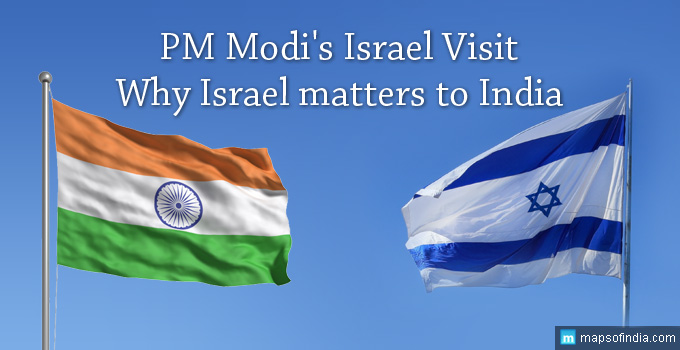
 Prime Minister Narendra Modi is on a historic visit to Israel, being the first Indian Prime Minister to visit the nation. His three-day visit began on Monday, 3 July, 2017. He has met Israeli Prime Minister Benjamin Netanyahu and will meet with President Reuven Rivlin. The leaders of the two countries are seeking to strengthen India-Israel relationship which include security, agriculture, water, energy, defence and technology among others. The two leaders will be discussing sharing of intelligence and measure to counter terrorism. Other aspects to be covered during this visit include economic, cultural and people-to-people ties. India and Israel are also slated to sign a number of agreements.
India-Israel Bilateral Ties
India and Israel have always enjoyed an extensive economic, military, and strategic relationship. The relationship with Israel has further expanded under the regime of Prime Minister Narendra Modi, when India abstained from voting against Israel in the United Nations in several resolutions. However, it all began with former prime minister PV Narasimha Rao, the pragmatist, who decided to improve relations with Israel in 1992, at the end of the Cold War.
Prime Minister Narendra Modi is on a historic visit to Israel, being the first Indian Prime Minister to visit the nation. His three-day visit began on Monday, 3 July, 2017. He has met Israeli Prime Minister Benjamin Netanyahu and will meet with President Reuven Rivlin. The leaders of the two countries are seeking to strengthen India-Israel relationship which include security, agriculture, water, energy, defence and technology among others. The two leaders will be discussing sharing of intelligence and measure to counter terrorism. Other aspects to be covered during this visit include economic, cultural and people-to-people ties. India and Israel are also slated to sign a number of agreements.
India-Israel Bilateral Ties
India and Israel have always enjoyed an extensive economic, military, and strategic relationship. The relationship with Israel has further expanded under the regime of Prime Minister Narendra Modi, when India abstained from voting against Israel in the United Nations in several resolutions. However, it all began with former prime minister PV Narasimha Rao, the pragmatist, who decided to improve relations with Israel in 1992, at the end of the Cold War.
- India is the largest buyer of Israeli military equipment. In fact Israel is the second-largest defence supplier to India after Russia.
- While Ezer Weizman became the first Israeli President to visit India in 1997, Jaswant Singh became the first Indian Foreign Minister to visit Israel in 2000.
- Military business between the two nations in the period 1999 – 2009 amounted to $9 billion.
- The two countries share military and strategic ties including joint military training and sharing of intelligence on terrorist groups.
- During the 2014 Israel-Hamas conflict, External Affairs Minister Sushma Swaraj insisted that "there is absolutely no change in India's policy towards Palestine, which is that we fully support the Palestinian cause while maintaining good relations with Israel.”
- When the UNHRC report alleging that Israel had committed war crimes was tabled for vote, India abstained from voting.
- In recent years the accelerated Islamic extremist terrorism in both nations has generated a strong strategic alliance between the two countries.
- India recently launched a military satellite for Israel through its Indian Space Research Organisation (ISRO).
- He will balance relations with Israel with that of other Gulf countries. Modi knows that the Arab countries cannot be ignored for seven million Indians live and work out of the region, and send back remittances fluctuating between $35 and $4o billion annually.
- He has also reiterated that he would not completely break from the past and gave a categorical “No” for an answer when asked if India would shift its embassy to Jerusalem by an Israeli newspaper.
- Recognising the key issues between Israel and Palestine as mutual recognition, borders, security, water rights, control of Jerusalem, Israeli settlements, Palestinian freedom of movement, and Palestinian right of return, Modi has also said that he would abide by Delhi’s line on the Palestinian issue. He said, "India believes in a two-state solution in which both Israel and a future Palestinian state coexist peacefully."
- Modi has promised that a final-status agreement should respect the sentiments and address demands of all affected parties.