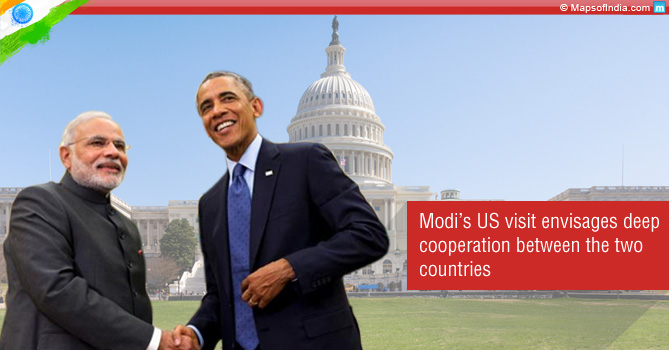
 Prime Minister Narendra Modi was looking forward to substantial, effective and highly memorable visit of the US, and it proved true in every respect. He got what he wanted: a rock star reception at the Madison Square Garden, enthusiastic response from the top US businessmen and unprecedented warmth shown from President Barack Obama and his team members at the White House. Indeed, it was a headline-grabbing tour of US by any Indian Prime Minister in the past more than 60 years. Effervescence of Modi’s charm impacted the highly individualistic Obama deeply.
“Vision Statement for the Strategic Partnership” issued after talks between the two countries, reflects clearly the impact Modi’s visit has made on the US authorities. As it envisages not only “Chalein Saath Saath (we go together forward)”, a new mantra for Indo-US relationship, but also endorses a wide ranging “deep cooperation” between the two countries in every sector for the benefit of global stability over the next 10 years. However, things came for a shove when the two countries in order to consolidate criminal law enforcement system and to fight terrorism emphasized on joint and concerted efforts to dismantle safe havens for terrorist and criminal networks, disrupt all financial and tactical support for networks like Al-Qaeda, Lashkar-e-Taiba, Jaish-e-Mohammad, the D-company and the Haqqanis.
Putting pressure on Pakistan, India and the US called for bringing the perpetrators of the November 2008 terrorist attacks in Mumbai to justice. Before this too, the two countries had pledged to fight together against terrorism, yet for the first time, they reaffirmed the need for dismantling every infrastructure that supports terrorism in South Asia, West Asia or other parts of the world. This is of course, a new development and speaks volume of sweetness poured into the two countries’ ties during the five-day visit of Prime Minister Modi.
In defence, they agreed to build an enduring partnership in which both sides treat each other at the same level. Given this, they agreed for defence technology transfer, trade, research, co-production and co-development of high-end defence equipments. In this regard, the two countries decided to renew for ten more years the 2005 Framework for India-US Defence Relationship. Also, defence teams of the two nations were directed to develop plans for more ambitious programs and activities. They agreed to reinvigorate the political-military dialogue and expand its role to serve as a tool on the issue of export licensing, defence cooperation and strategic cooperation. Such measures have enthused Pentagon officials.
Even though they say that it would take a little while implementing all those agreed by the two countries, they agree that joint-production and development of some of the top brand equipments would prove to be a milestone in Indo-US relationship. Under joint Defence Trade and Technology Initiative with India, the US defence authorities have, for the moment, identified 17 specific defence projects for joint development.
Prime Minister Narendra Modi was looking forward to substantial, effective and highly memorable visit of the US, and it proved true in every respect. He got what he wanted: a rock star reception at the Madison Square Garden, enthusiastic response from the top US businessmen and unprecedented warmth shown from President Barack Obama and his team members at the White House. Indeed, it was a headline-grabbing tour of US by any Indian Prime Minister in the past more than 60 years. Effervescence of Modi’s charm impacted the highly individualistic Obama deeply.
“Vision Statement for the Strategic Partnership” issued after talks between the two countries, reflects clearly the impact Modi’s visit has made on the US authorities. As it envisages not only “Chalein Saath Saath (we go together forward)”, a new mantra for Indo-US relationship, but also endorses a wide ranging “deep cooperation” between the two countries in every sector for the benefit of global stability over the next 10 years. However, things came for a shove when the two countries in order to consolidate criminal law enforcement system and to fight terrorism emphasized on joint and concerted efforts to dismantle safe havens for terrorist and criminal networks, disrupt all financial and tactical support for networks like Al-Qaeda, Lashkar-e-Taiba, Jaish-e-Mohammad, the D-company and the Haqqanis.
Putting pressure on Pakistan, India and the US called for bringing the perpetrators of the November 2008 terrorist attacks in Mumbai to justice. Before this too, the two countries had pledged to fight together against terrorism, yet for the first time, they reaffirmed the need for dismantling every infrastructure that supports terrorism in South Asia, West Asia or other parts of the world. This is of course, a new development and speaks volume of sweetness poured into the two countries’ ties during the five-day visit of Prime Minister Modi.
In defence, they agreed to build an enduring partnership in which both sides treat each other at the same level. Given this, they agreed for defence technology transfer, trade, research, co-production and co-development of high-end defence equipments. In this regard, the two countries decided to renew for ten more years the 2005 Framework for India-US Defence Relationship. Also, defence teams of the two nations were directed to develop plans for more ambitious programs and activities. They agreed to reinvigorate the political-military dialogue and expand its role to serve as a tool on the issue of export licensing, defence cooperation and strategic cooperation. Such measures have enthused Pentagon officials.
Even though they say that it would take a little while implementing all those agreed by the two countries, they agree that joint-production and development of some of the top brand equipments would prove to be a milestone in Indo-US relationship. Under joint Defence Trade and Technology Initiative with India, the US defence authorities have, for the moment, identified 17 specific defence projects for joint development.
Prime Minister Narendra Modi was looking forward to substantial, effective and highly memorable visit of the US, and it proved true in every respect. He got what he wanted: a rock star reception at the Madison Square Garden, enthusiastic response from the top US businessmen and unprecedented warmth shown from President Barack Obama and his team members at the White House. Indeed, it was a headline-grabbing tour of US by any Indian Prime Minister in the past more than 60 years. Effervescence of Modi’s charm impacted the highly individualistic Obama deeply.
“Vision Statement for the Strategic Partnership” issued after talks between the two countries, reflects clearly the impact Modi’s visit has made on the US authorities. As it envisages not only “Chalein Saath Saath (we go together forward)”, a new mantra for Indo-US relationship, but also endorses a wide ranging “deep cooperation” between the two countries in every sector for the benefit of global stability over the next 10 years. However, things came for a shove when the two countries in order to consolidate criminal law enforcement system and to fight terrorism emphasized on joint and concerted efforts to dismantle safe havens for terrorist and criminal networks, disrupt all financial and tactical support for networks like Al-Qaeda, Lashkar-e-Taiba, Jaish-e-Mohammad, the D-company and the Haqqanis.
Putting pressure on Pakistan, India and the US called for bringing the perpetrators of the November 2008 terrorist attacks in Mumbai to justice. Before this too, the two countries had pledged to fight together against terrorism, yet for the first time, they reaffirmed the need for dismantling every infrastructure that supports terrorism in South Asia, West Asia or other parts of the world. This is of course, a new development and speaks volume of sweetness poured into the two countries’ ties during the five-day visit of Prime Minister Modi.
In defence, they agreed to build an enduring partnership in which both sides treat each other at the same level. Given this, they agreed for defence technology transfer, trade, research, co-production and co-development of high-end defence equipments. In this regard, the two countries decided to renew for ten more years the 2005 Framework for India-US Defence Relationship. Also, defence teams of the two nations were directed to develop plans for more ambitious programs and activities. They agreed to reinvigorate the political-military dialogue and expand its role to serve as a tool on the issue of export licensing, defence cooperation and strategic cooperation. Such measures have enthused Pentagon officials.
Even though they say that it would take a little while implementing all those agreed by the two countries, they agree that joint-production and development of some of the top brand equipments would prove to be a milestone in Indo-US relationship. Under joint Defence Trade and Technology Initiative with India, the US defence authorities have, for the moment, identified 17 specific defence projects for joint development.
Prime Minister Narendra Modi was looking forward to substantial, effective and highly memorable visit of the US, and it proved true in every respect. He got what he wanted: a rock star reception at the Madison Square Garden, enthusiastic response from the top US businessmen and unprecedented warmth shown from President Barack Obama and his team members at the White House. Indeed, it was a headline-grabbing tour of US by any Indian Prime Minister in the past more than 60 years. Effervescence of Modi’s charm impacted the highly individualistic Obama deeply.
“Vision Statement for the Strategic Partnership” issued after talks between the two countries, reflects clearly the impact Modi’s visit has made on the US authorities. As it envisages not only “Chalein Saath Saath (we go together forward)”, a new mantra for Indo-US relationship, but also endorses a wide ranging “deep cooperation” between the two countries in every sector for the benefit of global stability over the next 10 years. However, things came for a shove when the two countries in order to consolidate criminal law enforcement system and to fight terrorism emphasized on joint and concerted efforts to dismantle safe havens for terrorist and criminal networks, disrupt all financial and tactical support for networks like Al-Qaeda, Lashkar-e-Taiba, Jaish-e-Mohammad, the D-company and the Haqqanis.
Putting pressure on Pakistan, India and the US called for bringing the perpetrators of the November 2008 terrorist attacks in Mumbai to justice. Before this too, the two countries had pledged to fight together against terrorism, yet for the first time, they reaffirmed the need for dismantling every infrastructure that supports terrorism in South Asia, West Asia or other parts of the world. This is of course, a new development and speaks volume of sweetness poured into the two countries’ ties during the five-day visit of Prime Minister Modi.
In defence, they agreed to build an enduring partnership in which both sides treat each other at the same level. Given this, they agreed for defence technology transfer, trade, research, co-production and co-development of high-end defence equipments. In this regard, the two countries decided to renew for ten more years the 2005 Framework for India-US Defence Relationship. Also, defence teams of the two nations were directed to develop plans for more ambitious programs and activities. They agreed to reinvigorate the political-military dialogue and expand its role to serve as a tool on the issue of export licensing, defence cooperation and strategic cooperation. Such measures have enthused Pentagon officials.
Even though they say that it would take a little while implementing all those agreed by the two countries, they agree that joint-production and development of some of the top brand equipments would prove to be a milestone in Indo-US relationship. Under joint Defence Trade and Technology Initiative with India, the US defence authorities have, for the moment, identified 17 specific defence projects for joint development.