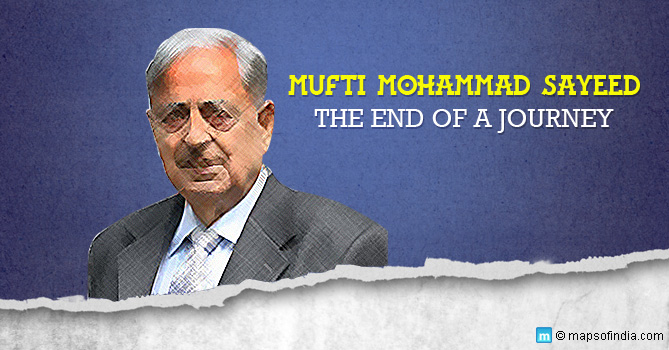
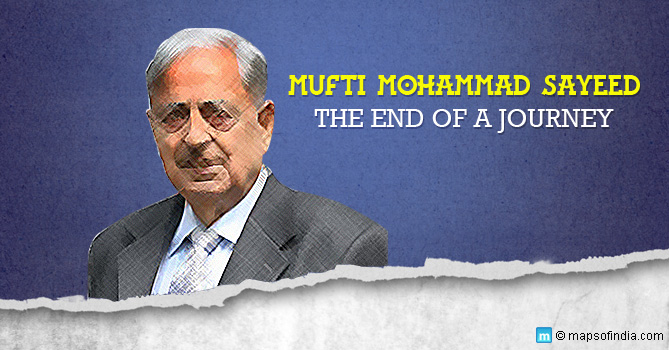
 A seasoned and respected politician, Mufti Mohammad Sayeed played a crucial role in guiding and providing good governance to strife-stricken Jammu & Kashmir during his two terms as the Chief Minister of the state. He built up a strong reputation on the basis of his hard work, emphasis on development of the state, love for the people and loyalty towards the state and the country. Here are a few facts about the great leader.
Early life and background
Sayeed was born on January 12, 1936. He completed his graduation from S.P. College in Srinagar and thereafter obtained a degree in law. He also got a postgraduate degree in Arab history from Aligarh Muslim University. Sayeed was a practicing lawyer before he took a plunge into politics. His political career started way back in the late 50s and in 1962, he was elected to the Assembly from Bijbehara.Initiation into Politics and Rise
- Sayeed’s career began in the late 50s when he joined G M Sadiq’s Democratic National Conference. Recognizing Sayeed’s potential, Sadiq appointed him as the District Convenor of the party.
- In 1962, Sayeed made a grand entry in the assembly when he was elected to the state assembly from Bijbehara. Sadiq, who had by then become the Chief Minister of J&K, appointed the young Sayeed as a Deputy Minister.
- A few years later, Sayeed parted ways with the Democratic National Conference and joined the Indian National Congress.
- In 1972, Sayeed became a Cabinet Minister. He was also the Congress party’s leader in the Legislative Council.
- In 1986, Prime Minister Rajiv Gandhi appointed him as the Union Minister for Tourism and Civil Aviation.
- In 1987, Sayeed fell out with the Congress. At that time he was the tourism minister, a post he quit and co-founded the Jan Morcha with VP Singh. He won the Lok Sabha election from Uttar Pradesh’s Muzaffarnagar as a Janta Dal candidate in 1989. Mufti Mohammad Sayeed holds the distinction of being the first Muslim Home Minister in Prime Minister VP Singh’s cabinet.
- In 1999, Sayeed formed his own party – People’s Democratic Party (PDP). The party was founded with the aim to start an unconditional dialogue with Kashmiris for the resolution of the problem which had engulfed the state since 1989.