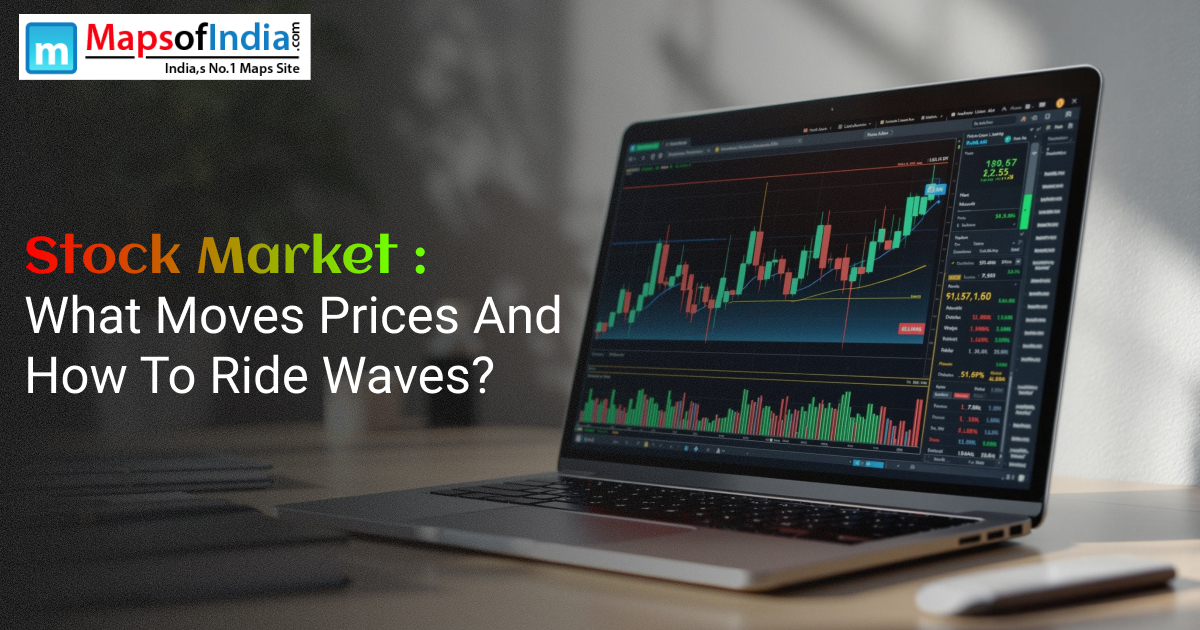
What Moves Stock Prices?
Basically, the prices of the stocks are determined by supply and demand. But what shifts supply or demand in the first place? It has been broken down into fundamental and technical forces.Fundamental Drivers
The factors that affect how well a company does in business and how strong its finances are called fundamental drivers.Earnings and Revenue
Quarterly earnings reports are the strong fundamental drivers of the stock. When a company exceeds hopes, demand frequently rises,which drives prices higher. Vice versa, poor results or guidance can provoke sales.Macroeconomic Indicators
Factors that play a major role in shaping investor sentiments are interest rates, inflation, GDP growth, and unemployment data. For example, rising interest rates can reduce the present value of future cash flows, which leads to lower stock prices, especially for growth stocks.Industry Trends
A company doesn’t work in a void. Across the board shifts, like the rise of electric vehicles or artificial intelligence can boost entire industries. Companies that are properly positioned within these trends constantly exceed.News and Events
Geopolitical tensions, regulatory changes, and major business events like mergers or leadership changes can all impact investor outlooks and lead to quick price reactions.Technical Factors
Technical analysis focuses on the financial performance itself.Market Sentiment
Driven by worry and greed, Often driven by fear and greed, investor emotions can move prices without depending on fundamentals. Bubbles form when hope is uncontrolled, and crashes happen when panic takes over.Volume and Momentum
How many shares are traded are traders monitor volume and how fast prices are moving is momentum to measure strength. High volume during a rise can indicate powerful buying interest, while falling volume may trace at weakness.Support and Resistance
Prices often bounce off certain levels of support and resistance. Understanding these zones will be helpful for traders to make better entries and exits.Algorithmic and High-Frequency Trading
In today’s digital world, computers play an enormous role. Calculations respond to patterns, news headlines, and price action at lightning speeds. Rapid moves and false breakouts can be caused by it.The Psychology of Market Waves
The market is not everytime logical. It is driven by humans, and humans are emotional. This gives rise to the psychology of market cycles.The Market Cycle
A classic market cycle has four phases:- Accumulation Phase: Smart money enters while the public is still irritable. Prices are low, volume is simple.
- Markup Phase: Positive news and better fundamentals lead to wider engagement. Prices rise constantly.
- Distribution Phase: Smart money sells to those who come late. Volume may increase; price growth slows.
- Markdown Phase: Prices fall quickly and often. Due to which, panic sets in, and investors run away.
Common Investor Biases
Even the best investors are prone to psychological traps:- Herd Behavior: Following the crowd without due diligence.
- Overconfidence: Believing you can time the market consistently.
- Loss Aversion: Holding on to losers longer than winners.
- Recency Bias: Giving too much weight to recent events.
How to Ride the Waves
There are more deep fundamentals to know that how to ride the waves without wiping out:1. Have a Clear Strategy
Basically, your approach determines how you navigate market waves. It depends on whether you are a long-term investor, swing trader, or day trader.- Long-Term Investors: Focus on fundamentals and buy when prices drop below inherent worth.
- Swing Traders: Use technical analysis to ride short- to medium-term trends.
- Day Traders: Look for high instability, volume, and momentum for fast entries and exits.
2. Use Technical Analysis Wisely
Having knowledge of how to spot trends, support/resistance, moving averages, and volume patterns can help you predict price action. Tools such as:- Relative Strength Index (RSI) – which evaluates if a stock is overbought or oversold.
- Moving Averages (MA) – which supports trend direction and support zones.
- MACD (Moving Average Convergence Divergence) – helps identify changes in momentum.
- Use Stop-Loss Orders: Automatically exits the losing trades before increase in loss.
- Diversify: Don’t invest a lot only in a single trade.
- Position Sizing: Don’t risk your capital on a single trade.