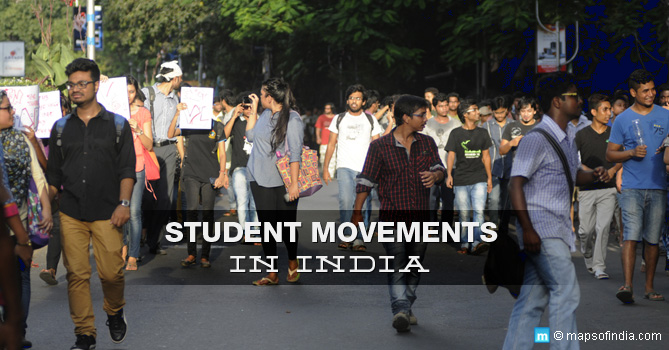
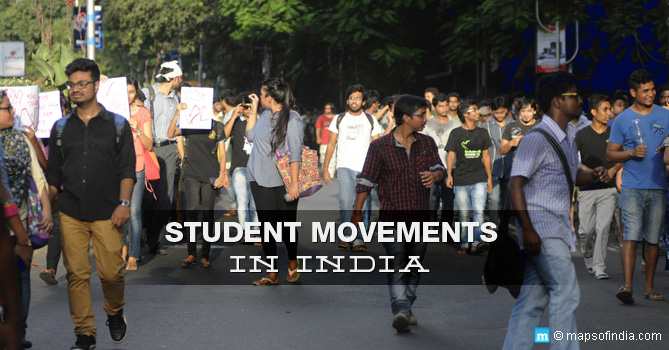
 Organised student movement in India is eighty years old as its origin dates back to 1936 when a permanent All India Student Federation was mooted to “prepare the students for citizenship in order to take their due share in the struggle for complete national freedom”. Since then, the students of India have been “arousing their social, political and economic consciousness”. They refused to work only within the realm of issues facing the students but went ahead and participated in steering the ship of the government. Student movements in India have always shown concern for wider sociopolitical issues.
The recent spate of protests at the prestigious Jawaharlal Nehru University (JNU) in Delhi and the formation of human chain to condemn the arrest of JNUSU President Kanhaiya Kumar is just one such incident. If JNU demands dropping of “arbitrary charges” of sedition against Kumar, student in the past had raised several other demands that they felt were necessary to fix aberrations in society.
Organised student movement in India is eighty years old as its origin dates back to 1936 when a permanent All India Student Federation was mooted to “prepare the students for citizenship in order to take their due share in the struggle for complete national freedom”. Since then, the students of India have been “arousing their social, political and economic consciousness”. They refused to work only within the realm of issues facing the students but went ahead and participated in steering the ship of the government. Student movements in India have always shown concern for wider sociopolitical issues.
The recent spate of protests at the prestigious Jawaharlal Nehru University (JNU) in Delhi and the formation of human chain to condemn the arrest of JNUSU President Kanhaiya Kumar is just one such incident. If JNU demands dropping of “arbitrary charges” of sedition against Kumar, student in the past had raised several other demands that they felt were necessary to fix aberrations in society.
Organised student movement in India is eighty years old as its origin dates back to 1936 when a permanent All India Student Federation was mooted to “prepare the students for citizenship in order to take their due share in the struggle for complete national freedom”. Since then, the students of India have been “arousing their social, political and economic consciousness”. They refused to work only within the realm of issues facing the students but went ahead and participated in steering the ship of the government. Student movements in India have always shown concern for wider sociopolitical issues.
The recent spate of protests at the prestigious Jawaharlal Nehru University (JNU) in Delhi and the formation of human chain to condemn the arrest of JNUSU President Kanhaiya Kumar is just one such incident. If JNU demands dropping of “arbitrary charges” of sedition against Kumar, student in the past had raised several other demands that they felt were necessary to fix aberrations in society.
Organised student movement in India is eighty years old as its origin dates back to 1936 when a permanent All India Student Federation was mooted to “prepare the students for citizenship in order to take their due share in the struggle for complete national freedom”. Since then, the students of India have been “arousing their social, political and economic consciousness”. They refused to work only within the realm of issues facing the students but went ahead and participated in steering the ship of the government. Student movements in India have always shown concern for wider sociopolitical issues.
The recent spate of protests at the prestigious Jawaharlal Nehru University (JNU) in Delhi and the formation of human chain to condemn the arrest of JNUSU President Kanhaiya Kumar is just one such incident. If JNU demands dropping of “arbitrary charges” of sedition against Kumar, student in the past had raised several other demands that they felt were necessary to fix aberrations in society.