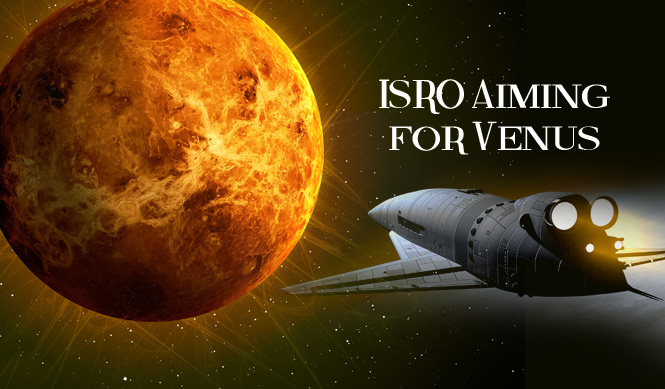
 The next big interplanetary space mission from ISRO could be to Venus!
From all indicators, the next stop in space will be Venus. Although still under discussion, there is a fair chance ISRO will launch a Venus Mission in about 2-3 years. This would be a continuation of its interplanetary space programme that started with the Chandrayaan-1 Mission to the Moon and was followed by the Mars Orbiter Mission.
Around the time the Venus Mission is being planned for launch, ISRO is also aiming to launch its second lunar mission, Chandrayaan-2. And it doesn’t end here. This July, ISRO is planning to test a miniature version of an aircraft shaped re-usable launch vehicle. It will be mounted on a strap-on Polar Satellite Launch Vehicle Rocket (PSLV) and launched into space and released at an altitude of 70 km.
Once the 1.5 tonne module separates from the launch rocket, it would be guided back to earth at a descending speed of 2 km per second. The front of the test module will be covered with special heat resistant tiles, to withstand the intense friction heat that touches 1200 Degrees Celsius, once the vehicle starts its decent towards the earth. The descent speed will be controlled through special fins designed to control the rate of descent and provide stability.
Last December, ISRO carried out another launch to test and validate various aspects of re-entry, aero-braking and the parachute launch system. A 3.7 tonne cupcake shaped ‘Crew’ module was launched into space at an altitude of 126 kms by a 630 tonne rocket. Once ‘Crew’ separated from the mother rocket, it made its descent back to earth. The speed of descent was controlled by three parachutes before she splashed down into the Bay of Bengal. Point to note is that during the forthcoming experiment in July this year, the test module will use special ‘fins’ to control the descent speed instead of parachutes.
ISRO has been riding on the wave of international recognition of its capability, when it successfully managed to place the Mars Orbiter into the Mars orbit, in the very first attempt. In doing so, not only did India become the first nation to succeed for the first time but also managed to achieve the same at the lowest cost.
The next big interplanetary space mission from ISRO could be to Venus!
From all indicators, the next stop in space will be Venus. Although still under discussion, there is a fair chance ISRO will launch a Venus Mission in about 2-3 years. This would be a continuation of its interplanetary space programme that started with the Chandrayaan-1 Mission to the Moon and was followed by the Mars Orbiter Mission.
Around the time the Venus Mission is being planned for launch, ISRO is also aiming to launch its second lunar mission, Chandrayaan-2. And it doesn’t end here. This July, ISRO is planning to test a miniature version of an aircraft shaped re-usable launch vehicle. It will be mounted on a strap-on Polar Satellite Launch Vehicle Rocket (PSLV) and launched into space and released at an altitude of 70 km.
Once the 1.5 tonne module separates from the launch rocket, it would be guided back to earth at a descending speed of 2 km per second. The front of the test module will be covered with special heat resistant tiles, to withstand the intense friction heat that touches 1200 Degrees Celsius, once the vehicle starts its decent towards the earth. The descent speed will be controlled through special fins designed to control the rate of descent and provide stability.
Last December, ISRO carried out another launch to test and validate various aspects of re-entry, aero-braking and the parachute launch system. A 3.7 tonne cupcake shaped ‘Crew’ module was launched into space at an altitude of 126 kms by a 630 tonne rocket. Once ‘Crew’ separated from the mother rocket, it made its descent back to earth. The speed of descent was controlled by three parachutes before she splashed down into the Bay of Bengal. Point to note is that during the forthcoming experiment in July this year, the test module will use special ‘fins’ to control the descent speed instead of parachutes.
ISRO has been riding on the wave of international recognition of its capability, when it successfully managed to place the Mars Orbiter into the Mars orbit, in the very first attempt. In doing so, not only did India become the first nation to succeed for the first time but also managed to achieve the same at the lowest cost.
The next big interplanetary space mission from ISRO could be to Venus!
From all indicators, the next stop in space will be Venus. Although still under discussion, there is a fair chance ISRO will launch a Venus Mission in about 2-3 years. This would be a continuation of its interplanetary space programme that started with the Chandrayaan-1 Mission to the Moon and was followed by the Mars Orbiter Mission.
Around the time the Venus Mission is being planned for launch, ISRO is also aiming to launch its second lunar mission, Chandrayaan-2. And it doesn’t end here. This July, ISRO is planning to test a miniature version of an aircraft shaped re-usable launch vehicle. It will be mounted on a strap-on Polar Satellite Launch Vehicle Rocket (PSLV) and launched into space and released at an altitude of 70 km.
Once the 1.5 tonne module separates from the launch rocket, it would be guided back to earth at a descending speed of 2 km per second. The front of the test module will be covered with special heat resistant tiles, to withstand the intense friction heat that touches 1200 Degrees Celsius, once the vehicle starts its decent towards the earth. The descent speed will be controlled through special fins designed to control the rate of descent and provide stability.
Last December, ISRO carried out another launch to test and validate various aspects of re-entry, aero-braking and the parachute launch system. A 3.7 tonne cupcake shaped ‘Crew’ module was launched into space at an altitude of 126 kms by a 630 tonne rocket. Once ‘Crew’ separated from the mother rocket, it made its descent back to earth. The speed of descent was controlled by three parachutes before she splashed down into the Bay of Bengal. Point to note is that during the forthcoming experiment in July this year, the test module will use special ‘fins’ to control the descent speed instead of parachutes.
ISRO has been riding on the wave of international recognition of its capability, when it successfully managed to place the Mars Orbiter into the Mars orbit, in the very first attempt. In doing so, not only did India become the first nation to succeed for the first time but also managed to achieve the same at the lowest cost.
The next big interplanetary space mission from ISRO could be to Venus!
From all indicators, the next stop in space will be Venus. Although still under discussion, there is a fair chance ISRO will launch a Venus Mission in about 2-3 years. This would be a continuation of its interplanetary space programme that started with the Chandrayaan-1 Mission to the Moon and was followed by the Mars Orbiter Mission.
Around the time the Venus Mission is being planned for launch, ISRO is also aiming to launch its second lunar mission, Chandrayaan-2. And it doesn’t end here. This July, ISRO is planning to test a miniature version of an aircraft shaped re-usable launch vehicle. It will be mounted on a strap-on Polar Satellite Launch Vehicle Rocket (PSLV) and launched into space and released at an altitude of 70 km.
Once the 1.5 tonne module separates from the launch rocket, it would be guided back to earth at a descending speed of 2 km per second. The front of the test module will be covered with special heat resistant tiles, to withstand the intense friction heat that touches 1200 Degrees Celsius, once the vehicle starts its decent towards the earth. The descent speed will be controlled through special fins designed to control the rate of descent and provide stability.
Last December, ISRO carried out another launch to test and validate various aspects of re-entry, aero-braking and the parachute launch system. A 3.7 tonne cupcake shaped ‘Crew’ module was launched into space at an altitude of 126 kms by a 630 tonne rocket. Once ‘Crew’ separated from the mother rocket, it made its descent back to earth. The speed of descent was controlled by three parachutes before she splashed down into the Bay of Bengal. Point to note is that during the forthcoming experiment in July this year, the test module will use special ‘fins’ to control the descent speed instead of parachutes.
ISRO has been riding on the wave of international recognition of its capability, when it successfully managed to place the Mars Orbiter into the Mars orbit, in the very first attempt. In doing so, not only did India become the first nation to succeed for the first time but also managed to achieve the same at the lowest cost.