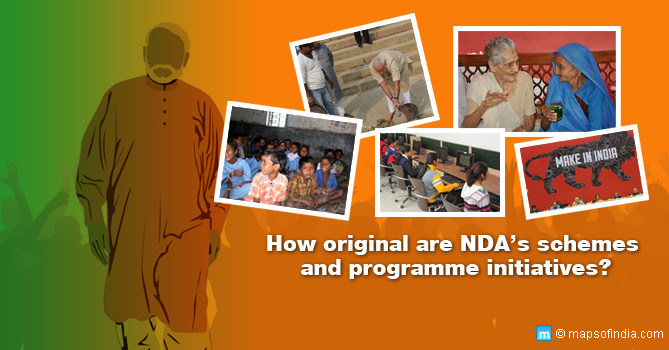
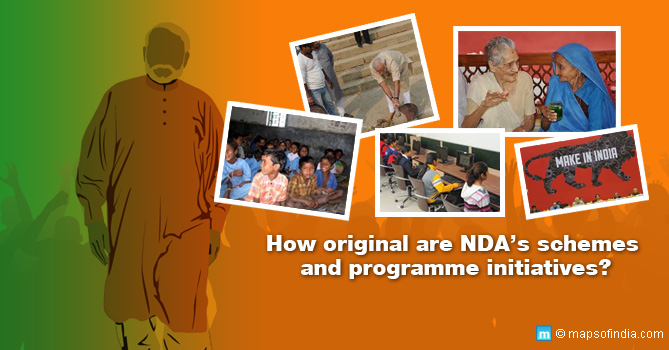
 There is no easy answer to this question. Congress party has been accusing Prime Minister Modi and his government of renaming, repackaging and re-launching various social security and infrastructure programmes that were launched during the UPA regime or earlier. So, is there any merit in this claim?
When we compare any scheme, programme or initiative of any government, there is a fair chance that there would be some form of similarity or overlapping between schemes or programmes of different governments. The difference mostly would lie in scale of fund deployment, target, size and spread of beneficiaries, and the efficiency of execution.
Too often, political parties squabble over claiming credit on being the first to initiate a programme. While that may well be the case, it is not the originality for which a government is remembered but on the parameters stated above. Therefore, if programmes of respective governments are to be factually compared, it must be on the basis of the parameters mentioned above and not really on the originality of the idea.
Take the NDA government under PM Modi launching the Digital India campaign. Without doubt it is an ambitious programme that will catalyze and catapult the Indian economy in the 21st century. That is an imperative and a necessity, and is original in its scope and ambition. However, to claim that this was the first in technology initiative would not stand true.
India’s IT revolution actually dates back to the policy decision taken during Prime Minister Indira Gandhi regime in 1984, just before her tragic death. This was launched and implemented by Rajiv Gandhi and was the first real step towards what later became an IT revolution in India.
For the first time, permission to export software through a satellite link, led to Texas Instruments to open its first centre in India. This was followed by several initiatives like establishing rural telephone exchanges, software technology parks etc, that ushered in an ecosystem on which the subsequent decades built upon, and today India is credited with having a cutting edge IT industry that can only get better. But it is unfair to compare any technology-based initiative like Digital India to any previous initiative, as all were during different eras, with different goals and on different technology platforms.
There is no easy answer to this question. Congress party has been accusing Prime Minister Modi and his government of renaming, repackaging and re-launching various social security and infrastructure programmes that were launched during the UPA regime or earlier. So, is there any merit in this claim?
When we compare any scheme, programme or initiative of any government, there is a fair chance that there would be some form of similarity or overlapping between schemes or programmes of different governments. The difference mostly would lie in scale of fund deployment, target, size and spread of beneficiaries, and the efficiency of execution.
Too often, political parties squabble over claiming credit on being the first to initiate a programme. While that may well be the case, it is not the originality for which a government is remembered but on the parameters stated above. Therefore, if programmes of respective governments are to be factually compared, it must be on the basis of the parameters mentioned above and not really on the originality of the idea.
Take the NDA government under PM Modi launching the Digital India campaign. Without doubt it is an ambitious programme that will catalyze and catapult the Indian economy in the 21st century. That is an imperative and a necessity, and is original in its scope and ambition. However, to claim that this was the first in technology initiative would not stand true.
India’s IT revolution actually dates back to the policy decision taken during Prime Minister Indira Gandhi regime in 1984, just before her tragic death. This was launched and implemented by Rajiv Gandhi and was the first real step towards what later became an IT revolution in India.
For the first time, permission to export software through a satellite link, led to Texas Instruments to open its first centre in India. This was followed by several initiatives like establishing rural telephone exchanges, software technology parks etc, that ushered in an ecosystem on which the subsequent decades built upon, and today India is credited with having a cutting edge IT industry that can only get better. But it is unfair to compare any technology-based initiative like Digital India to any previous initiative, as all were during different eras, with different goals and on different technology platforms.
There is no easy answer to this question. Congress party has been accusing Prime Minister Modi and his government of renaming, repackaging and re-launching various social security and infrastructure programmes that were launched during the UPA regime or earlier. So, is there any merit in this claim?
When we compare any scheme, programme or initiative of any government, there is a fair chance that there would be some form of similarity or overlapping between schemes or programmes of different governments. The difference mostly would lie in scale of fund deployment, target, size and spread of beneficiaries, and the efficiency of execution.
Too often, political parties squabble over claiming credit on being the first to initiate a programme. While that may well be the case, it is not the originality for which a government is remembered but on the parameters stated above. Therefore, if programmes of respective governments are to be factually compared, it must be on the basis of the parameters mentioned above and not really on the originality of the idea.
Take the NDA government under PM Modi launching the Digital India campaign. Without doubt it is an ambitious programme that will catalyze and catapult the Indian economy in the 21st century. That is an imperative and a necessity, and is original in its scope and ambition. However, to claim that this was the first in technology initiative would not stand true.
India’s IT revolution actually dates back to the policy decision taken during Prime Minister Indira Gandhi regime in 1984, just before her tragic death. This was launched and implemented by Rajiv Gandhi and was the first real step towards what later became an IT revolution in India.
For the first time, permission to export software through a satellite link, led to Texas Instruments to open its first centre in India. This was followed by several initiatives like establishing rural telephone exchanges, software technology parks etc, that ushered in an ecosystem on which the subsequent decades built upon, and today India is credited with having a cutting edge IT industry that can only get better. But it is unfair to compare any technology-based initiative like Digital India to any previous initiative, as all were during different eras, with different goals and on different technology platforms.
There is no easy answer to this question. Congress party has been accusing Prime Minister Modi and his government of renaming, repackaging and re-launching various social security and infrastructure programmes that were launched during the UPA regime or earlier. So, is there any merit in this claim?
When we compare any scheme, programme or initiative of any government, there is a fair chance that there would be some form of similarity or overlapping between schemes or programmes of different governments. The difference mostly would lie in scale of fund deployment, target, size and spread of beneficiaries, and the efficiency of execution.
Too often, political parties squabble over claiming credit on being the first to initiate a programme. While that may well be the case, it is not the originality for which a government is remembered but on the parameters stated above. Therefore, if programmes of respective governments are to be factually compared, it must be on the basis of the parameters mentioned above and not really on the originality of the idea.
Take the NDA government under PM Modi launching the Digital India campaign. Without doubt it is an ambitious programme that will catalyze and catapult the Indian economy in the 21st century. That is an imperative and a necessity, and is original in its scope and ambition. However, to claim that this was the first in technology initiative would not stand true.
India’s IT revolution actually dates back to the policy decision taken during Prime Minister Indira Gandhi regime in 1984, just before her tragic death. This was launched and implemented by Rajiv Gandhi and was the first real step towards what later became an IT revolution in India.
For the first time, permission to export software through a satellite link, led to Texas Instruments to open its first centre in India. This was followed by several initiatives like establishing rural telephone exchanges, software technology parks etc, that ushered in an ecosystem on which the subsequent decades built upon, and today India is credited with having a cutting edge IT industry that can only get better. But it is unfair to compare any technology-based initiative like Digital India to any previous initiative, as all were during different eras, with different goals and on different technology platforms.